

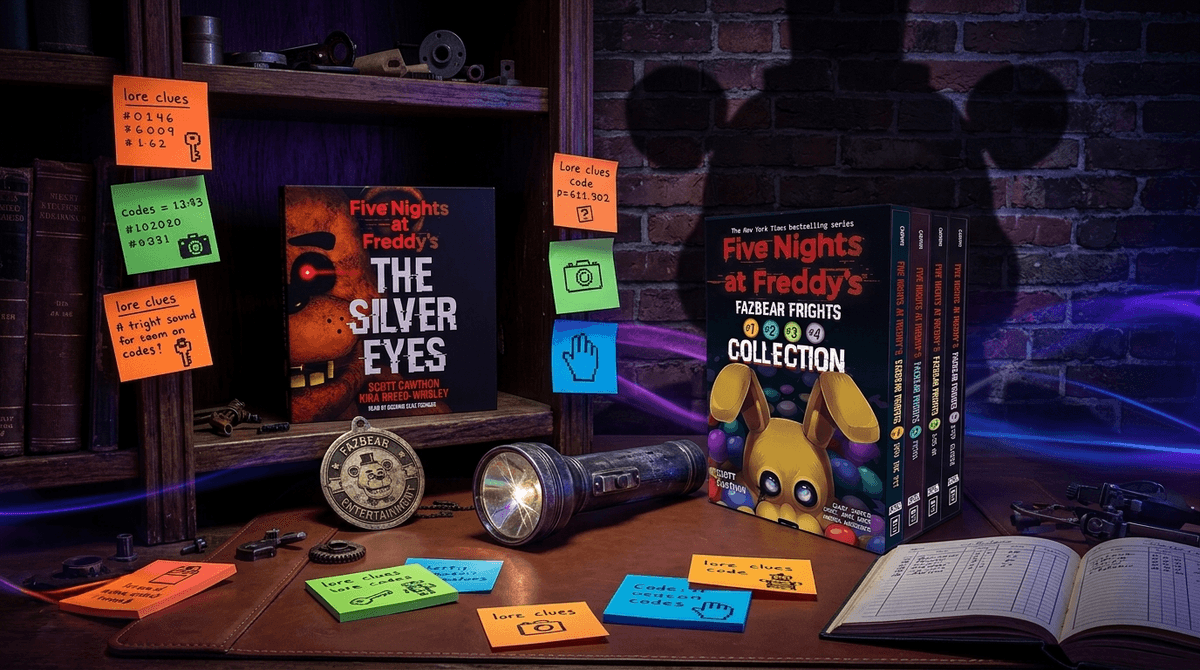
TL;DR: The Five Nights at Freddy's book series is a massive collection of horror stories that expand on the viral Five Nights at Freddy's game. While the games rely on jump scares, the books dive into heavy body horror, "twisted" animatronics, and a complex lore that middle schoolers find irresistible. They aren't exactly Shakespeare, but they get reluctant readers turning pages.
Quick Links for the Obsessed:
- The Original Trilogy: The Silver Eyes
- The Anthology Series: Fazbear Frights
- The Graphic Novels: The Silver Eyes: Graphic Novel
- The Newest Series: Tales from the Pizzaplex
If you feel like you’ve been hearing about Freddy Fazbear since the Obama administration, you’re not wrong. What started as a simple indie game about a night security guard surviving haunted animatronics has exploded into a multi-media empire.
The books aren't just "novelizations" of the games. They are essential "lore builders." For a FNAF fan, reading the books is like finding the missing pieces of a 10,000-piece puzzle. There are three main "flavors" of these books:
- The Novel Trilogy: A self-contained story following a girl named Charlie (daughter of the guy who built the animatronics).
- The Anthologies (Fazbear Frights & Tales from the Pizzaplex): Short story collections. These are the most popular and, frankly, the most disturbing. They are like Goosebumps but with the "scary" dial turned up to eleven and a much higher body count.
- The Graphic Novels: Visual adaptations of the novels and short stories. These are huge with the Diary of a Wimpy Kid crowd who are looking for something "edgier."

You might be wondering why your 11-year-old, who usually won't touch a book without a "required reading" sticker on it, is suddenly devouring a 300-page paperback.
It’s the Lore.
In the world of Five Nights at Freddy's, nothing is explained clearly. The creator, Scott Cawthon, hides clues in 8-bit minigames, source code, and—you guessed it—the books. Kids love feeling like detectives. They watch "Theory" videos on YouTube (like Game Theory) and then go to the books to see if their theories about "The Crying Child" or "Purple Guy" hold water.
It’s also a social currency. Being the kid who knows why the animatronics are actually haunted by "Remnant" (basically soul-juice) is high-status in the 6th-grade lunchroom.
Ages 12+ This is the best place to start if your kid wants a real story. It follows Charlie returning to her hometown to deal with the legacy of her father’s restaurant, Freddy Fazbear’s Pizza. It’s a bit wordy and the pacing can be slow, but it’s the "cleanest" entry point into the narrative.
- The Verdict: It's decent YA horror. If your kid liked Stranger Things, they’ll probably dig this.
Ages 11+ This is the first book in the anthology series. Each book contains three short stories. These are fast-paced and lean heavily into "be careful what you wish for" tropes.
- The Verdict: Some stories are genuinely creative; others feel like they were written in a weekend to meet a deadline. But for a kid with a short attention span, the 60-page story format is gold.
Ages 10+ If you have a reluctant reader, the graphic novels are the "gateway drug." The art style is... polarizing. Some fans love it; others think it looks a bit amateurish.
- The Verdict: Great for visual learners, but be warned: seeing the "Springtrap" suit in a drawing is much more vivid than reading about it.
Ages 8+ This is basically a pokedex for animatronics. It's not a story; it's a reference guide.
- The Verdict: If you have a younger kid (3rd or 4th grade) who is obsessed with the characters but you aren't ready for them to read about kids getting stuffed into suits, this is the safest bet. It’s all stats and pictures.
Check out our guide on finding age-appropriate horror for middle schoolers
Let’s be real: These books are dark. We aren't talking about "spooky ghosts." We are talking about:
- Body Horror: Characters being "stitched" together or transformed into machines.
- Child Endangerment: The entire premise is built on the "Missing Children Incident."
- Grim Endings: Unlike many kids' books, the protagonist doesn't always win. Sometimes they... well, they don't make it.
Community Data Insight: Our data shows that while the FNAF Movie is rated PG-13, the books are being read heavily by kids as young as 9. However, the "sweet spot" for comprehension and emotional maturity is 11 to 14 (Grades 6-8).
If your child is sensitive to themes of kidnapping or physical injury, these are a hard pass. If they regularly play Roblox horror games like DOORS or Piggy, they’ve already been "primed" for this level of intensity.
Here is the thing: some of these books are objectively not "good" literature. The prose can be clunky, and the plots often rely on "magic science" to explain away plot holes.
However, they serve a purpose. In an age where we are fighting TikTok and YouTube Shorts for our kids' attention, a book that actually makes them want to sit on the couch for two hours is a win.
Watch out for the Graphic Novels. Because they are visual, the gore is "on the page." In the prose books, the kid’s imagination does the work. Sometimes the imagination is scarier; sometimes the drawing is more traumatizing. Know your kid.
If your kid is deep in the FNAF hole, don't just roll your eyes. Use it as a bridge. Ask them:
- "Which animatronic is the most misunderstood?" (They will have a 20-minute answer for this).
- "Do you think the ending of that story was fair?"
- "Why do you think the creator chose to make the villain a guy in a bunny suit?"
These questions move them from passive consumption to critical thinking. You’re taking "brain rot" and turning it into literary analysis. (Sneaky, right?)
The Five Nights at Freddy's books are the modern-day equivalent of the scary stories we used to tell at sleepovers, just with better marketing and a lot more merchandise. They are intense, occasionally gruesome, and wildly popular.
If your child is in middle school and enjoys a good chill, these books are a relatively harmless way to engage their imagination. Just maybe don't read them right before bed if they’re prone to checking under the bed for animatronic bears.
- Check the shelf: See if they’re reading the Graphic Novels or the Anthologies.
- Set a boundary: If the stories are causing nightmares, pivot them to the Character Encyclopedia which is all facts, no frights.
- Explore alternatives: If they love the "mystery" aspect, try introducing them to Gravity Falls or the Eerie Elementary series for a slightly younger/tamer vibe.