

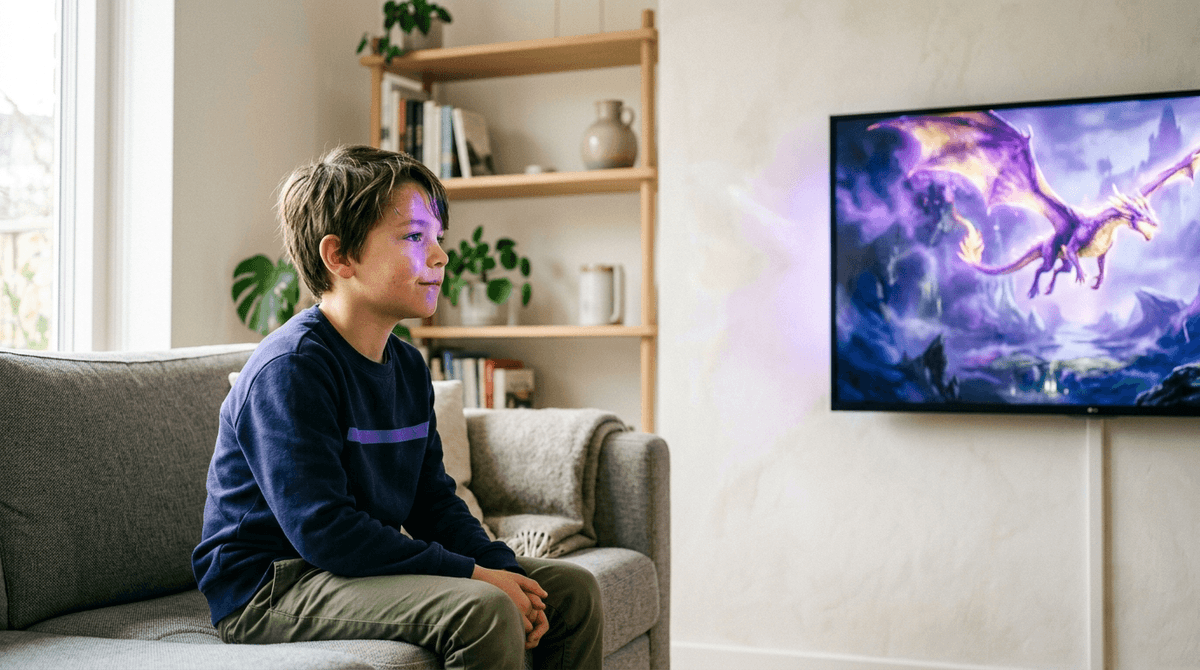
Magical storylines and talking animals won't scramble your child's brain before dinner. New eye-tracking data reveals that watching high-fantasy content has no immediate negative impact on a child's ability to focus or control their impulses, debunking the idea that "impossible" stories overtax young minds.
Watching high-fantasy television does not immediately drain the cognitive batteries of children aged 5 to 7. Researchers found no significant difference in attention or self-control between kids who watched magical content and those who watched realistic shows, suggesting that "impossible" events are not inherently harmful to a child's short-term focus.
Parents often carry a specific type of "screen time guilt" regarding shows that aren't strictly educational or realistic. The fear is that fantastical elements—like a character flying or a tree talking—force the brain to work so hard to process the "impossible" that the child is left cognitively depleted and more prone to tantrums or distraction.
This finding provides a data-backed permission slip to stop worrying about the genre of a show for short-term behavioral reasons. If your child is struggling to focus after screen time, the culprit is likely the total duration of the session or the abruptness of the transition, rather than the presence of magic or talking dragons in the episode they just watched.
The "fantasy deficit" hypothesis has dominated early childhood media research for over a decade. The theory suggests that because young children are still learning the laws of physics and logic, seeing those laws broken on screen creates a "cognitive load" that exhausts their executive functions—the mental skills we use to pay attention and manage emotions.
Researchers wanted to move beyond subjective parent surveys and simple toy-based tests, which can be influenced by a child’s mood or the researcher's bias. By using eye-tracking technology, they could measure the brain's "brakes" in real-time, specifically looking at how quickly and accurately a child could resist a visual distraction after watching different types of media.
High-fantasy television showed no measurable "drain" on a child's inhibitory control or visual attention compared to low-fantasy programming. Whether a child was watching a realistic story about a playground or a magical story about a wizard, their ability to perform focus-heavy tasks remained the same.
- The "brakes" held steady. Researchers used "anti-saccade" tasks, where a child must intentionally look away from a flashing stimulus. This is a gold-standard measure of impulse control, and fantasy media did not make kids any "twitchier" or less able to look away.
- The stats are robust. Using Bayesian analysis—a method that helps confirm if a "null result" is actually true rather than just a mistake—the researchers found strong evidence that the lack of impact was real and not just a fluke in the data.
- Context didn't matter. The results were consistent regardless of the child’s age, how much TV they usually watch at home, or whether they already had baseline difficulties with attention.
- Reality vs. Fantasy is a wash. The study directly challenged previous high-profile findings that claimed fast-paced fantasy shows like SpongeBob SquarePants caused immediate attention drops, suggesting those older studies might have been seeing the effects of "fast pacing" rather than "fantasy" itself.
The shift toward objective eye-tracking suggests that the "fantasy deficit" might have been an academic mirage created by how we used to test kids. When you ask a child to sit still and wait for a marshmallow after a show, you aren't just testing their brain; you're testing their patience with a stranger in a lab. Eye-tracking bypasses the social performance and looks directly at the hardware of the visual system.
This implies that children’s brains are much better at "reality testing" than we gave them credit for. Even at age five, kids seem to have a mental toggle switch that allows them to process "impossible" screen events without it spilling over into their ability to navigate the real world. The "load" of magic isn't heavy enough to break their focus.
The sample size of 65 children is relatively small. While eye-tracking is a high-precision tool, a larger group would provide more certainty that there aren't very subtle effects hidden in specific subgroups of children.
Crucially, this study only looked at the immediate impact of one viewing session. It does not tell us what happens to a child’s brain after six months of a heavy fantasy-only media diet. It also doesn't account for the "quality" of the show's pacing; a high-fantasy show that also has frantic, one-second cuts might still cause issues, but those issues would be due to the editing, not the magic.
- If your child wants to watch a show with magic or talking animals, then let them choose the genre they enjoy most without worrying it will negatively impact their focus for a subsequent task like homework or dinner.
- If you notice your child is particularly distractible after screen time, then look at the "pacing" of the show (how fast the scenes change) or the total time spent seated rather than blaming the fantastical content.
- If you are trying to decide between "realistic" educational TV and "purely for fun" fantasy TV, then recognize that from a cognitive-drain perspective, the "impossible" elements of the fun show aren't making it a worse choice for their brain.
You can cross "fantasy shows" off your list of immediate parenting concerns. The data shows that 5-to-7-year-olds are perfectly capable of watching magical content without losing their ability to pay attention or control their impulses afterward.
Arian Namazi S, Sadeghi S, Kiani M (2026). An eye tracking examination of fantasy television's immediate influence on children's executive functions. Scientific reports. doi:10.1038/s41598-026-54794-5 — pubmed.ncbi.nlm.nih.gov