

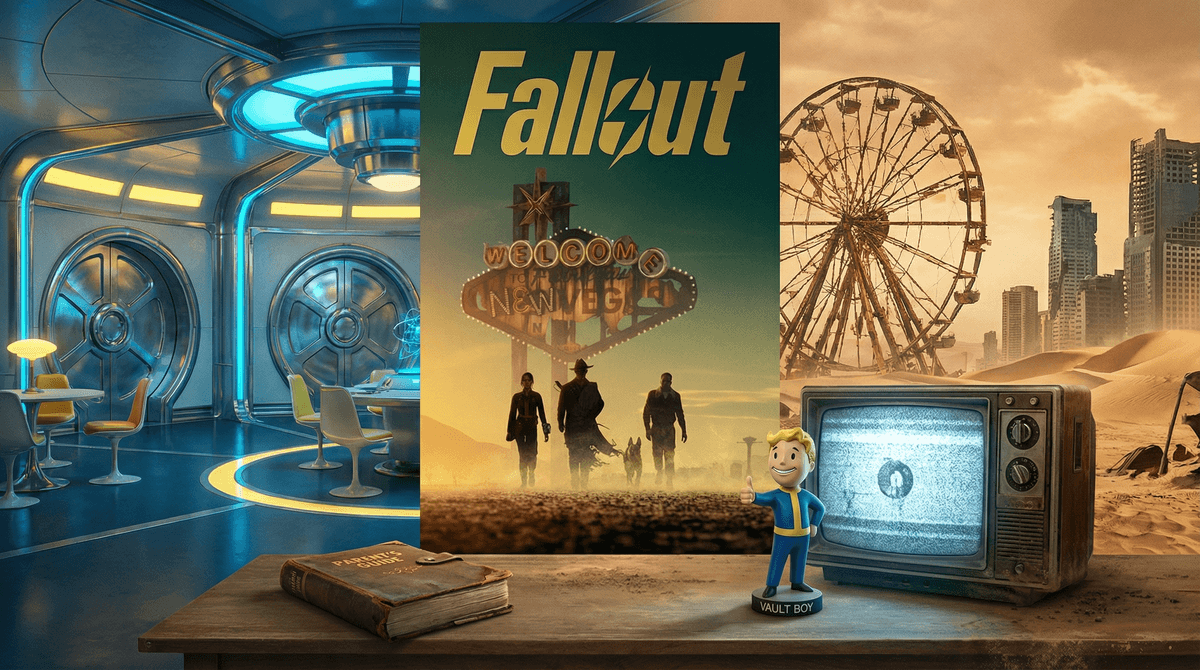
TL;DR: Fallout is intense and graphic :)
Fallout Season 2 drops its first episode Tuesday, December 16, 2025 at 9 p.m. ET on Prime Video, then switches to weekly Wednesday releases through February 4, 2026. This is firmly TV-MA territory — graphic violence, frequent profanity, sexual content, and drug use throughout. If your teen loved Season 1 and you're comfortable with mature content, this is appointment viewing. If you're on the fence, read on for what to expect and how to navigate the weekly drop schedule.
Quick links:
Fallout Season 2 continues the story of Lucy (Ella Purnell) and her ghoul companion Max as they navigate the post-apocalyptic wasteland. Eight episodes, roughly 50-60 minutes each, all requiring that Prime Video subscription (which, according to our data, about 62% of families use either supervised or freely).
The show earned its TV-MA rating honestly. We're talking:
- Strong violence and graphic injury (think dismemberment, radiation burns, the works)
- Frequent profanity (all the words)
- Sexual content (occasional but present)
- Drug use (both recreational and the in-universe Chems)
This isn't The Last of Us trying to be prestige TV with occasional bursts of violence. Fallout leans into its video game roots with darkly comedic gore, retro-futuristic aesthetics, and moral ambiguity that makes everyone a little uncomfortable. If your teen played the games, they know what they're signing up for. If they haven't, this might be a jarring introduction.
Here's the full drop schedule:
- Episode 1 – Tuesday, December 16, 2025, 9 p.m. ET / 6 p.m. PT
- Episode 2 – Wednesday, December 24, 2025, 12 a.m. PT (3 a.m. ET)
- Episode 3 – Wednesday, December 31, 2025, 12 a.m. PT (3 a.m. ET)
- Episode 4 – Wednesday, January 7, 2026, 12 a.m. PT (3 a.m. ET)
- Episode 5 – Wednesday, January 14, 2026, 12 a.m. PT (3 a.m. ET)
- Episode 6 – Wednesday, January 21, 2026, 12 a.m. PT (3 a.m. ET)
- Episode 7 – Wednesday, January 28, 2026, 12 a.m. PT (3 a.m. ET)
- Episode 8 (Finale) – Wednesday, February 4, 2026, 12 a.m. PT (3 a.m. ET)
Notice anything? After the Tuesday premiere, everything drops at midnight PT on Wednesdays — which means 3 a.m. ET for East Coast families. This is actually helpful for parents who want to preview episodes before teens watch. You can check out the new episode Wednesday morning (or evening after work) before your kid gets home from school.
The weekly release also means no binge-watching spirals. Your teen can't disappear into their room for eight hours on launch day. It's appointment viewing, which gives you natural conversation points each week. "What did you think of this week's episode?" becomes a regular dinner table question.
Also worth noting: Episodes 2 and 3 drop on Christmas Eve and New Year's Eve respectively. If your family travels for holidays or has strict screen-free celebration days, plan accordingly. The episodes aren't going anywhere, but teens will definitely feel FOMO if their friends are discussing plot twists while they're at Grandma's house.
Let's be direct: This show is not appropriate for middle schoolers, full stop. The violence isn't cartoonish — it's visceral and often played for dark comedy, which can be more disturbing than straight horror. The moral ambiguity (factions doing terrible things for "good reasons") requires emotional maturity to process.
High school teens (15+) are the target audience, and even then, it depends on your kid and your family's comfort level. Questions to ask yourself:
- Have they watched other TV-MA content with you? How did they handle it?
- Are they comfortable with gore, or do they get nightmares from Stranger Things?
- Can they discuss moral complexity, or do they need clear heroes and villains?
- Are they playing the Fallout games already? (If yes, they've seen worse)
If you're on the fence, watch Episode 1 yourself first. The Tuesday premiere gives you a 24-hour window before the next episode drops. If you're uncomfortable, you can have that conversation before they're three episodes deep.
For families looking for post-apocalyptic stories without the mature content, consider alternatives like The Last Kids on Earth (Netflix) or the Horizon Zero Dawn game (rated T for Teen).
Despite the mature content, Fallout has genuine merit beyond "cool explosions and mutants." The show explores:
Moral complexity: No faction is purely good or evil. The Brotherhood of Steel, the NCR, the various Vault experiments — everyone believes they're saving humanity while doing monstrous things. This creates rich discussion material about ends justifying means, propaganda, and institutional corruption.
Satire and social commentary: The retro-futuristic 1950s aesthetic isn't just visual flair — it's commentary on American exceptionalism, Cold War paranoia, and corporate greed. Vault-Tec's experiments are thinly veiled critiques of real-world unethical research.
Character development: Lucy's journey from naive Vault dweller to hardened survivor mirrors a loss of innocence that resonates with teens navigating their own disillusionment with authority and institutions.
If your teen is into the games, this show deepens the lore in meaningful ways. If they're not, it's still a compelling story about humanity's capacity for both survival and cruelty.
The weekly format gives you natural opportunities to check in. Here are some non-preachy conversation starters:
After Episode 1: "What did you think of how they portrayed the Vaults compared to the games?" (Gets them talking about adaptation choices)
Mid-season: "Which faction do you think is 'right,' if any?" (Opens discussion about moral ambiguity)
After violent scenes: "That was pretty intense. How are you feeling about it?" (Simple check-in, no judgment)
Finale week: "If you were Lucy, what would you do differently?" (Explores decision-making and consequences)
Don't force it. If your teen shuts down, respect that. But having the option to discuss heavy themes in the context of a shared show can be more effective than abstract "let's talk about violence" lectures.
About 38% of families in our data don't use Amazon Prime at all, while 32% use it with supervision and 30% let kids access it freely. If you're in that supervised category, Fallout is a perfect example of why.
Prime Video doesn't have the same robust parental controls as Netflix or Disney+. There's no separate kids profile that automatically filters content. If your teen has access to Prime Video, they have access to everything — including plenty of TV-MA content beyond Fallout.
Quick setup tip: If you're allowing Fallout but want to maintain control over other content, consider watching together on a shared device rather than letting them stream independently on their phone or laptop. It's not foolproof, but it creates a natural boundary.
Learn more about Prime Video parental controls
Fallout Season 2 is appointment television for teens who can handle mature content — and it's genuinely well-made, thought-provoking TV. But it's not for everyone, and that's okay. The weekly release schedule actually works in parents' favor, giving you time to preview, discuss, and decide week-by-week whether to continue.
If you're allowing it: Use the weekly format to your advantage. Make it a shared experience if possible, or at least create space for regular check-ins about what they're watching.
If you're not: Don't stress about FOMO. Teens will survive not watching the hot show, and there are plenty of alternatives for post-apocalyptic storytelling that don't require you to compromise your family's boundaries.
If you're unsure: Watch Episode 1 yourself on December 16th. You'll know within the first 20 minutes whether this is something you're comfortable with your teen watching. Trust your gut.
Remember, with our community data showing that families average 4.2 hours of screen time daily, this eight-episode season represents about eight hours total — spread over seven weeks. In the grand scheme of screen time battles, this is manageable. The question isn't whether they'll watch TV; it's whether this TV aligns with your family's values.
- December 16th: Preview Episode 1 yourself if you're on the fence
- Set expectations: If you're allowing it, establish whether this is solo viewing or family viewing
- Check in weekly: Use the Wednesday drop schedule as a natural conversation prompt
- Have an exit strategy: If it's too much after a few episodes, it's okay to stop