

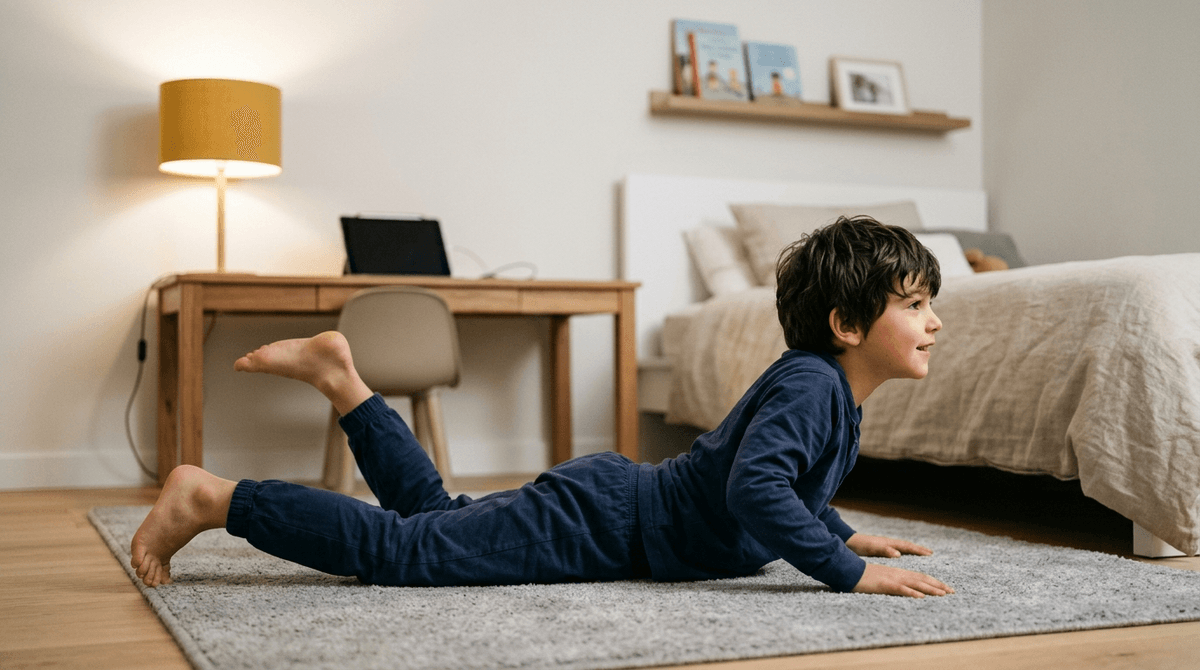
Swapping 15 minutes of evening screen time for physical activity moves a child’s sleep onset up by nearly 10 minutes.
Replacing passive screens with active play in the late afternoon is the most effective way to shift your child’s sleep schedule earlier. Just 15 minutes of movement claws back time that would otherwise be spent fighting for sleep late into the evening.
Bedtime is the most stressful hour of the day for most households, and many parents default to screens to keep kids "calm" while finishing work or making dinner. This research shows that "burning off steam" isn't just an old wives' tale; it is a measurable physiological lever for sleep. For a parent struggling with a child who stays awake until 9:00 PM, small shifts in activity can gain back nearly an hour of evening "me-time" over the course of a week.
Sleep scientists wanted to solve the conflict between "winding down" and "burning energy" in early childhood. Most pediatric advice focuses on quiet routines, but researchers suspected that the specific composition of a child’s afternoon—how they trade minutes between screens and movement—mattered more than the routine itself. By analyzing over 13,000 days of data, they looked at how a child’s sleep changed on days when they were more active than their own personal average.
"Replacing 15 minutes of habitual screen time with physical activity in the 4 hours before bed was associated with falling asleep 7–8 minutes earlier." The study found that movement is a powerful sleep catalyst, while screens act as a consistent sleep inhibitor.
- Physical activity is the strongest lever. On days when kids were more active than usual, they fell asleep roughly 3 to 6 minutes earlier than their personal average.
- Routine works for older kids. A standard bath-and-book routine helped 4-year-olds fall asleep about 9 minutes earlier.
- The "toddler trap" is real. For 2-year-olds, longer-than-usual bedtime routines actually led to later sleep onset. When the routine stretches, it’s often a sign of resistance rather than relaxation.
The findings on 2-year-olds suggest that "routine creep" is a form of hidden sleep resistance. When a routine stretches beyond its normal bounds, it is rarely because the child is getting more relaxed; it is because the child is successfully negotiating for more awake time. Parents should view a dragging routine not as extra bonding, but as a signal that the child isn't physically tired enough to settle.
The data is nearly two decades old. Collected between 2006 and 2008, the study does not account for the high-engagement, algorithmic nature of modern tablets and smartphones, which likely delay sleep even more than the "old" screens studied here. Additionally, the study is observational and based on parent diaries rather than wearable devices, which can be less precise than objective motion tracking.
- If your child is still wide awake at 8:30 PM... try a 15-minute "kitchen dance party" or living room obstacle course around 5:00 PM to replace their usual show.
- If your 2-year-old is constantly asking for "one more book"... set a strict timer for the bedtime routine to prevent the "routine creep" that actually delays sleep onset.
- If you are worried that evening play will "hype them up"... lean into the movement; the data shows physical activity in the four hours before bed facilitates sleep rather than preventing it.
- If you have a 4-year-old... prioritize the predictable bath-and-book sequence, as it has a statistically significant "anchoring" effect for that specific age group.
You don't need a total lifestyle overhaul to get your kids to bed earlier. Swapping just a quarter-hour of digital time for physical play provides a measurable head start on the bedtime battle. Stop worrying about "overstimulation" from movement and start worrying about the stalling tactics disguised as a bedtime routine.
Bourke M, Thomas G, Maddren CI et al. (2026). Daily associations between time-use and sleep onset timing in children: A multilevel compositional data analysis. Sleep health. doi:10.1016/j.sleh.2026.04.010 — pubmed.ncbi.nlm.nih.gov