

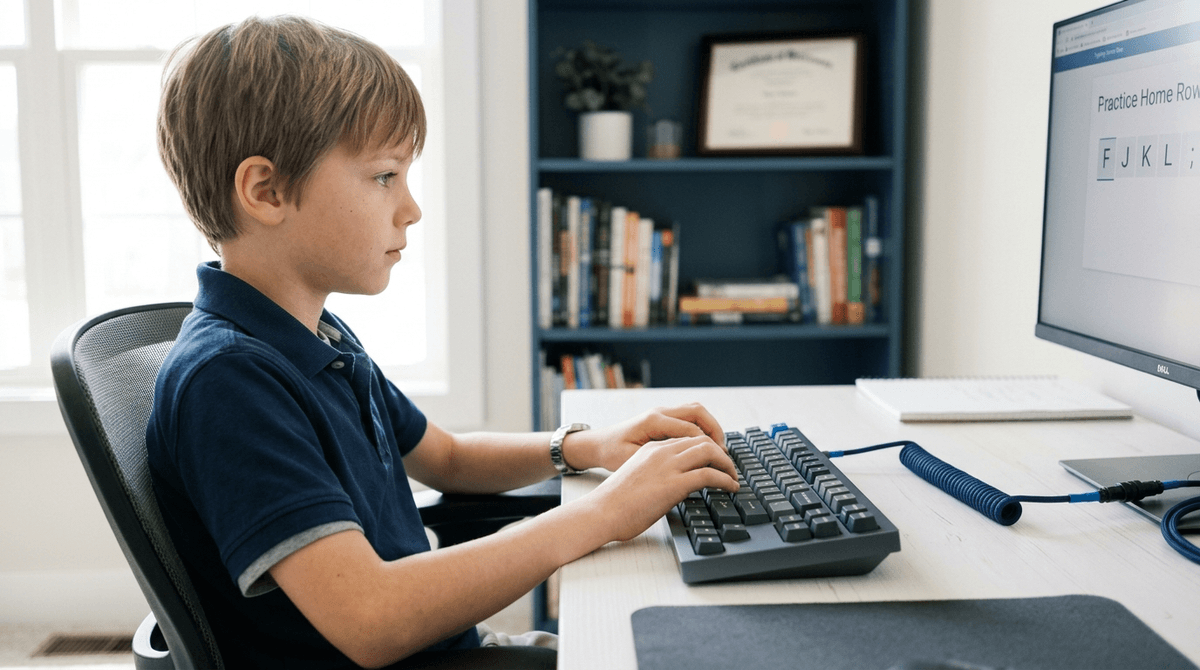
Elementary students learn to type significantly faster and more accurately when using a structured, developmental curriculum rather than relying on free online games or no instruction at all.
Prioritize a formal, occupational therapy-based typing program over unstructured "free play" games to ensure your child builds the muscle memory needed for academic success. While children can learn the basics of the keyboard as early as kindergarten, the most significant gains in speed and accuracy happen between third and fifth grade when following a consistent, 24-week curriculum.
Typing is the primary way kids communicate their thoughts in the modern classroom, yet many schools have stopped teaching it as a formal skill. When a child "hunts and pecks," they use up valuable "cognitive load"—the brain power required to find the letter 'B' is brain power not being used to craft a persuasive sentence or solve a word problem.
By the time a student reaches middle school, bad typing habits are deeply ingrained and physically difficult to break. Establishing correct posture and finger placement in elementary school ensures that the keyboard becomes an invisible tool rather than a constant bottleneck. This study shows that simply putting a kid in front of a laptop isn't enough; the method of instruction determines whether they actually get faster.
Researchers were concerned that while schools have transitioned to 1-to-1 device programs (like Chromebooks for every student), the actual instruction on how to use those devices has lagged behind. Most schools either offer no typing instruction or point kids toward free, gamified websites. The study aimed to see if a structured curriculum based on occupational therapy principles—focusing on the physical mechanics of typing—outperformed the "just let them play" approach.
The data suggests that "deliberate practice" beats "unstructured play" across every elementary grade level. The findings were clear on the impact of formal instruction:
- Speed gains are measurable: Students using a structured curriculum (specifically Keyboarding Without Tears) gained an average of 4.5 words per minute (WPM) over a 24-week period, significantly outperforming the control group.
- Accuracy is the differentiator: While free games like BBC Dance Mat Typing provided some benefit, they were inconsistent. Only the structured program led to reliable improvements in technical accuracy across all grades.
- The "sweet spot" for speed: Third through fifth graders saw the most substantial gains in net words per minute. Their motor skills are developed enough to translate instruction into raw speed.
- Start early for habits, not speed: Even kindergarteners were able to learn the keyboard layout and proper sitting posture. They won't be fast, but they can avoid developing the "two-finger" habit that plagues older students.
The "digital native" is a myth when it comes to technical skills. We often assume that because kids can navigate a tablet by age three, they will intuitively understand a QWERTY keyboard. They don't. Typing is a complex fine-motor task that requires specific hand-eye coordination and core stability.
The study implies that the "gamification" of typing—where speed is the only metric rewarded—might actually be counterproductive. Programs that prioritize "playing the game" often allow kids to use the wrong fingers as long as they hit the key fast enough. A structured curriculum focuses on the process (how you hit the key) over the immediate result (hitting the key quickly), which leads to a higher "speed ceiling" later in life.
The study followed 160 students at a single private school, which means the results might not perfectly mirror a crowded public school classroom with fewer resources. Additionally, the study was "quasi-experimental," meaning the groups weren't randomized perfectly, which can sometimes skew results.
Most importantly, one of the study's authors has a professional affiliation with the "Keyboarding Without Tears" curriculum. While the data was peer-reviewed, this potential conflict of interest is why the findings should be viewed as a strong signal rather than an absolute law.
- If your school doesn't offer a formal typing class, schedule two 15-minute sessions at home per week using a structured program rather than letting your child browse free typing game sites.
- If your child is in Kindergarten or 1st grade, focus entirely on "pre-keyboarding" basics: sitting up straight, keeping feet flat on the floor, and understanding that the left hand stays on the left side of the board.
- If your child is in 3rd grade or above, this is the time for a "typing push." The motor skills are ready, and the academic benefits of being a fast typist will be felt immediately in their writing assignments.
- If you are choosing a home program, look for one that emphasizes "home row" placement and posture before it introduces timed speed tests or "enemy-blasting" games.
Stop treating typing as an optional "extra" and start treating it as a foundational literacy skill. A few months of structured, intentional practice in elementary school prevents a lifetime of inefficient "hunting and pecking" that slows down academic output.
Denise K. Donica, Peter Giroux, Amber Faust (2018). Keyboarding instruction: Comparison of techniques for improved keyboarding skills in elementary students. Journal of Occupational Therapy, Schools, & Early Intervention. doi:10.1080/19411243.2018.1512067 — tandfonline.com