

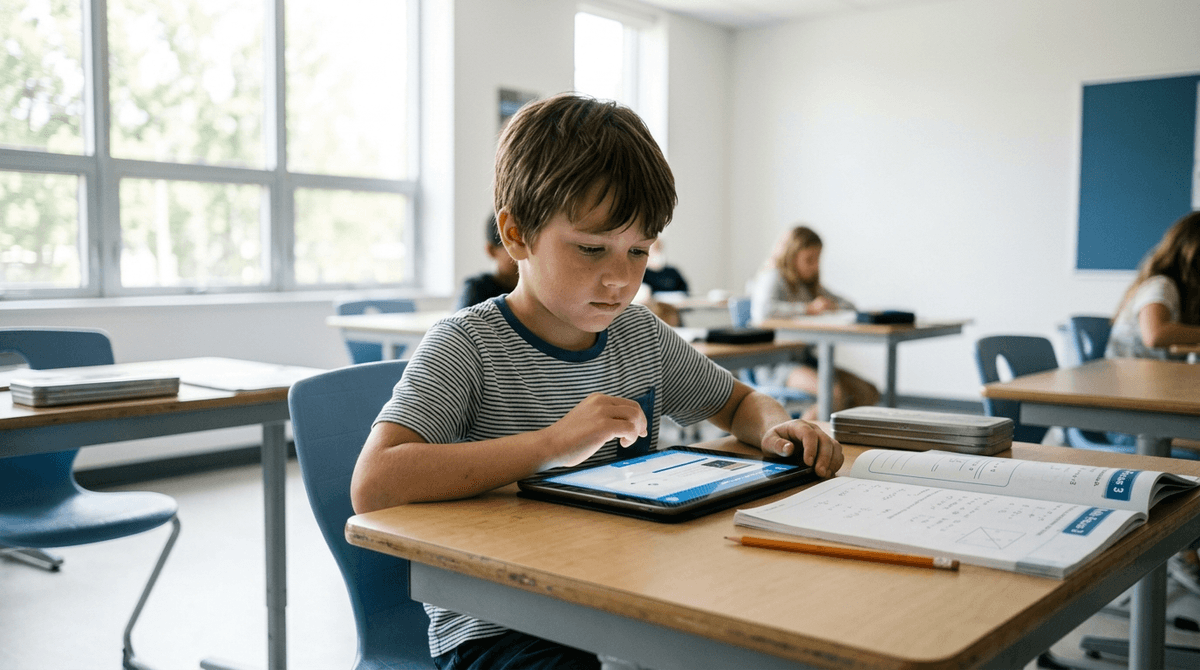

Frequent use of educational software in the early years of school is linked to lower reading and math scores, disproportionately hurting students who are already struggling.
Frequent classroom technology use in kindergarten through third grade drops test scores in core subjects and widens the achievement gap between the highest and lowest performers. While tech is often sold as a tool for equity, it appears to act as a "gap-widener" that harms low-achieving children more than their peers.
Parents often view "educational" apps as a safe or even superior way for children to learn, but these tools can backfire during the critical K-3 window for literacy and numeracy. If your child is falling behind, the instinct to double down on "remedial" software might be exactly the wrong move.
This isn't just a "screen time" debate; it's a question of instructional quality. For children in the earliest stages of learning, the data suggests that tablets and software are fundamentally less effective than human-led instruction for building foundational skills like phonics and basic arithmetic.
Researchers analyzed a massive national dataset to determine if the multi-billion dollar investment in classroom EdTech was actually delivering results. They were specifically looking for a "gap-widening" effect—the possibility that technology might help some students while leaving others further behind.
The study was prompted by concerns that classroom tech often serves as a "digital babysitter" or "edutainment" rather than a rigorous teaching tool. By tracking 18,174 American children from 2010 to 2014, researchers could see exactly how the frequency of software use in the classroom impacted standardized test scores over a four-year period.
Kindergarteners who used educational software daily or weekly showed significantly lower scores in reading and math compared to kids who rarely used it. The research points to several striking patterns:
- The Achievement Gap: Technology use didn't just lower average scores; it hit low-achieving students the hardest. High-achieving students seemed more "resilient" to the negative effects, while those already struggling saw their progress stall further.
- Subject Specificity: The damage was concentrated in reading and math—foundational subjects that require intense focus, sequential learning, and human feedback. Interestingly, science achievement showed no statistically significant negative impact, suggesting tech might be better suited for "applied" subjects than for core skill-building.
- Instruction Replacement: The study suggests that software often replaces high-quality human instruction rather than supplementing it. By third grade, the direct negative impact on average scores softened, but the inequality gap between high and low achievers grew even wider.
- The "Dumbing Down" Effect: One major driver for these drops is likely the nature of the software itself. Many programs prioritize keeping kids engaged through gamification, which can distract from the actual cognitive work required to master a subject.
The study suggests that high-achieving students have a "buffer" that struggling students lack. These children might have the cognitive tools to navigate a screen without getting distracted, or they may have more robust support at home to offset a weaker classroom experience.
For the child who finds reading difficult, a tablet isn't a life-raft; it's an anchor. The findings imply that "edutainment"—software that prioritizes keeping kids quiet and busy—is likely eroding the rigor of the curriculum. When a teacher uses an app to manage a classroom or "park" a group of students so they can work with others, the students on the screens are essentially losing active learning time.
This data is observational, meaning it shows a strong correlation but cannot definitively prove that the software alone caused the lower scores. Other classroom factors—like a teacher's overall experience or the school's total resources—could also be at play.
The data tracks children from 2010 to 2014. While the sample size of 18,000 children is massive and provides high statistical power, the specific software used a decade ago has evolved. However, the core psychological principles of how children learn to read and do math have not changed, and the "edutainment" features of modern apps have arguably become even more distracting.
- If your child is struggling with foundational reading or math... request more one-on-one or small-group instruction with the teacher rather than accepting more time on "remedial" learning apps.
- If you are choosing between a school that touts its "1:1 tablet ratio" and one that emphasizes teacher-led instruction... prioritize the human-centric environment during the K-3 years, as this is the most critical window for skill-building.
- If your child's teacher uses technology for science or "applied" projects... worry less, as the study found no significant negative impact on science achievement, where tech can sometimes offer helpful visualizations or simulations.
- If your child is using educational software at home for "extra practice"... set a short timer and stay involved, ensuring they are actually doing the math or reading rather than just clicking through game-like rewards.
- If your school uses "adaptive" software to replace core curriculum... ask the administration for the evidence that this specific software is more effective than the human-led instruction it is replacing.
For the youngest learners, tablets are no substitute for teachers, and "educational" software in the classroom may actually be pulling your child’s test scores down. You have permission to be the parent who asks why the screens are on during math and reading—and to demand more human interaction for the skills that matter most.
Ahn J (2022). Exploring the Negative and Gap-Widening Effects of EdTech on Young Children's Learning Achievement: Evidence from a Longitudinal Dataset of Children in American K-3 Classrooms. International journal of environmental research and public health. doi:10.3390/ijerph19095430 — ncbi.nlm.nih.gov