

You know those hours your kid spent raiding your closet for dress-up? That's moved online. Dress-up games are digital fashion playgrounds where kids create looks, style characters, and explore aesthetics without the pile of clothes on your bedroom floor.
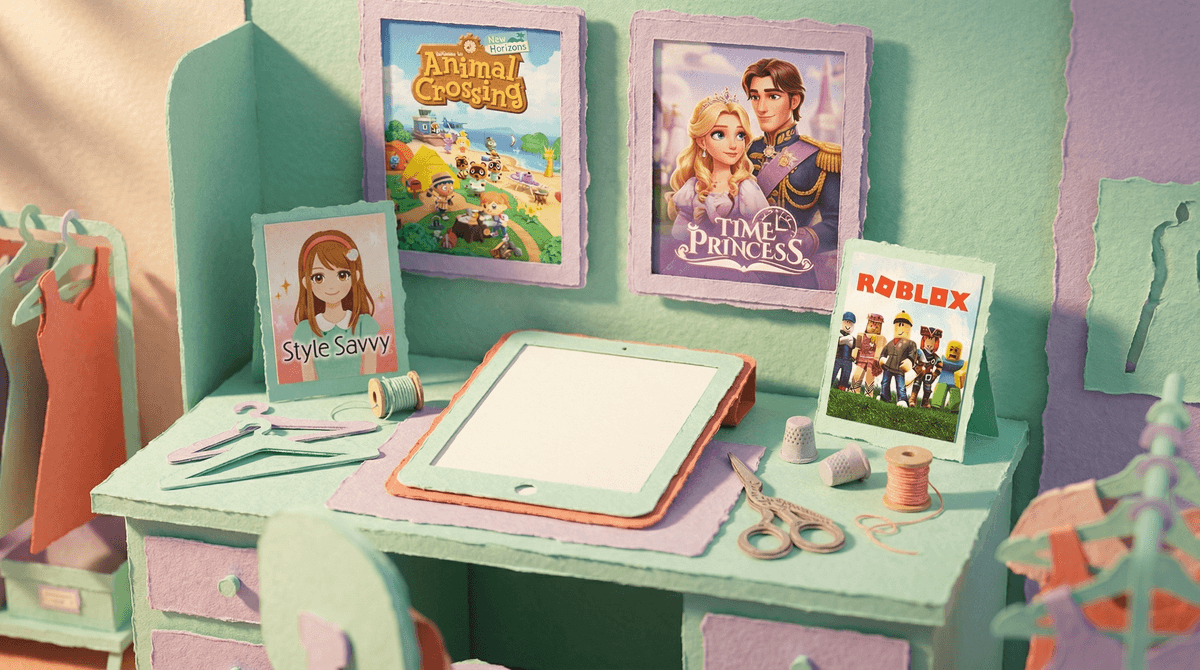
These games range from simple paper-doll style apps where kids drag outfits onto characters, to elaborate fashion empire simulators where they run boutiques, compete in style battles, and collect thousands of virtual items. Think Style Savvy, Dress Up! Time Princess, and the fashion corners of Roblox and Animal Crossing.
The appeal is obvious: creative expression, low-stakes experimentation, and that dopamine hit of seeing your vision come together. But like most things our kids love online, there's more happening under the hood than just harmless fun.
It's creative play with infinite options. No physical limitations, no laundry, no "that's my good scarf!" Real dress-up is constrained by what's in the closet. Digital dress-up offers thousands of items, styles from every era and culture, and the ability to instantly pivot from cottagecore to cyberpunk.
It's social currency. In many of these games, especially on platforms like Roblox, your outfit IS your identity. Kids aren't just playing dress-up—they're curating a persona, signaling their taste, and participating in a visual language their peers understand. That "basic" avatar? Social death. That rare item? Instant status.
It's genuinely relaxing. In a world of high-stakes gaming and social media pressure, dress-up games offer low-pressure creativity. No fail states, no timers, no competition (unless they want it). It's digital fidgeting with an aesthetic payoff.
The collection aspect is real. These games tap into the same psychology as trading cards or Beanie Babies. Gotta catch 'em all, but make it fashion. New items drop regularly, limited editions create urgency, and completing sets triggers that sweet, sweet reward response in the brain.
Here's where it gets complicated.
In-app purchases are the business model. Most dress-up games are free to download, which means they make money another way. That "limited edition ball gown" costs real money. Those "gems" or "diamonds" to unlock new chapters? Real money. The game might be free, but that wardrobe costs more than your kid's actual clothes.
And these games are masterfully designed to make spending feel painless. Virtual currency creates psychological distance from real money. (Learn more about how virtual currency works on kids' brains .) Limited-time offers create urgency. "Watch an ad to get free gems!" trains kids to trade their attention for rewards.
Data collection is extensive. These games often ask for email addresses, track playing habits, and collect data on preferences and behaviors. Some integrate with social media. That information has value—to advertisers, to the game company, to whoever they share it with. Always check the privacy policy, even though I know it's 47 pages of legal jargon.
The aesthetics can be... a lot. Many dress-up games feature hypersexualized character designs—tiny waists, huge eyes, revealing clothing as the "best" options. The beauty standards are often narrow and Eurocentric. Your 7-year-old is absorbing these ideals while they play, even if they can't articulate it.
Social features introduce social problems. Games with chat, sharing, or competitive elements bring all the usual online social issues: comparison, exclusion, cyberbullying, and exposure to strangers. That "fashion battle" can turn into a self-esteem crusher real quick.
Ages 4-7: Stick with simple, offline-capable games with no social features or purchases. Toca Boca games are solid here—creative, open-ended, and designed for little kids. Watch out for anything requiring reading skills they don't have yet, which creates frustration or forces them to click through without understanding what they're agreeing to.
Ages 8-11: They can handle more complex games, but you need to be involved. Set up parental controls, disable in-app purchases (or require password approval), and check in regularly about what they're playing. Games like Animal Crossing offer dress-up elements within a broader, safer context. If they're on Roblox fashion games, read this guide to Roblox parental controls immediately.
Ages 12+: They're probably already deep in the fashion game ecosystem. Focus on media literacy: talk about monetization strategies, beauty standards, and how these games are designed to keep them playing (and paying). Set spending limits, discuss why they want certain items, and help them recognize FOMO manipulation.
Start with the app store settings. Disable in-app purchases or require approval for every transaction. This is non-negotiable unless you enjoy surprise credit card bills.
Play together, at least once. You need to see what they're actually doing. Is it creative and fun? Is it a slot machine dressed up as a fashion game? You can't make informed decisions without seeing it yourself.
Talk about the money. Make virtual currency real. "Those 1,000 gems cost $10. That's two weeks of allowance. Is this outfit worth it?" Help them understand what they're actually spending.
Discuss the images. Ask questions: "Do people really look like this?" "What do you notice about all these characters?" "How do you feel when you see these outfits?" You're not lecturing—you're helping them develop critical thinking.
Set time limits that make sense. Dress-up games can be genuinely creative and relaxing, but they're also designed to be addictive. 30 minutes of creative play? Great. Three hours of compulsive collecting? Problem.
Check the privacy settings. Turn off social features for younger kids. Disable chat. Make profiles private. Assume every game is collecting more data than you'd like and minimize what you can.
Dress-up games aren't inherently good or bad—they're tools. In the right context, they offer creative expression, aesthetic exploration, and genuine fun. In the wrong context, they're monetization machines that teach unhealthy beauty standards and drain your bank account.
The question isn't "should my kid play dress-up games?" It's "which games, with what guardrails, and with how much conversation?"
Your job isn't to ban all digital dress-up (good luck with that anyway). Your job is to help your kid navigate these games with awareness, boundaries, and critical thinking skills. That means being involved, asking questions, and making intentional choices rather than just letting the algorithm decide what your kid consumes.
And maybe, just maybe, suggest they raid your actual closet sometimes too. At least that's free.
-
Audit what they're playing now. Download the games yourself and actually look at them. Check the age ratings, privacy policies, and in-app purchase options.
-
Set up device-level restrictions. Don't rely on individual game settings—control purchases and screen time at the device level.
-
Have the money conversation. If they want to spend on these games, help them use their own money and track what they're spending. Real financial literacy starts here.
-
Explore alternatives. Physical dress-up, thrift store fashion hunts, or creative games like Minecraft where they can design skins and outfits within a broader creative context.
-
Check in regularly. This isn't a one-time conversation. Games update, your kid's interests change, and new concerns emerge. Make this an ongoing dialogue, not a lecture.
Need help evaluating a specific game? Ask about any dress-up game your kid is playing and get personalized guidance for your family.