

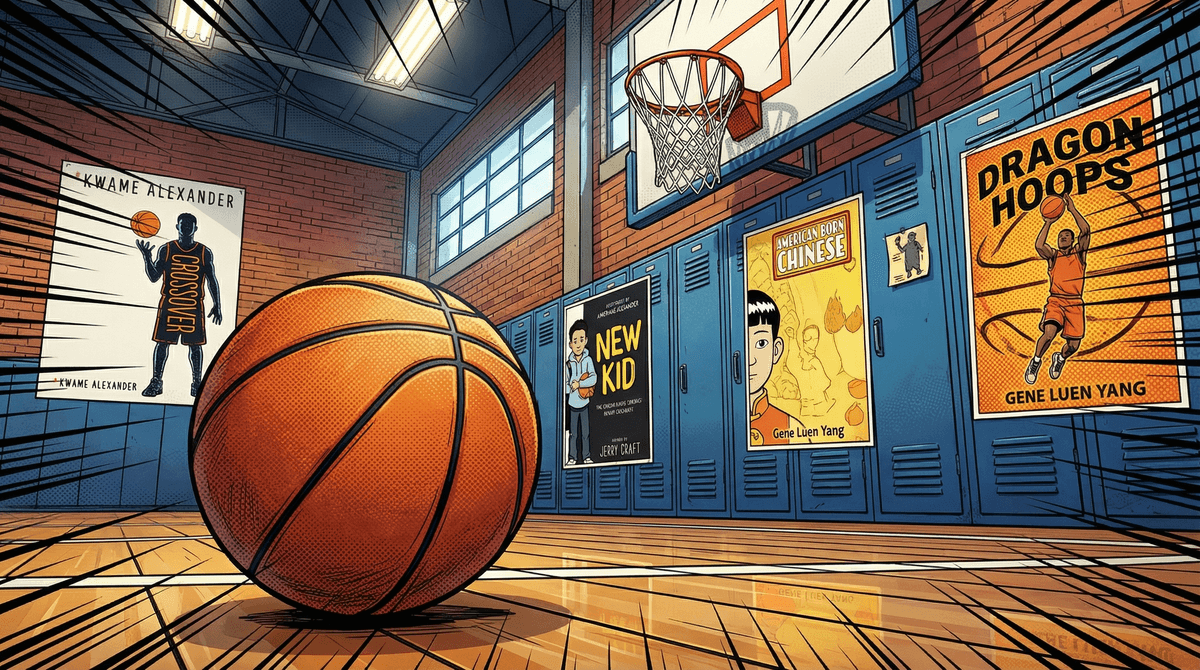
Dragon Hoops by Gene Luen Yang is a graphic novel published in 2020 that follows the real-life basketball season of the Bishop O'Dowd High School Dragons in Oakland, California. But here's what makes it different from your typical sports story: it's written and illustrated by Gene Luen Yang (yes, the American Born Chinese guy), who taught at the school and initially had zero interest in sports.
The book weaves together multiple narratives: the team's journey through their championship season, Yang's own creative struggles and personal history, profiles of individual players dealing with family pressure and identity questions, and even the history of basketball itself. It's part sports documentary, part memoir, part meditation on what it means to tell other people's stories.
At around 450 pages, it's a substantial read, but the graphic novel format makes it move quickly. Think of it as a really engaging documentary series in book form.
It's real. These aren't fictional characters with perfectly scripted arcs—they're actual teenagers who gave Yang permission to tell their stories. The players deal with divorced parents, academic pressure, questions about their racial identity, and the weight of being "the one who might make it." That authenticity resonates.
The format removes barriers. For reluctant readers or kids who think they "don't like books," graphic novels can be a game-changer. The visual storytelling in Dragon Hoops carries emotional weight that pure text might not capture—you can see the exhaustion on a player's face after a tough loss, the tension in a crucial game moment.
It's about more than basketball. Even teens who couldn't care less about sports find themselves invested because Yang is honest about his own skepticism. He literally starts the book explaining why he doesn't get sports culture. But through following the team, he (and readers) discover it's really about dedication, teamwork, facing failure, and the complicated relationship between individual achievement and collective success.
Identity and belonging matter here. The book explores what it means to be Asian American, Black, mixed race, an immigrant, a first-generation college student—all through the lens of a diverse basketball team. It doesn't preach; it just shows these realities as part of these kids' lives.
Best for ages 12+, though mature 10-11 year-olds who are strong readers could handle it.
The content is generally pretty clean—no graphic violence, sex, or heavy profanity. There's some mild language (the occasional "damn" or "hell"), and the book deals with mature themes like divorce, parental pressure, and racism, but it's all handled thoughtfully.
Content considerations:
- Discussion of racial stereotypes and microaggressions
- Family dysfunction and divorce
- Academic and athletic pressure
- Brief mentions of historical violence (in the basketball history sections)
- Themes of failure and disappointment
The emotional content might be heavier than the "age rating" suggests. Some kids will breeze through; others might need to process what they're reading, especially if they're dealing with similar pressures around sports, academics, or family expectations.
This is a great bridge book. If your kid loved Raina Telgemeier's books but is aging out of them, or if they're into The Crossover but won't touch anything without pictures, Dragon Hoops sits perfectly in that middle space. It's sophisticated enough for high schoolers but accessible enough for middle schoolers.
Yang is a National Ambassador for Young People's Literature, which is basically the librarian stamp of approval. His work consistently wins awards (American Born Chinese was the first graphic novel nominated for a National Book Award), and he takes the responsibility of storytelling seriously. In Dragon Hoops, he explicitly wrestles with questions like "Do I have the right to tell this story?" and "How do I represent people fairly?" That meta-narrative about ethical storytelling is actually one of the book's strengths.
It's a conversation starter about effort vs. talent. One of the book's central tensions is about players who work incredibly hard but might not have natural athletic gifts, versus players with raw talent who struggle with motivation. If your teen plays sports (or does anything competitive—debate , theater, esports), this book will hit home.
The diversity is authentic, not performative. Yang doesn't make a big deal about representation; he just shows a real Oakland high school basketball team, which happens to be incredibly diverse. The book explores how race and culture intersect with sports without turning it into an after-school special.
Instead of the standard "what did you think?" here are some questions that might generate actual conversation:
"Yang says he didn't 'get' sports at first. What's something you didn't get until you tried it?" This opens up dialogue about assumptions and being willing to change your mind.
"Which player's story stuck with you most?" Let them lead here. Their answer might surprise you and reveal what pressures they're feeling.
"The book talks about 'flow state'—that feeling when you're completely focused. When do you feel that?" This can reveal what activities genuinely engage your kid, whether it's gaming, art, sports, or something else entirely.
"Do you think Yang had the right to tell these players' stories?" This is a surprisingly sophisticated question about consent, power dynamics, and representation that teens can really sink their teeth into.
Dragon Hoops is one of those rare books that works on multiple levels. Surface level: it's an engaging sports story with great art. Deeper level: it's about identity, effort, failure, and what we owe each other when we tell stories.
Buy it if: Your teen plays sports, likes graphic novels, is interested in storytelling or journalism, needs something "literary" that doesn't feel like homework, or is navigating questions about identity and belonging.
Skip it if: Your kid is under 10 (too long and emotionally complex), needs pure escapism right now (this is grounded and real), or genuinely hates both sports and school stories.
The real win: This is a book that teens will actually finish and might even think about after they close it. In a world of TikTok and YouTube Shorts, that's not nothing.
Want to explore more graphic novels that tackle real issues? Check out our guides to Hey Kiddo by Jarrett Krosoczka, Stamped (graphic novel adaptation), or New Kid by Jerry Craft.
Wondering if your teen's reading habits stack up? Find graphic novel recommendations by teen reading level.