

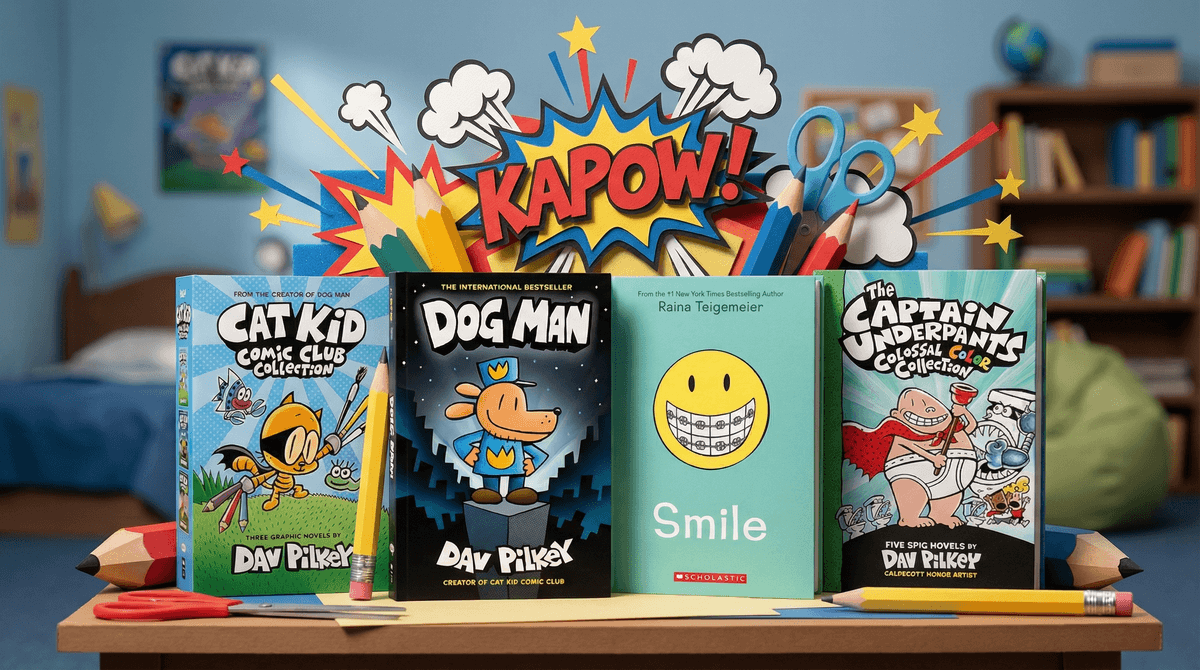
Look, if you have an elementary schooler, you've probably tripped over at least three Dog Man books in your house this week. Dog Man is a graphic novel series by Dav Pilkey (yes, the Captain Underpants guy), and it's basically taken over the 6-10 year old reading world like nothing since... well, since Captain Underpants.
The premise is wonderfully absurd: a police dog and a cop are both injured in an explosion, so doctors sew the dog's head onto the cop's body. The result is Dog Man – a crime-fighting hero with the head of a dog and the body of a police officer. He fights villains like Petey the Cat (who's actually surprisingly complex as a character), saves the day, and there are lots of jokes about butts and poop along the way.
The books are written in a comic book format with hand-drawn illustrations that look like they were created by a kid (which is actually part of the story – supposedly they're made by two elementary school students named George and Harold, the same kids from Captain Underpants). There are currently 12 books in the main series, plus spin-offs, and they fly off the shelves faster than you can say "flip-o-rama."
Here's the thing about Dog Man that I think parents sometimes miss: these books are getting kids to READ. Like, voluntarily. Without bribing them.
The humor is perfectly pitched at the elementary school level – silly enough to feel rebellious (there's a character literally named "Flat Petey"), but not so edgy that teachers won't let kids read them at school. The illustrations carry a lot of the story, which makes them accessible for reluctant readers or kids who struggle with dense text. And Pilkey is actually pretty clever about sneaking in real emotional depth between the butt jokes.
Kids also love the "Flip-O-Rama" interactive sections where they flip pages back and forth to animate action sequences. It makes reading feel active and playful rather than like a chore. Plus, the books have this meta element where the characters are supposedly created by two kids, which makes young readers feel like "hey, I could do this too."
The community aspect is real too. Dog Man is a shared language on the playground. Kids trade books, compare which one is their favorite, and debate whether Petey is actually a good guy deep down (he kind of is, honestly).
Dog Man sits at the center of something bigger that's happening with kids and reading: the graphic novel revolution. And before you write these off as "not real reading" (I see you, I've heard that concern), let's talk about what's actually going on here.
Graphic novels require a different kind of literacy – kids are reading text, interpreting images, understanding how panels flow, picking up on visual cues and body language. It's actually pretty sophisticated cognitive work. Studies have shown that graphic novels can improve reading comprehension, vocabulary, and engagement with literature, especially for reluctant readers or kids with learning differences.
For ages 6-8, Dog Man is often the bridge from picture books to chapter books. The images provide scaffolding for the text, building confidence.
For ages 8-10, kids are often reading them independently and starting to branch out to other graphic novel series like Diary of a Wimpy Kid, The Bad Guys, or Wings of Fire graphic novels.
For ages 10-12, many kids transition to more complex graphic novels like Raina Telgemeier's work (Smile, Sisters, Guts), Amulet series, or even manga.
Okay, real talk. Dog Man isn't going to win a Newbery Medal. The humor can be repetitive. There are a LOT of butt jokes. If you're reading it aloud for the 47th time, you might want to scream into a pillow.
BUT (and this is a big but, no pun intended), Pilkey actually weaves in some genuinely good stuff:
- Redemption arcs: Petey the Cat goes from villain to trying to be a good dad to his kitten, Li'l Petey
- Friendship themes: The relationship between Dog Man and his friends is actually sweet
- Growth mindset: Characters make mistakes and learn from them
- Creativity encouragement: The books literally show kids making comics and encourage readers to create their own
The "Supa Buddies" book club activities at the end of each book include drawing prompts and writing exercises. I've seen kids who "hate writing" spend hours making their own Dog Man comics.
The bathroom humor is real. If you're not okay with jokes about poop, pee, and butts, Dog Man might not be your family's vibe. That said, it's all pretty innocent – there's nothing inappropriate beyond bodily function humor.
The reading level varies. The books are officially listed for ages 7-10, but I know 5-year-olds who love having them read aloud and 12-year-olds who still grab the new releases. Don't stress too much about the "right" age.
They're surprisingly expensive for how fast kids read them. At $10-13 per book and maybe 30 minutes of reading time, the cost-per-hour can feel steep. Library holds are your friend here. So are hand-me-downs and birthday gifts.
There's a learning curve for parents. If you're used to traditional chapter books, the graphic novel format might feel chaotic at first. That's okay. Your kid gets it, even if you don't immediately.
The series has staying power. Unlike some trends that burn bright and fast, Dog Man has been going strong since 2016. New books are still being released, so this isn't a phase that's ending anytime soon.
Here's something interesting: Dog Man exists almost entirely in book form. There's no Dog Man TV show (yet), no major video game, no app. In a world where most kids' media is deeply tied to screens, Dog Man is refreshingly analog.
That said, kids DO watch YouTube videos of people reading Dog Man books, doing Dog Man crafts, or creating Dog Man animations. If your kid is into this, you might want to check out what they're watching to make sure it's age-appropriate content.
Some kids also use Roblox to create Dog Man-themed games or use drawing apps to make their own Dog Man comics digitally. This kind of creative expression is actually pretty cool – they're taking something they love and extending it into other mediums.
Dog Man isn't high literature, but it's getting kids excited about reading, teaching them that books can be fun, and building a community of young readers. In an age where we're all worried about screen time and literacy rates, that's actually kind of a big deal.
If your kid loves Dog Man, lean into it. Ask them about their favorite characters. Let them tell you the plot (even if it makes zero sense). Maybe even try drawing your own comic together.
And if Dog Man isn't your kid's thing? That's totally fine too. There are approximately one million other graphic novel series out there. Check out what other kids their age are reading and see what sticks.
If your kid is already into Dog Man:
- Check your library's graphic novel section for similar series
- Encourage them to create their own comics (Pilkey has tutorial videos on his website)
- Consider other Dav Pilkey series like Captain Underpants or Cat Kid Comic Club
If you're trying to get a reluctant reader interested:
- Start with Dog Man book 1 (they're mostly standalone but there is a loose order)
- Read it together, taking turns with the dialogue
- Don't stress about "proper" reading – let them look at the pictures and absorb the story however works for them
If you're wondering what comes after Dog Man:
- Raina Telgemeier for kids ready for more emotional depth
- The Bad Guys series for similar humor with different characters
- Nathan Hale's Hazardous Tales for kids interested in history
- Amulet series for fantasy fans ready for more complex plots
The goal isn't to rush them through Dog Man or push them toward "better" books. The goal is to help them discover that reading can be joyful. And if that joy comes with a side of butt jokes? Well, worse things have happened.