

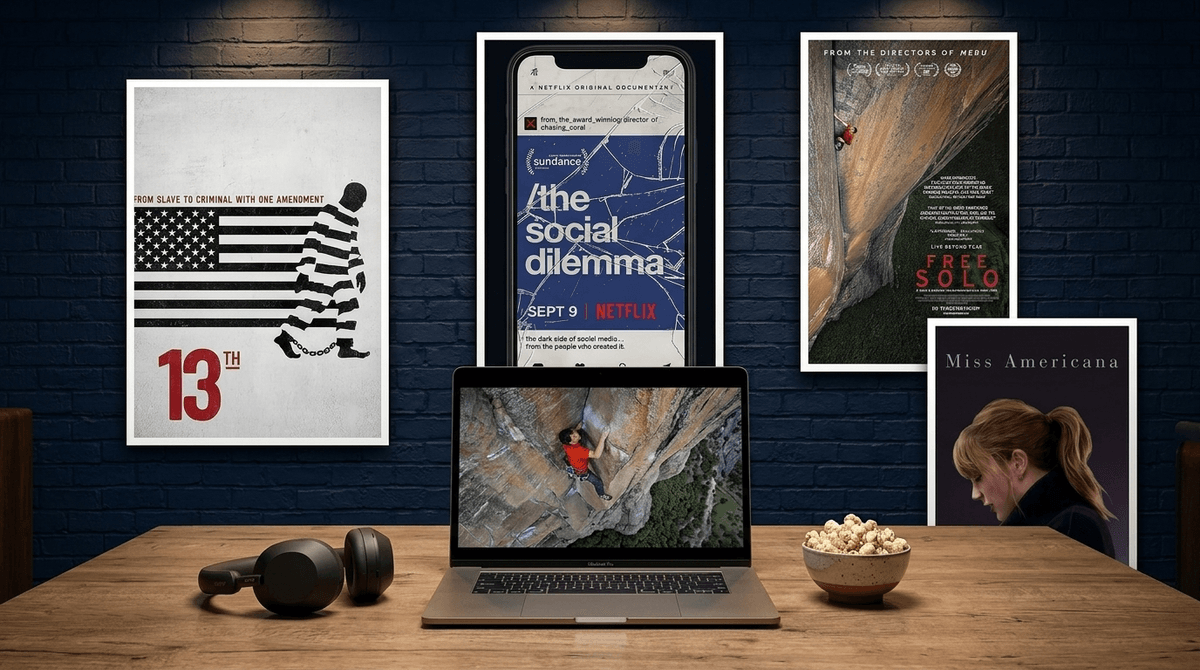
TL;DR: The Quick List If you only have thirty seconds before your teen disappears back into the world of TikTok or Roblox, here are the top picks for your next family movie night:
- For the Tech-Obsessed: The Social Dilemma (Netflix)
- For the Adrenaline Junkie: Free Solo (Disney+)
- For the Budding Activist: 13th (Netflix)
- For the Music Fan: Miss Americana (Netflix)
- For the Science Geek: Fire of Love (Disney+)
Get a documentary recommendation based on your teen's interests
We’ve all been there. It’s Friday night, and you’re trying to compete with the infinite scroll. Your teen is currently laughing at a meme about "Ohio" or watching a three-minute breakdown of Skibidi Toilet lore, and the idea of suggesting a "documentary" feels like asking them to do extra-credit calculus.
But here is a secret: we are living in the golden age of non-fiction filmmaking. Documentaries aren't the dry, monotone voiceovers we grew up with in social studies class. Today’s docs are high-stakes, visually stunning, and often more dramatic than the latest Marvel movie.
The goal isn't to "educate" them in a way that feels like a chore. It’s to swap the "brain rot" content for something that actually sparks a conversation. When we move beyond the binge, we give our kids a chance to see the world—and their place in it—a little more clearly.
Teens are currently bombarded with short-form content that prioritizes speed over depth. Whether it’s YouTube Shorts or Instagram Reels, their brains are being trained to process information in 15-second bursts.
Watching a feature-length documentary is a "digital wellness" win in itself. It’s an exercise in sustained attention. More importantly, it provides context. If your kid is seeing snippets of political unrest or climate change on their feed, a well-made documentary provides the "why" and "how" that a 60-second clip simply can't.
If you want to talk to your teen about their digital habits without sounding like you’re lecturing them, let the professionals do it.
This is the "gateway drug" of documentaries for modern families. It features the very people who built Facebook and Pinterest explaining exactly how they designed these platforms to be addictive.
- Why it works: It doesn’t blame the kids; it blames the algorithm. It shifts the conversation from "You spend too much time on your phone" to "The smartest engineers in the world are paid to keep you staring at that screen."
- Ages: 12+
If your teen is interested in data privacy or how "free" apps actually make money, this dive into the Cambridge Analytica scandal is eye-opening. It explains how personal data is weaponized in ways that affect everything from what they buy to how people vote.
- Ages: 13+ (It’s dense, but worth it for older teens).
Check out our guide on helping teens navigate social media algorithms
Sometimes the best way to get a teen’s attention is through pure, unadulterated tension. These films are better than any action thriller because they’re real.
Alex Honnold climbing the 3,000-foot face of El Capitan without a rope is the definition of "high stakes." Even if your teen has no interest in rock climbing, the psychological study of what it takes to be that disciplined (and arguably that reckless) is fascinating.
- Why it works: The cinematography is mind-blowing. It’s a great jumping-off point for talking about risk, passion, and the literal "brain chemistry" of thrill-seeking.
- Ages: 10+ (Some mild profanity, mostly from the sheer stress of the situation).
Even if they weren't alive for the 90s Bulls era, this docuseries about Michael Jordan is a masterclass in the cost of greatness. It’s gritty, it’s competitive, and it shows the "ugly" side of being the best in the world.
- Ages: 14+ (Contains significant profanity, but it's authentic to the locker room environment).
Teens are often more socially aware than we give them credit for. They want to understand the systems they’re inheriting.
Ava DuVernay’s exploration of the U.S. prison system and the history of racial inequality is essential viewing. It’s fast-paced, visually engaging, and pulls no punches.
- Why it matters: It connects historical events to current headlines in a way that feels urgent and relevant.
- Ages: 15+ (Contains disturbing images and intense themes).
This film follows a group of teens at a summer camp for kids with disabilities in the 1970s who went on to spark the disability rights movement. It’s funny, rebellious, and incredibly moving.
- Ages: 12+
If your teen is resistant to "serious" topics, start with something they already care about.
Even if you aren't a "Swiftie," this look at Taylor Swift’s career deals with the reality of fame, the pressure of public perception, and finding your voice. It’s a great way to talk about the "curated" lives we see online versus reality.
- Ages: 13+
A breakdown of how "We Are the World" was recorded in a single night. It sounds niche, but seeing icons like Michael Jackson, Bruce Springsteen, and Cyndi Lauper struggle with their parts and deal with massive egos is surprisingly relatable.
- Ages: 10+
When picking a documentary, the "rating" doesn't always tell the whole story. A TV-MA documentary might be rated that way because of a few F-bombs in an interview, whereas a PG-13 documentary might contain graphic historical footage that is much harder to process.
- 10-12 Years Old: Stick to nature and "feat" documentaries like My Octopus Teacher or Apollo 11. These are visually driven and generally positive.
- 13-15 Years Old: This is the sweet spot for tech and social commentary. They are starting to form their own worldviews and appreciate being treated like adults who can handle complex topics.
- 16+ Years Old: At this age, almost everything is on the table. Focus on "investigative" docs that challenge their assumptions.
The quickest way to kill the vibe is to pause the movie and ask, "So, what did we learn about the industrial complex?"
Instead, try these low-pressure conversation starters:
- "I didn't realize [Fact from the movie] was a thing. Did you know that?"
- "That person was intense. Do you think they were brave or just crazy?"
- "Does that actually happen at your school/on your feed, or is the movie exaggerating?"
If they want to keep scrolling on their phone while watching, try to make the movie the "main character" of the room. Dim the lights, get the good snacks, and maybe even put your own phone in the other room to model that "deep dive" behavior.
Learn more about modeling healthy screen habits for your kids
Documentaries are a bridge. They bridge the gap between the mindless entertainment our kids consume and the complex world they are about to enter as adults. You don't need to watch a documentary every night, but swapping out one "binge-watch" a month for a deep dive can change the way your family talks about the world.
Next time they say something is "lowkey mid" or "totally Ohio," maybe—just maybe—you can counter with a story about a guy climbing a mountain without a rope or the secret history of the internet.
- Pick one: Choose one of the films above based on what your kid is already into (Sports? The Last Dance. Social Media? The Social Dilemma).
- Check the platform: Most of these are on Netflix or Disney+.
- Low-stakes invite: "Hey, I heard this movie is actually wild/stressful/cool. Want to watch it Friday?"