

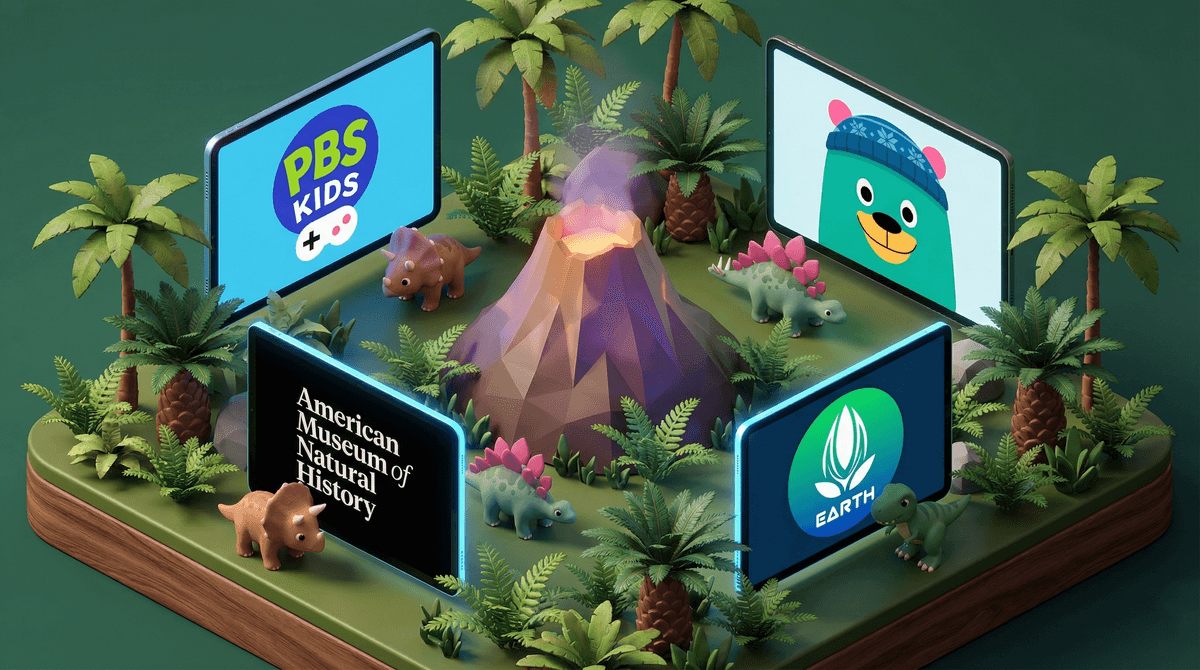
Dinosaur apps are everywhere—from simple coloring games to elaborate AR experiences where a T-Rex appears in your living room. The category spans everything from PBS Kids dinosaur games to subscription-based "edutainment" apps promising to teach paleontology through mini-games.
Here's the thing: not all dinosaur apps are created equal. Some are genuinely educational experiences that teach kids about prehistoric life, scientific thinking, and natural history. Others are basically digital slot machines with a Triceratops skin, designed to keep kids tapping while serving ads or pushing in-app purchases.
The tricky part? They often look the same at first glance. Both will have colorful dinosaurs, fun sound effects, and claims about being "educational." But one might teach your kid about the Cretaceous period while the other just teaches them to beg for your credit card.
Before we get into app quality, let's acknowledge: the dinosaur phase is real and it's powerful. There's actual research showing that intense childhood interests (like dinosaurs) boost perseverance, improve attention span, and enhance knowledge-processing skills.
Kids love dinosaurs because they're:
- Huge and powerful (appealing to kids who feel small)
- Safely extinct (scary but not actually threatening)
- Real but almost mythical (like dragons that actually existed)
- Endlessly categorizable (perfect for that kid brain that loves sorting and organizing)
So when your 5-year-old wants to play dinosaur apps for the hundredth time, that obsession isn't random—it's developmentally meaningful. The question is whether the apps they're using are channeling that interest into actual learning or just exploiting it for engagement.
The Good: Actually Educational
Quality dinosaur apps share some common traits:
- Accurate information (yes, even for preschoolers—don't underestimate them)
- Minimal or no ads
- Clear learning objectives beyond "keep the kid busy"
- Encourage curiosity rather than just tapping
Tinybop's Earth is a solid example—it's not dinosaur-exclusive, but includes prehistoric life in a genuinely exploratory way. Khan Academy Kids has some dinosaur content that's free and ad-free. The American Museum of Natural History's Explorer app brings actual museum content to your device.
The Bad: Digital Babysitting
Then there are apps that are basically just... fine. Not harmful, not particularly educational. They're the digital equivalent of letting your kid play with plastic dinosaur toys—which, to be clear, is also fine sometimes. We all need 20 minutes to make dinner.
These apps usually involve:
- Repetitive mini-games
- Lots of tapping and swiping without much thinking
- Generic "learn colors/shapes/numbers" content with a dinosaur theme
- Acceptable but not transformative
The Ugly: Predatory Design
Watch out for apps that:
- Bombard kids with ads (especially video ads they can't skip)
- Push in-app purchases constantly (those "$99.99 Dino Coin Packs")
- Use manipulative design (countdown timers, artificial scarcity, "your friend has more dinosaurs than you!")
- Collect excessive data without clear privacy policies
If an app is free with no clear revenue model, assume the revenue model is your kid's attention and your data. Learn more about how free apps actually make money .
.
Ages 2-4: At this age, honestly? Physical dinosaur toys are probably better than apps. If you do use apps, look for simple cause-and-effect games with no ads. PBS Kids Games has some dinosaur content that's appropriate and free.
Ages 5-7: This is prime dinosaur obsession age. Look for apps that:
- Teach actual dinosaur names and facts
- Include some reading (even just labels)
- Have a "museum" or "collection" element that rewards learning
- Limit session length naturally (not endless scrolling)
Ages 8-12: Older kids can handle more complex apps. Consider:
- AR experiences that blend physical and digital play
- Apps with actual paleontology concepts (fossilization, excavation, classification)
- Creative tools (design your own dinosaur, create habitats)
- Documentary-style content
Check out alternatives to mindless gaming apps for more age-appropriate options.
The 20-minute rule: Even a "good" dinosaur app shouldn't replace books, documentaries, museum visits, or imaginative play. If your kid loves dinosaurs, that passion should expand beyond the screen, not just live on it.
Co-play when possible: Especially with younger kids, playing together transforms any app into a better learning experience. Ask questions: "Why do you think that dinosaur has a long neck?" "Which one is your favorite and why?"
Check privacy settings: Many kids' apps collect way more data than necessary. Read about kids' app privacy concerns before downloading.
Subscription fatigue is real: Many "educational" apps cost $5-10/month. That adds up fast. Before subscribing, try your local library's digital resources—many offer free access to premium educational apps.
Dinosaur apps aren't inherently good or bad—they're tools. A well-designed app can absolutely enhance your kid's dinosaur obsession and teach real concepts. A poorly designed one will just teach them to zone out and tap mindlessly.
The best dinosaur apps:
- Teach accurate information
- Respect your kid's attention
- Don't manipulate or monetize excessively
- Complement (not replace) other forms of learning
The worst dinosaur apps:
- Are basically ad delivery systems
- Push constant purchases
- Provide no real educational value
- Use manipulative design to maximize engagement
If your kid is in a dinosaur phase, lean into it—but do it intentionally. Download one or two quality apps, set time limits, and balance screen time with books like the classic Dinosaurs Love Underpants, documentaries, and trips to natural history museums.
And remember: the dinosaur phase will end eventually. When it does, you'll actually miss hearing about the difference between the Jurassic and Cretaceous periods for the thousandth time. Probably.
Not sure which apps are worth your time? Screenwise can help you evaluate specific apps based on your family's values and your kid's age. We cut through the marketing claims and tell you what's actually educational versus what's just dressed-up screen time.
Because you deserve better than guessing whether "Dino Fun Adventure Land Pro" is going to teach your kid about paleontology or just teach them to ask for your credit card.