

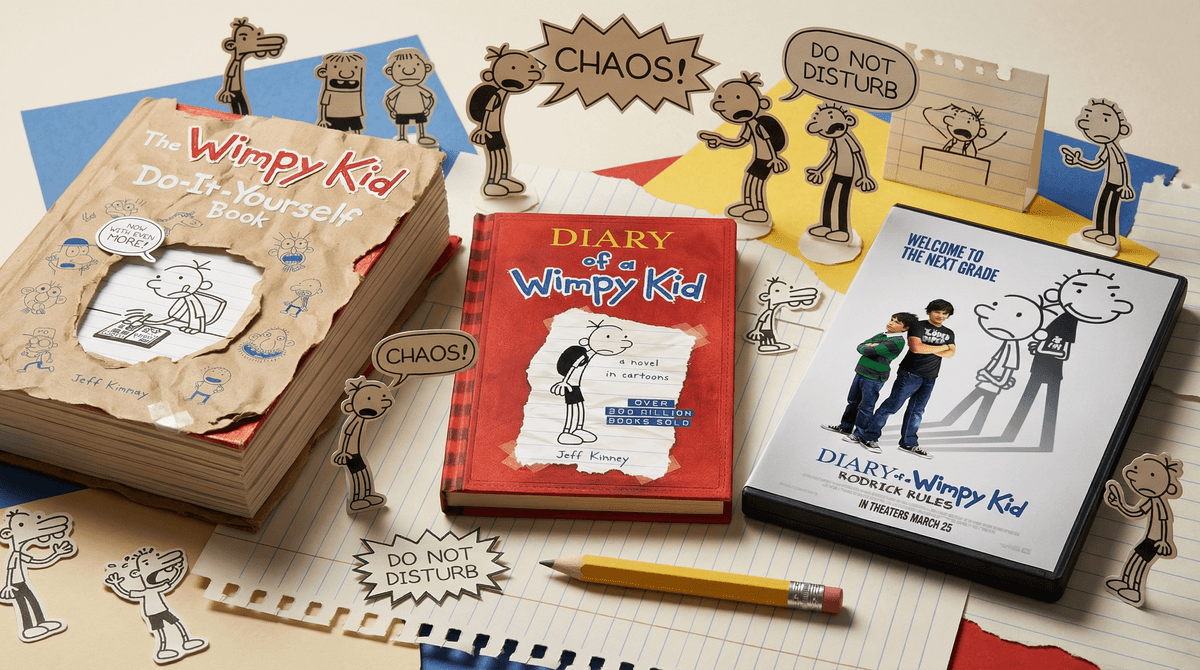
Diary of a Wimpy Kid is a wildly popular book series by Jeff Kinney that follows middle schooler Greg Heffley as he navigates the social minefield of adolescence. Written in a journal format with stick-figure illustrations on every page, these books have sold over 250 million copies worldwide and spawned movies, an animated Disney+ series, and countless spin-offs.
What started in 2007 has become a cultural phenomenon that's still going strong—there are now 18+ books in the main series, plus supplemental books like "Do It Yourself" journals that kids absolutely devour. If your child is between ages 7-13, chances are high they've either read these books or their friends have.
The format is genius: short chapters, tons of illustrations, and a protagonist who's deeply flawed but somehow relatable. Greg isn't a hero. He's often selfish, occasionally mean to his best friend Rowley, and constantly scheming to become popular. And that's exactly why kids connect with him.
Let's be real—Greg Heffley is kind of a terrible person sometimes. He throws his best friend under the bus, he's embarrassed by his family, and he's obsessed with status and popularity. So why do kids love him?
Because he's honest about the messy parts of growing up. Greg says the quiet parts out loud. He admits he doesn't want to sit with the "uncool" kids at lunch. He confesses he's jealous of his older brother Rodrick. He's terrified of the Cheese Touch (a playground contamination game that will make perfect sense to any middle schooler).
The books also nail the awkwardness of middle school in a way that feels validating rather than preachy. Greg's not learning heartwarming lessons about kindness—he's just trying to survive. Kids see themselves in his struggles, even if (hopefully) they're making better choices than he does.
Plus, the format makes reading feel accessible. Reluctant readers especially love these books because they don't look intimidating. Half the pages are illustrations, the font is handwriting-style, and chapters are short. It's reading that doesn't feel like work.
Here's where it gets interesting for us as parents: these books can actually be conversation gold if we approach them right.
Greg is not a role model. And that's okay—actually, that's the point. He's a character study in what happens when you prioritize popularity over authenticity, when you treat your best friend poorly, and when you're so focused on yourself that you miss what really matters.
The key is reading these books WITH your kid (at least the first few) and talking about Greg's choices. Questions like:
- "What do you think about how Greg treated Rowley there?"
- "Have you ever felt pressure to act differently around certain friends?"
- "Why do you think Greg cares so much about being popular?"
These books give you a low-stakes way to talk about peer pressure, friendship, and authenticity without it feeling like a lecture. You're just discussing a character, not interrogating your kid about their own choices.
The "Is This Too Mean?" Question
Some parents worry these books teach kids to be selfish or unkind. Fair concern. Greg does lie, manipulate, and act selfishly—a lot. But here's the thing: consequences matter in these books. Greg's schemes usually backfire. His selfishness often leaves him lonely or in trouble. The books don't celebrate his behavior; they document it.
That said, younger or more literal-minded kids (especially ages 7-9) might need more guidance to understand that Greg's choices aren't meant to be copied. If your child tends to mimic what they read without critical thinking, you might want to wait until they're a bit older or be more hands-on with discussions.
Ages 7-9: These kids can usually handle the reading level, but may need help understanding that Greg's behavior isn't admirable. Read together and talk about character choices. Watch for whether your child is laughing WITH Greg or AT him—there's a difference.
Ages 10-12: The sweet spot. These kids are living Greg's world—they understand the social dynamics he's navigating. They're more likely to see his flaws and make comparisons to their own lives. Great opportunity for conversations about the kind of friend they want to be.
Ages 13+: Most kids age out naturally, though some enjoy revisiting the books for nostalgia. At this age, they can definitely analyze Greg's character critically and might even enjoy discussing why they found him relatable when they were younger.
Content Notes
The books are pretty tame content-wise—no violence, no romance beyond innocent crushes, no substance use. The "edgiest" content is:
- Bathroom humor (farts, underwear jokes—standard middle school stuff)
- Mild insults and name-calling between characters
- Some scary moments (like the story of the "Pig" in The Long Haul)
- Family conflict (sibling rivalry, parent frustration)
Nothing that would surprise you, but worth knowing if your family has different boundaries around humor or respect.
The book series has been adapted multiple times—there were live-action movies (2010-2017) and more recently, animated films on Disney+. The adaptations are generally faithful to the books and carry the same themes.
If your kid loves the books and wants to watch the movies, they're a decent family movie night option. Just know that seeing Greg's behavior acted out on screen can feel different than reading about it—some parents find the movies make his selfishness feel more uncomfortable to watch.
Diary of a Wimpy Kid isn't perfect, and neither is Greg Heffley. But that's what makes these books valuable. They give us a window into how kids think about friendship, popularity, and fitting in—and they give us language to talk about these topics without it feeling heavy.
Instead of asking "Are these books good for my kid?" try asking "How can I use these books to understand my kid better?" Because when your child is laughing at Greg's latest scheme or cringing at how he treated Rowley, they're processing their own social world.
These books have gotten millions of kids reading who otherwise wouldn't pick up a book. That's worth something. And if they spark conversations about empathy, authenticity, and the kind of person your kid wants to be? That's worth even more.
If your kid is reading these: Ask them which character they relate to most and why. You might be surprised by their answer—and it'll tell you a lot about how they see themselves in their own social world.
If you're considering these books: Start with book one and read it together. See how your kid responds and whether they're picking up on the fact that Greg's choices have consequences.
Want to dig deeper? Find advice on talking to kids about friendship and peer pressure or explore other books that tackle similar themes.
And remember: if your kid is reading anything voluntarily, you're already winning.