

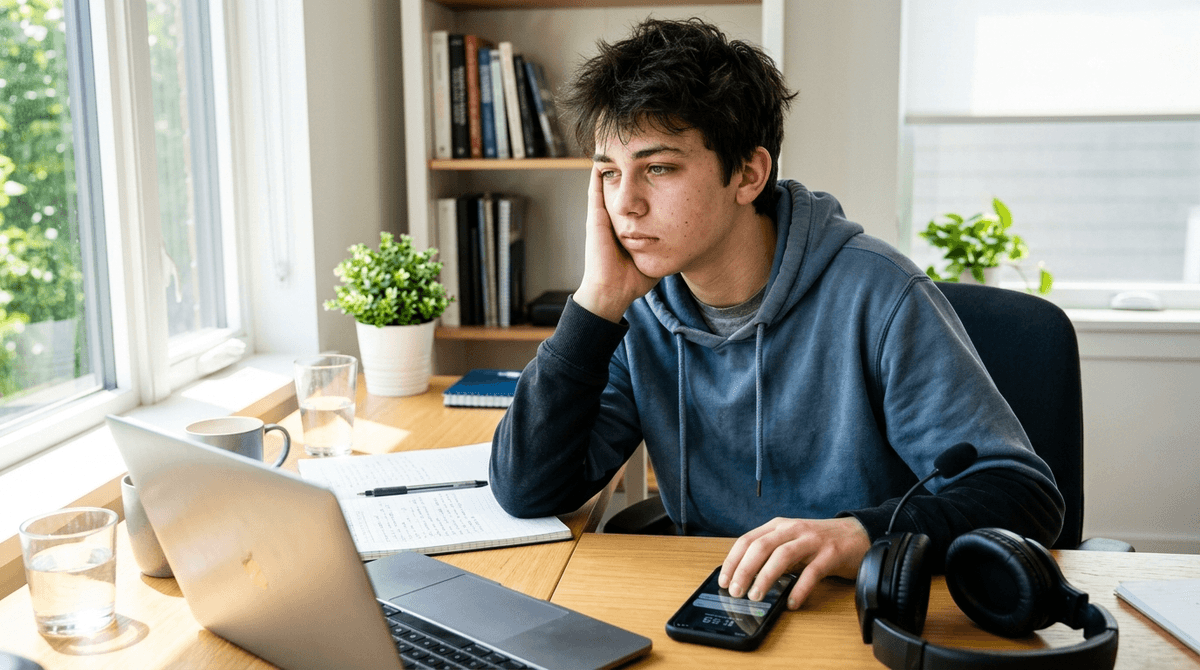
Daytime grogginess is the primary gateway to emotional spirals and a self-reinforcing loop of video game use. Stop looking at screen time as the standalone cause of behavior issues and start looking at daytime alertness as the early warning system.
Daytime dysfunction and poor sleep trigger a rise in emotional symptoms and hyperactivity six months later, creating a self-reinforcing loop where gaming and restlessness fuel one another.
This shifts the focus for parents from "screen limits" to "sleep hygiene." Most digital wellness advice centers on the number of hours a child spends on a device, but this data suggests that the child's level of alertness during the day is the actual fuse. If a teenager is struggling to stay awake or alert during school or extracurriculars, a decline in their mental health is likely already in motion. Prioritizing a sleep environment that ensures daytime alertness is a more effective intervention for emotional stability than simply seizing a smartphone after a blow-up occurs.
Researchers wanted to move past the "chicken or the egg" debate regarding whether screens cause bad sleep or bad sleep causes screen use. By identifying "bridge symptoms"—the specific behaviors that link sleep, screens, and mental health—they could see which behavior started first and which ones acted as "hubs" that dragged other problems along with them. They focused on how these traits interact over time rather than just looking at a single snapshot of a child's life.
The findings highlight a sophisticated network of triggers that determine a teen's behavioral trajectory over a six-month period.
- Daytime dysfunction is the primary bridge. When adolescents struggle to stay awake or function during the day, it serves as a direct predictor of increased emotional symptoms and hyperactivity half a year later.
- Video games and hyperactivity are a "feedback loop." A bidirectional relationship exists where more gaming predicts more hyperactivity, and higher hyperactivity leads to even more gaming. They feed each other in a cycle that becomes harder to break the longer it continues.
- Emotional symptoms are central hubs. Once a child begins showing signs of emotional distress, it acts as a "central" issue that is most likely to trigger a variety of other behavioral problems across the network.
- Helping others is a protective shield. Prosocial behavior—like volunteering or helping friends—was the only factor that negatively predicted future hyperactivity, suggesting it can "cancel out" some behavioral risks.
- The patterns are universal across genders. Despite common stereotypes about "gamer boys" or "emotional girls," the network of how sleep, screens, and emotions interact was remarkably consistent for both boys and girls.
The study implies that "screen addiction" is often a misdiagnosis of a sleep-deprived child looking for easy, low-energy stimulation. If a parent only addresses the screen use without fixing the underlying "daytime dysfunction," the child remains in a vulnerable state. The emotional symptoms will simply find a different outlet because the "bridge"—the fatigue that prevents emotional regulation—is still intact. This suggests that the most "addictive" quality of a video game might be its ability to provide a hit of dopamine to a brain that is too tired to engage in more demanding social or physical activities.
The findings are based on self-reported data from 4,800 Chinese students with an average age of 16. While the sample size is large and the analysis is sophisticated, adolescents can be notoriously poor at estimating their own sleep quality or exact screen hours compared to objective tracking data. Additionally, the cultural context of high academic pressure in China may influence the specific ways "daytime dysfunction" manifests compared to students in other regions. The six-month window is also relatively short; it shows us the "spark," but not necessarily the "forest fire" of late adolescence.
- If your child is frequently napping or struggling to stay alert after school... prioritize a consistent wake-up time and morning sunlight exposure over strict evening screen bans, as daytime alertness is the strongest predictor of future emotional stability.
- If you see your child caught in a cycle of restless energy and marathon gaming... break the loop by introducing high-engagement physical activities, as hyperactivity and video games reinforce each other in a closed circuit.
- If you want a functional tool to manage hyperactive tendencies... encourage your teen to take on a "helper" role in the community or family, as prosocial activities were found to specifically lower subsequent hyperactive traits.
- If you are monitoring for signs of a mental health decline... look for "daytime dysfunction" (heavy fatigue or nodding off) as the earliest warning sign, often appearing months before more obvious emotional symptoms take hold.
Focus on how your child functions during the day to protect how they feel at night. If they are alert and engaged during daylight hours, the risks associated with screen use and hyperactivity drop significantly.
Li L, Lu X, Jiang G et al. (2026). Sleep traits, screen use, and emotional and behavioral problems: A short-term longitudinal cross-lagged panel network analysis. Addictive behaviors. doi:10.1016/j.addbeh.2026.108759 — pubmed.ncbi.nlm.nih.gov