

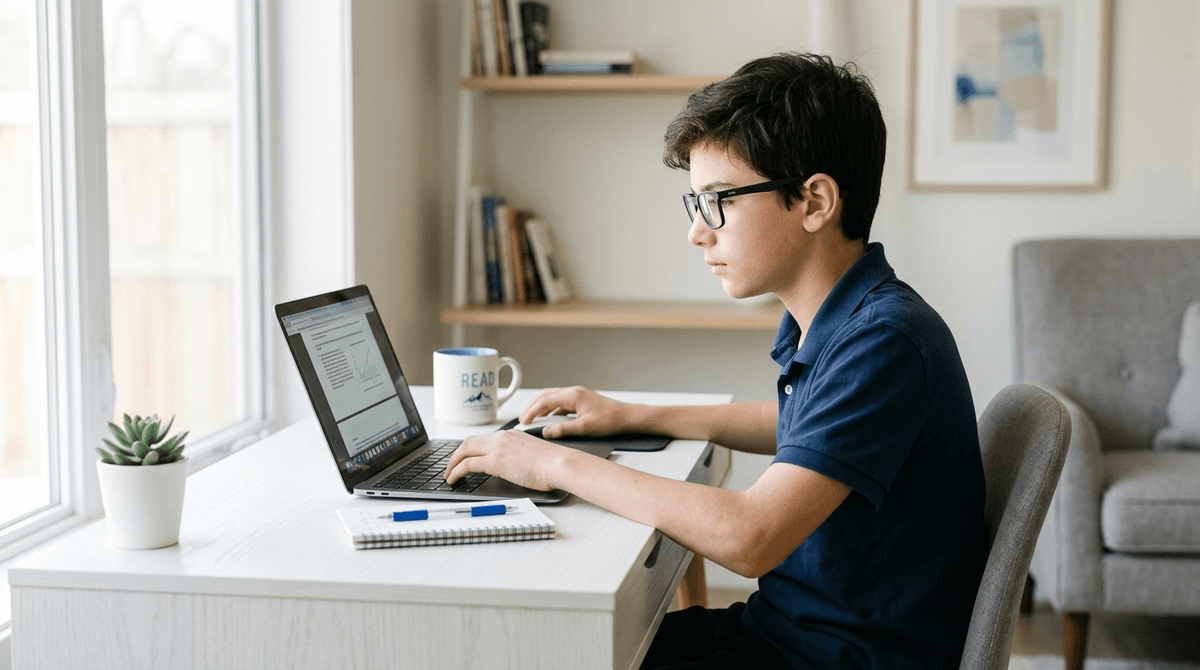
Kids who spend hours staring at screens are more than twice as likely to develop nearsightedness, with computers posing a significantly higher risk to developing eyes than smartphones or televisions.
High screen time doubles the risk of myopia in children and adolescents, but the type of device matters more than we previously thought. Computers are the primary culprit, showing a significantly stronger link to eye damage than smartphones or TVs.
Nearsightedness isn't just about needing glasses; it is a permanent change in the shape of the eyeball that can increase the risk of serious vision issues like retinal detachment later in life. This finding changes the "screen time" conversation from a general limit to a specific focus on how kids are consuming content. If your child is doing the bulk of their schoolwork or gaming on a laptop, they are at a much higher risk than if they were watching the same content on a television across the room.
Global rates of nearsightedness are skyrocketing, and health experts expect half the world’s population to be myopic by 2050. Researchers are trying to move beyond general warnings to identify exactly which digital habits are the most damaging. This meta-analysis of over 100,000 children sought to distinguish between the small screen in a hand and the monitor on a desk to see if the "near-work" of computing is the true driver of the epidemic.
Children with high screen usage are roughly 2.4 times more likely to have myopia than those with low usage. The risk is cumulative and measurable: every additional hour of daily screen time is associated with a 7% increase in the risk of developing myopia.
While the study found a "modest" link between television use and eye issues, computers were the standout threat. In cross-sectional data, computer use was associated with an eight-fold increase in the odds of nearsightedness. Surprisingly, smartphone use did not reach statistical significance in this specific subgroup analysis, likely because the intensity and duration of computer sessions far exceed the typical "pick-up-and-put-down" nature of phone use.
The "computer effect" is likely a combination of proximity and persistence. When a child uses a computer, they tend to stay at a fixed focal distance for long, uninterrupted stretches. This prevents the eye's ciliary muscles from relaxing. Smartphones are often used in shorter bursts or while moving, which provides the eyes with "micro-breaks" that computers typically don't allow. The problem isn't just the light from the screen; it's the physical act of "locking" the focus on a near object for hours at a time.
The findings are based on observational data, which means they identify a strong connection but don't strictly prove that screens cause the eye to elongate. Because much of the data was collected via self-reported questionnaires, the actual amount of screen time might be even higher than reported, as parents and children often underestimate their digital usage. Additionally, the researchers noted a "publication bias," where studies showing no link between screens and eyes are less likely to be published than those showing a major risk.
- If your child uses a laptop for schoolwork or gaming, move the device at least 20 inches away and encourage them to use an external monitor and keyboard to force a greater distance between their eyes and the screen.
- If you are choosing between a movie on a tablet or a movie on the living room TV, choose the TV to increase the focal distance and reduce the strain on the eye's focusing mechanism.
- If your child is on a device for more than an hour, enforce the "20-20-20 rule": every 20 minutes, they must look at something 20 feet away for at least 20 seconds to allow the eye muscles to reset.
- If you can cut just one hour of screen time from the daily routine, you statistically lower your child's myopia risk by roughly 7%.
Computers pose a far greater risk to your child’s vision than phones or televisions, but the total "dose" of daily screen time is the ultimate driver of nearsightedness. You don't need to ban technology, but you should prioritize moving digital activity to larger, more distant screens and mandating frequent breaks to look at the physical world.
Zong, Zhiqiang, Zhang, Yaxin, Qiao, Jianchao et al. (2024). The association between screen time exposure and myopia in children and adolescents: a meta-analysis. BMC Public Health. doi:10.1186/s12889-024-19113-5 — link.springer.com