

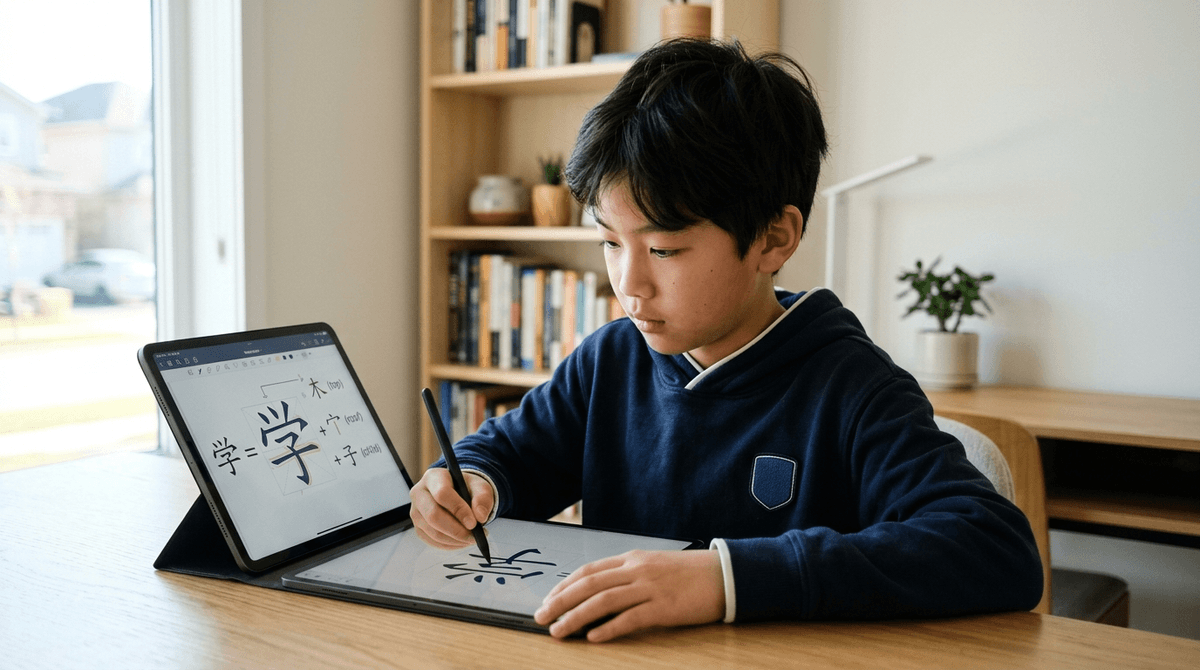
For older elementary students learning Chinese, reading mastery depends more on understanding how word parts fit together than on memorizing sounds or guessing from context.
Prioritize the internal logic of how characters form words to help third through fifth graders master Chinese reading. While younger children rely on sounds, older students need to understand "meaning-bearing parts" to truly grasp what they are reading.
Rote memorization has a ceiling. If you are still drilling stroke order and pronunciation with a ten-year-old, you are missing the lever that actually moves the needle on comprehension. Once the basics are settled, a child's ability to decode the "why" behind a character's construction is what allows them to tackle complex texts.
Educators have long debated whether reading is a visual game or a logic game. As children move into upper elementary, the sheer volume of new vocabulary makes memorization impossible. Researchers wanted to know which specific mental tools—sound, visual patterns, or word structure—actually help a child understand a paragraph.
Morphological awareness—understanding how word parts combine to create meaning—is the single most consistent predictor of reading success in grades 3, 4, and 5.
- Sound and visual recognition skills flatline in their impact as children get older.
- The ability to guess a word's meaning from its context (lexical inferencing) doesn't become a significant factor until 5th grade.
- For the 240 students studied, "word logic" was the dominant engine for comprehension.
We often tell kids to "guess from context" when they hit a word they don't know, but this study suggests that advice is mostly useless for third and fourth graders. They simply don't have the linguistic bandwidth to juggle the sentence's meaning while simultaneously solving a mystery word. They need the structural tools to "break" the word open first.
The researchers looked at different groups of kids at one point in time, rather than following the same kids over three years to track their growth. The sample of third graders was also relatively small, with only 53 students. Most importantly, Chinese is a meaning-based language; these findings do not translate directly to alphabetic languages like English, where sounding out words remains a primary tool for much longer.
- If your child is stuck on a new Chinese word, ask them to identify the radical or the "meaning part" instead of just telling them to sound it out.
- If a third or fourth grader cannot guess a word from the rest of the sentence, provide the definition immediately rather than forcing them to use context clues they aren't yet developmentally ready to use.
- If you are choosing supplemental workbooks, select materials that group characters by their components rather than by arbitrary themes like "at the park" or "my family."
- If your fifth grader is struggling with comprehension, practice "context clue" games with them, as this is the specific age where that skill finally starts to impact their scores.
Stop treating Chinese reading as a memory test and start treating it as a logic puzzle. By the time a child is nine or ten, their progress depends on their ability to see the "building blocks" inside every character.
Cheng, Xi, Zhang, Haomin (2023). Contributions of Metalinguistic Awareness and Lexical Inference to Reading Comprehension in Upper-Elementary Chinese Students. Journal of Research in Reading. — http://dx.doi.org/10.1111/1467-9817.12415