

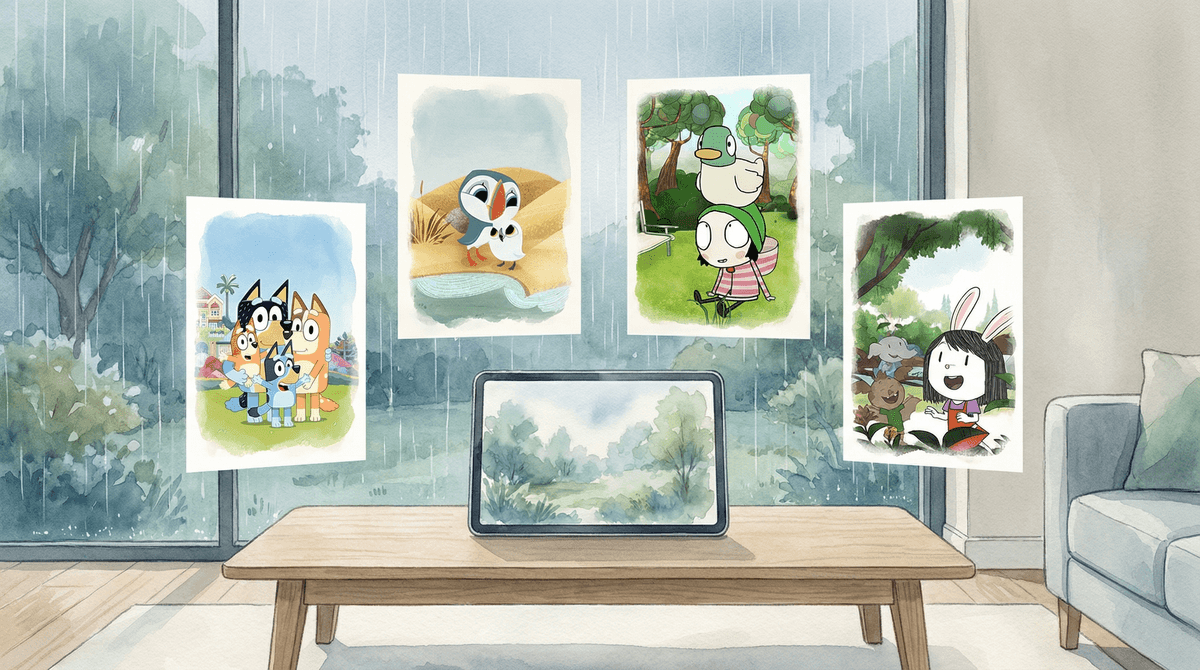
Calmer Alternatives to Lucas the Spider for Anxious Toddlers
If Lucas the Spider is causing nighttime anxiety or fear responses in your sensitive 2-year-old, you're not alone. Despite being marketed as adorable, those big spider eyes and unpredictable movements can be genuinely unsettling for some toddlers. Here are gentler alternatives that deliver the same sweetness without the creepy-crawly factor:
Ultra-calming picks:
- Bluey (Ages 2+)
- Puffin Rock (Ages 2-5)
- Sarah & Duck (Ages 2-6)
Gentle nature content:
- Octonauts (Ages 3+)
- Elinor Wonders Why (Ages 3-6)
Lucas the Spider has a 4.8-star rating and parents rave about how it "makes spiders cute." And for many kids, it absolutely does! But here's what's happening with sensitive toddlers: the spider design itself triggers an instinctive fear response that no amount of big eyes and sweet voice can override.
At age 2, kids are developmentally wired to be cautious about things that look "off" – and eight legs, rapid movements, and those giant reflective eyes hit multiple alarm bells in a toddler brain that's still learning what's safe and what's not. Some kids watch Lucas and think "friend!" Others watch and have nightmares for a week. Neither response is wrong – it's just biology.
If your toddler is in the second camp, you don't need to push through it or use it as "exposure therapy." There are dozens of shows that teach the same lessons about friendship, curiosity, and problem-solving without the arachnid anxiety.
Before we get to recommendations, let's talk about what "calming" actually means for 2-year-olds:
Predictable pacing – No sudden scene changes, loud noises, or jarring music. The show moves at a pace that matches how toddlers actually process information.
Soft color palettes – Bright colors are fine, but there's a difference between "cheerful" and "overstimulating." The best calming shows use watercolor aesthetics, muted tones, or natural lighting.
Gentle conflict – Problems get solved through talking, thinking, or asking for help. No villains, no danger, no high-stakes drama.
Familiar settings – Home, parks, neighborhoods. Not outer space, not fantasy realms (yet), just places that feel safe and recognizable.
Slow, clear dialogue – Characters speak at a pace toddlers can follow, with pauses for processing.
These shows are specifically designed to be soothing. They're the screen time equivalent of a weighted blanket.
Ages: 2+
Bluey is the gold standard for calming, developmentally appropriate content. Every episode is about everyday family life – playing games, going to the park, dealing with disappointment, learning to share. The animation is soft and watercolor-esque, the music is gentle, and the pacing is perfect for toddler attention spans.
Why it works: The conflicts are real but small. Bluey wants to play a certain game, but Bingo wants to play something else. They figure it out. That's the whole episode. No spiders, no scares, just life.
Parent bonus: You might actually enjoy watching this. The writing is surprisingly clever and emotionally intelligent. Many episodes will make you tear up (in a good way).
Ages: 2-5
This Irish animated series follows Oona the puffin and her little brother Baba as they explore their island home. It's narrated by Chris O'Dowd in the most soothing voice imaginable. The animation is soft, the stories are gentle, and every episode teaches something about nature without being preachy.
Why it works: The entire vibe is "cozy nature documentary for toddlers." Oona and Baba encounter seals, crabs, and other animals, but everything is friendly and curious. No predators, no danger, just exploration.
Heads up: Only two seasons exist, and it's not on every streaming platform. Currently on Apple TV+ and sometimes Amazon Prime. Worth hunting down.
Ages: 2-6
A British show about a girl named Sarah and her best friend Duck (who is, yes, a duck). They go on small adventures, solve gentle problems, and interact with quirky neighbors. The animation style is minimalist and calming, the music is soft, and the narrator has the kind of voice that could read a phone book and make it interesting.
Why it works: The pace is almost meditative. Scenes linger. Characters pause. There's space for your toddler's brain to process what's happening. It's the opposite of overstimulating.
Cultural note: Very British. Your kid might start saying "quite" and "lovely" and honestly? Adorable.
If you liked the "learning about animals" aspect of Lucas the Spider, these shows deliver nature education without any creepy-crawly anxiety.
Ages: 3+
A team of animal adventurers explore the ocean, rescue sea creatures, and learn about marine biology. Each episode follows a predictable structure: discover a creature, learn about it, help it with a problem, everyone's happy.
Why it works: The ocean creatures are cute and stylized (not realistic), the team is always helpful and kind, and the conflicts are always solvable. Plus, your kid will learn actual facts about real animals.
Slight caveat: There is occasionally mild peril (a creature is stuck, the Octonauts need to rescue it), but it's always resolved quickly and calmly. If your toddler is extremely sensitive, preview an episode first. Most 2-year-olds handle it fine.
Ages: 3-6
A PBS show about Elinor the bunny and her friends who explore nature and ask questions about how things work. It's science education disguised as gentle storytelling. The animation is soft and colorful, and the whole vibe is "curious, not scary."
Why it works: Elinor encounters insects, plants, and animals, but everything is presented through a lens of wonder and investigation. "Why do birds sing?" "How do ants carry heavy things?" The questions are interesting, the answers are age-appropriate, and nothing is frightening.
Parent bonus: Great for building scientific thinking. Elinor models the process of observing, asking questions, and testing ideas.
If you specifically want something with a similar "adorable creature having adventures" vibe as Lucas, but without the spider part:
Ages: 2-4
A little boy in blue and his animal friends (a duck, an elephant, a bird) have simple adventures in a minimalist white space. There's a narrator who gently guides the action and asks questions.
Why it works: The visual environment is as simple as it gets – characters on a white background. Zero visual clutter. The stories are basic (Pocoyo learns to share, Pocoyo plays hide and seek), and the tone is consistently gentle.
Heads up: The early seasons are better. Later seasons added more characters and more chaos. Stick with seasons 1-2.
Ages: 2-5
Based on the classic Dutch picture books, Miffy is a little rabbit who explores her world with curiosity and kindness. The animation is simple and clean, the stories are gentle, and the pacing is slow in the best possible way.
Why it works: Miffy's world is safe, predictable, and calm. She visits the playground, helps her dad in the garden, makes cookies with her mom. That's it. That's the show. It's lovely.
Ages: 1-3
Four bird-like creatures explore the world and learn about concepts like "up and down," "in and out," "full and empty." They don't talk much – mostly they observe and experiment. It's almost like watching toddlers learn through play, but the toddlers are colorful bird creatures.
Why it works: Minimal dialogue, maximum observation. The Twirlywoos watch real people doing real things (shot in live action), then try it themselves. It's engaging without being overstimulating.
If you've been using YouTube for Lucas the Spider clips, be cautious about letting the algorithm take over. YouTube's autoplay for toddler content is notoriously unreliable – one minute it's cute animal videos, the next it's... not.
Better YouTube options for this age:
- Hey Bear Sensory – Gentle animations with soft music, designed for sensory calming
- Pinkfong – The Baby Shark people also make lots of gentle animal content
- Super Simple Songs – Classic nursery rhymes and simple animations
Or better yet: Stick with curated streaming services like PBS Kids Video (free app), Disney+ (Bluey lives here), or Apple TV+ (Puffin Rock) where you don't have to worry about weird algorithm surprises.
For 2-year-olds specifically:
- Keep episodes short (7-11 minutes is ideal)
- Watch together when possible – your presence makes everything less scary
- Pause and talk about what's happening ("Look, Bluey is feeling sad. What do you think will help?")
- Don't force it – if a show isn't working, move on
Signs a show is too much:
- Your toddler asks to turn it off
- They seem agitated or anxious during or after
- They bring up scary elements later ("Where's the spider?")
- They have trouble sleeping after watching
Signs a show is just right:
- They're engaged but calm
- They reference characters positively ("Like Bluey!")
- They can watch without needing constant reassurance
- They transition away from screen time without meltdowns
"But other kids love Lucas the Spider!"
Totally true. And irrelevant. Your kid is not other kids. Some toddlers think spiders are fascinating. Some think they're terrifying. Neither response needs to be fixed or changed. There's no developmental milestone that says "must enjoy anthropomorphic spiders by age 2."
"Should I use this as exposure therapy?"
No. Exposure therapy is a real clinical technique, but it's not "force your toddler to watch something that scares them." If your child has a genuine spider phobia that's interfering with daily life, talk to a pediatrician. If they just don't like a particular cartoon, give them different cartoons.
"Are we making them too sensitive?"
You're making them feel heard and safe. That's the opposite of "too sensitive." A 2-year-old who learns "my parents listen when I say something bothers me" becomes a 12-year-old who tells you when something online makes them uncomfortable. You're building trust, not weakness.
"How do I explain why we're not watching Lucas anymore?"
Keep it simple: "We're going to watch different shows now. Let's try Bluey!" Toddlers don't need a dissertation on fear responses and individual differences. They just need a new option that feels better.
Lucas the Spider is a well-made show with good intentions, but it's not a universal toddler experience. If your 2-year-old finds it unsettling, that's completely normal and developmentally appropriate. There are dozens of shows that deliver the same sweetness, curiosity, and gentle lessons without triggering fear responses.
Start with Bluey – it's the most universally beloved toddler show for a reason. Branch out to Puffin Rock or Sarah & Duck if you want something even more calming. And if you want nature content, Elinor Wonders Why will scratch that educational itch without any spider-shaped anxiety.
Your kid will learn about friendship, kindness, and curiosity from lots of different characters. They don't need to learn it from a spider if the spider gives them nightmares.
This week:
- Pick one show from the ultra-calming tier and watch one episode together
- Ask your toddler if they liked it (they'll let you know)
- Remove Lucas the Spider from your streaming queue so it doesn't auto-suggest
This month:
- Rotate through 2-3 different calm shows to see what resonates
- Notice what time of day your toddler handles screen time best (morning? after nap? definitely not before bed?)
- Check out calming shows for toddlers for even more options
Remember: Screen time decisions are not moral decisions. You're not a better or worse parent based on which cartoon your toddler watches. You're just trying to find something that doesn't cause nightmares. That's a reasonable goal.