

Books with Autistic Characters: A Parent's Guide to Representation in Literature
Let's talk about representation in books — specifically, stories that feature autistic characters. And I'm not just talking about books about autism as a teaching tool (though those have their place). I'm talking about stories where autistic kids are the heroes, the detectives, the dragon riders, the friends having adventures. Stories where autism is part of who they are, not the entire plot.
Here's why this matters: Every kid deserves to see themselves in the stories they read. For autistic kids, finding characters who stim, who struggle with sensory overload, who think differently — that's powerful. It's the literary equivalent of "oh, there are other people like me."
And for neurotypical kids? These books build empathy and understanding in a way that no "let me explain autism to you" conversation ever could. They normalize neurodiversity. They show that different brains work in different ways, and that's just... how humans are.
About 1 in 36 kids in the U.S. is diagnosed with autism. That means in a typical classroom of 25 kids, you're likely looking at at least one autistic student, probably more. Your kid knows autistic peers, whether they realize it or not.
But here's the thing: representation in children's literature has been historically terrible. For years, autistic characters were either inspiration porn ("look how they overcame their disability!") or walking stereotypes (the genius who can't make eye contact and loves trains).
The good news? The last decade has brought us significantly better representation. We now have books written by autistic authors, featuring autistic characters who are fully realized people — funny, flawed, interesting, and yes, autistic.
Not all books with autistic characters are created equal. Here's what to look for:
Authentic voices: Books written by autistic authors tend to get the details right — the internal experience, not just the external behaviors. Elle McNicoll, Keiko Tobe, and Ginny Myers Sain are examples of authors who write from lived experience.
Nuanced characters: The character should be more than their diagnosis. They should have interests, relationships, goals, and personality traits that exist independently of being autistic.
Avoiding stereotypes: Not every autistic character needs to be a math genius or obsessed with trains. Autism presents differently in different people, especially in girls (who are often underdiagnosed because they don't fit the stereotypical profile).
Respectful language: Books that use identity-first language ("autistic person") rather than person-first language ("person with autism") tend to align better with how many autistic adults prefer to be described — though this varies by individual.
Picture Books (Ages 4-8)
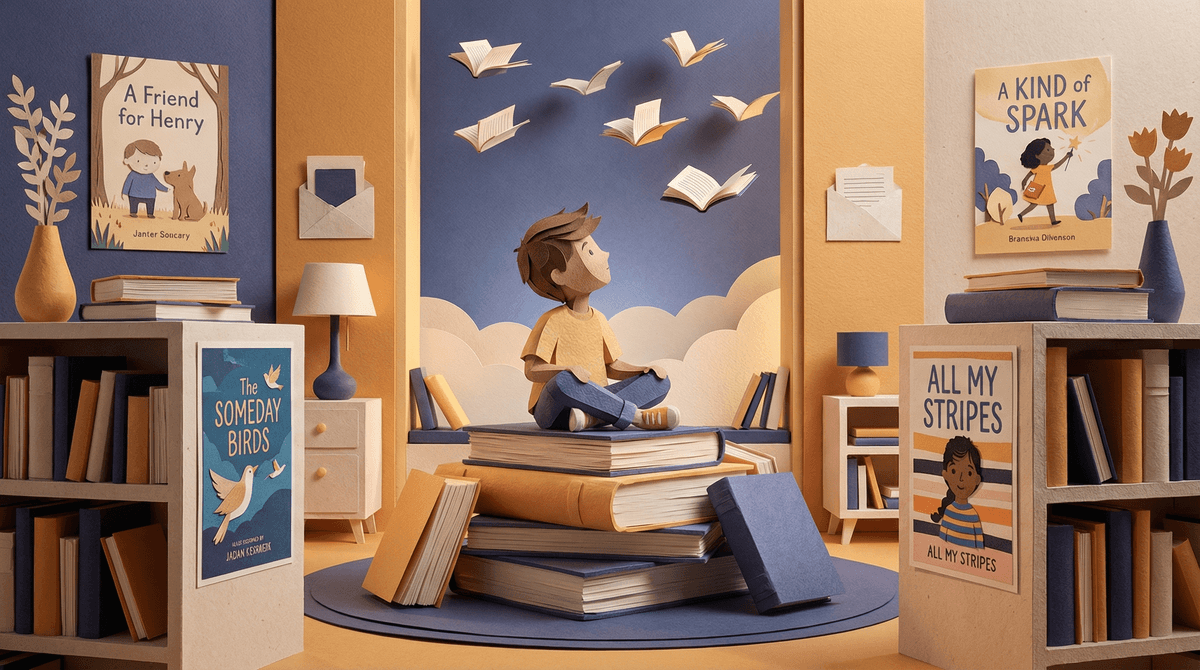
A Friend for Henry by Jenn Bailey — Henry is autistic and looking for a friend who's "just right" for him. Sweet, simple, and doesn't make autism the problem to solve.
All My Stripes by Shaina Rudolph — A young zebra with autism learns to appreciate all his different "stripes" (qualities) that make him who he is. Good conversation starter, though slightly more didactic.
I Talk Like a River by Jordan Scott — While this is about stuttering, not autism, it beautifully captures the experience of communication differences and sensory overwhelm in a way that resonates with many autistic kids.
Chapter Books (Ages 8-12)
A Kind of Spark by Elle McNicoll — Addie is autistic and fighting to get a memorial for the women accused of witchcraft in her Scottish town. Written by an autistic author, this one is gold standard for representation. Addie is fierce, funny, and fully realized.
Mockingbird by Kathryn Erskine — Caitlin is dealing with the death of her brother while navigating the world as an autistic kid. This one's been around since 2010 and holds up well. Fair warning: it deals with heavy themes including gun violence.
The Someday Birds by Sally J. Pla — Charlie is on a road trip to see his injured father, coping with change and uncertainty. The bird-watching angle gives him a special interest that drives the plot forward naturally.
Rain Reign by Ann M. Martin — Rose loves homonyms and her dog, Rain. When Rain goes missing during a storm, Rose has to navigate a world that doesn't always make sense to her. Beautiful and heartbreaking.
Middle Grade/YA (Ages 12+)
The Curious Incident of the Dog in the Night-Time by Mark Haddon — The classic. Christopher is a math genius investigating a dog's death. Note: Haddon is not autistic, and some autistic readers find aspects of this dated or problematic, but it's still widely read and discussed.
On the Edge of Gone by Corinne Duyvis — A Dutch sci-fi thriller about a comet hitting Earth, featuring an autistic protagonist. Written by an autistic author, this one shows autism in a survival situation without making it a liability.
Queens of Geek by Jen Wilde — One of the main characters is autistic, and the book is set at a comic convention. Fun, romantic, and refreshingly not trauma-focused.
Graphic Novels
El Deafo by Cece Bell — While this is about deafness, not autism, it's an excellent example of how to portray disability as part of identity without making it the whole story. Many autistic kids relate to Cece's experiences.
Speak by Laurie Halse Anderson (graphic novel adaptation) — The main character isn't explicitly autistic, but many autistic readers identify with her selective mutism and trauma response.
Not every book will resonate with every kid. Autism is a spectrum, and what feels authentic to one autistic reader might feel completely off to another. That's okay. Let your kid guide you on what feels right.
Some books are for autistic kids, some are for neurotypical kids, some are for both. A book like A Kind of Spark is powerful for autistic kids who see themselves in Addie. It's also powerful for neurotypical kids learning what it's like to be autistic in a neurotypical world. Know which audience you're reading for (or with).
Representation isn't just for autistic kids. If your child is neurotypical, these books are still valuable. They build empathy. They normalize neurodiversity. They prepare kids to be better friends, classmates, and humans.
Ask your librarian. Seriously. School and public librarians are staying on top of this stuff and can recommend books based on your kid's age, reading level, and interests. They're an underused resource.
Books with authentic autistic characters aren't just "nice to have" — they're essential. For autistic kids, they're mirrors. For neurotypical kids, they're windows. And for all kids, they're a reminder that there's no one way to be human.
Start with one book. See how it goes. Talk about it. Ask questions. Listen to what your kid notices and connects with. And then read another one.
Because here's the thing: the more we normalize neurodiversity in the stories we tell, the more we normalize it in the world we live in. And that benefits everyone.
- Check out alternatives to screen time for more book recommendations across genres
- Visit your local library and ask for their neurodiversity section (most have one now)
- Let your kid's interests guide you — if they love mystery, find an autistic detective. If they love fantasy, find an autistic dragon rider
- Consider audiobooks for kids who struggle with reading but love stories
- Talk to your kid about what representation means to them
