

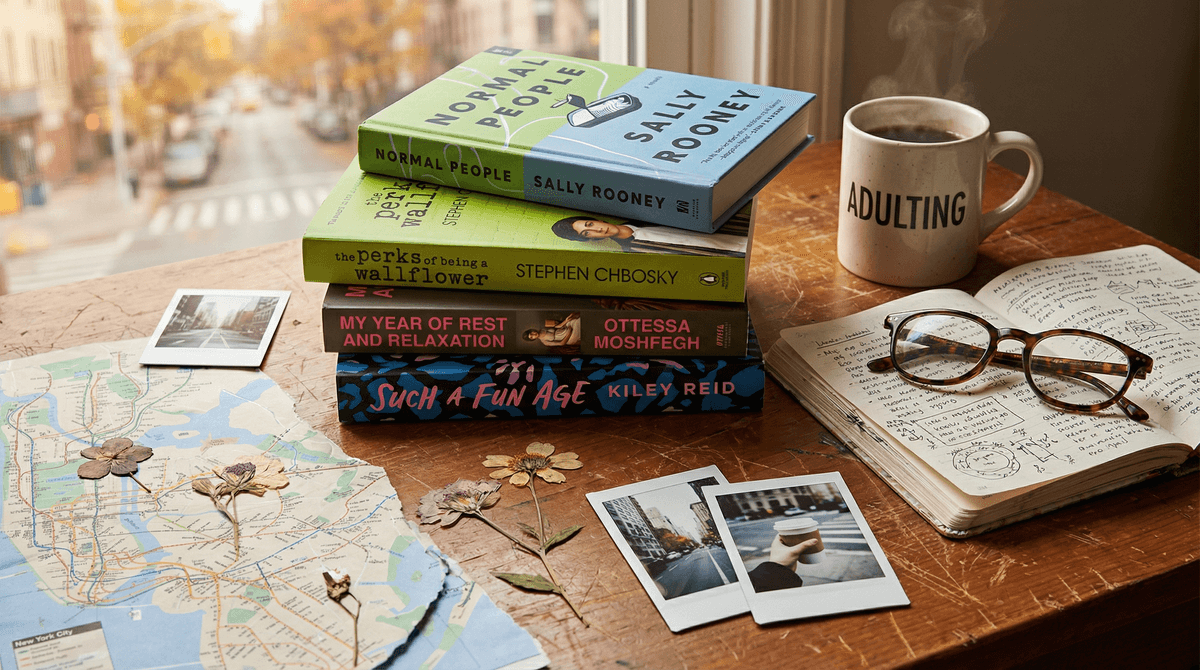
Books That Feel Like Being 22 and Figuring Your Life Out
TL;DR: Your teen is probably closer to 22 than you think—emotionally, anyway. These coming-of-age books capture the messy transition from "someone's kid" to "actual adult" and might be exactly what they need right now.
Quick picks:
Screenwise Parents
See allYour 15-year-old isn't 22, but they're already rehearsing for it. They're watching college students on TikTok talk about roommate drama, seeing 20-somethings on YouTube navigate first jobs and breakups, and absorbing a constant stream of "adulting is hard" content. The emotional landscape of early adulthood—the uncertainty, the identity questions, the "what am I doing with my life" panic—is already part of their mental furniture.
Books about being 22 and figuring it out serve a specific purpose that typical YA doesn't always hit: they show the aftermath. Not the triumphant graduation or college acceptance, but the weird, lonely, confusing years that come after. The ones where nobody's giving you a roadmap and every decision feels simultaneously huge and meaningless.
This matters because teens need to know that feeling lost is normal. That not having it figured out at 18 (or 22, or 30) isn't failure—it's just being human.
Ages 16+
This is the gold standard for "what even is my life" literature. Rooney follows Marianne and Connell from their final year of secondary school in Ireland through their college years at Trinity Dublin. The genius here is how she captures the way your sense of self can feel completely different depending on who you're with or where you are.
What makes it work: The prose is spare and observational—no dramatic declarations, just two people trying to figure out who they are and whether they can be together. There's sex (frank but not gratuitous), there's class tension, there's mental health stuff, and there's that very specific feeling of "I have no idea if I'm doing college right."
Parent heads up: Contains sexual content, some of it depicting unhealthy dynamics. Also deals with depression, self-harm, and emotional abuse. This is a book for older teens who can handle complex, sometimes uncomfortable relationship dynamics. Check out our full guide to Sally Rooney's books for more context.
Ages 16+
Rooney's first novel, actually, and it's even more explicitly about being 21 and pretending you have your shit together when you absolutely do not. Frances is a college student in Dublin who performs spoken word poetry with her ex-girlfriend and gets entangled with an older married couple.
What makes it work: It's about the performance of adulthood—going to dinner parties, having "mature" conversations, trying to seem sophisticated—while internally spiraling. Your teen might not be dating married actors, but they'll recognize the feeling of playacting at being grown up.
Parent heads up: Similar content warnings to Normal People—sexual content, including an affair, plus themes of chronic illness and economic anxiety.
Ages 14+
This one's been around since 1999 but it still hits. Charlie is a high school freshman writing letters to an anonymous stranger, chronicling his first year of high school with a group of senior friends who take him under their wing.
What makes it work: It's technically set in high school, but emotionally it's about that threshold moment—the first time you realize you get to choose who you become. Charlie's navigating trauma, sexuality, friendship, and the terrifying freedom of being seen for who you actually are.
Parent heads up: Deals with sexual abuse, mental health crises, drug use, and suicide. The tone is gentle but the content is heavy. Good for mature 14-year-olds and up, but worth a conversation before or after.
Ages 14+
Set in 1986, this follows two misfit high school students in Omaha who fall in love on the school bus. Eleanor's dealing with an abusive home situation; Park is trying to figure out his identity as a half-Korean kid in a white neighborhood.
What makes it work: The 22-year-old feeling here isn't about age—it's about that moment when you realize your family's problems are bigger than you can fix, and you have to decide who you're going to be anyway. It's about recognizing that love can't save you, but it can remind you that you're worth saving.
Parent heads up: Domestic abuse, body image issues, bullying, and some sexual content. The ending is bittersweet in a way that might frustrate teens looking for a neat resolution—which is actually kind of the point.
Ages 17+
A young woman in New York in 2000-2001 decides to spend a year sleeping—literally, with the help of a sketchy psychiatrist and a lot of pills. She's beautiful, thin, went to Columbia, has money, and is absolutely miserable.
What makes it work: It's darkly funny and deeply unsettling. It's about what happens when you have everything you're "supposed" to want and still feel empty. About opting out when opting out isn't really possible. About the specific way privilege can insulate you from consequences while still leaving you completely lost.
Parent heads up: Drug abuse, eating disorders, death, sexual content, and a pretty bleak worldview. This is for mature 17+ readers who can handle satire and moral ambiguity. Not everyone will get it, and that's okay.
Ages 16+
Emira is a 25-year-old Black woman working as a babysitter for a wealthy white family in Philadelphia. After a security guard accuses her of kidnapping the child she's babysitting, the incident is filmed and her employer becomes obsessively invested in "fixing" things.
What makes it work: It's about the performance of progressive values, the weird power dynamics of service work, and that particular 20-something feeling of "I'm too old to be doing this but too broke to do anything else." Emira is trying to figure out what she actually wants versus what she's supposed to want.
Parent heads up: Racial profiling, microaggressions, and some sexual content. Great for teens ready to think critically about class, race, and performative allyship.
Ages 16+
Candace Chen is a first-generation Chinese American working in publishing in New York when a plague starts turning people into zombies who endlessly repeat familiar routines. She's one of the last people in the city, still going to work because... what else is there?
What makes it work: It's a zombie novel that's actually about capitalism, immigration, and the way we sleepwalk through our lives. About the specific millennial/Gen Z experience of going through the motions because the alternative is too terrifying to contemplate. Written in 2018, it hit different during the pandemic.
Parent heads up: Violence, death, some sexual content. The horror elements are more existential than graphic.
Ages 17+
Ava is a 22-year-old Irish woman teaching English in Hong Kong, living rent-free in her wealthy banker boyfriend's apartment while falling for a female lawyer. She's broke, cynical, and performing a version of herself that might not be herself at all.
What makes it work: The voice is sharp and self-aware in a way that feels very 22—knowing you're making questionable choices but making them anyway. It's about economic precarity, queer identity, and the way you can be intimate with someone while keeping them at arm's length.
Parent heads up: Sexual content (both heterosexual and same-sex relationships), alcohol use, and themes of economic anxiety.
Ages 14+
A failed bank robber accidentally takes a group of apartment viewers hostage. It's a comedy about desperation, loneliness, and the way we're all just barely holding it together.
What makes it work: Backman writes with enormous compassion about people who feel like failures. The 22-year-old energy here is in the bank robber's situation—trying to do the right thing, screwing it up spectacularly, and having to live with the consequences while also being weirdly okay?
Parent heads up: Suicide is a significant theme (though handled with care). Some language. Generally one of the gentler options on this list.
Ages 17+
Tess arrives in New York at 22 and gets a job at a prestigious restaurant. It's about that first year of being on your own in a big city, learning a new world's rules, falling for the wrong people, and discovering what you're capable of.
What makes it work: The sensory detail is incredible—you can taste the food, feel the heat of the kitchen, smell the wine. It captures that specific intoxication of being young in New York and feeling like you're finally becoming yourself, even as you're making terrible decisions.
Parent heads up: Drug and alcohol use, sexual content, and toxic relationship dynamics. The restaurant industry is depicted realistically, which means it's not always pretty.
14-15 year olds: Start with The Perks of Being a Wallflower, Eleanor & Park, or Anxious People. These have the emotional complexity without some of the more explicit content.
16-17 year olds: Normal People, Such a Fun Age, Severance, and Exciting Times will resonate with teens who are thinking about college and beyond.
17+ or mature readers: My Year of Rest and Relaxation, Sweetbitter, and Conversations with Friends are for teens who can handle darker themes and moral ambiguity.
The maturity question: These books aren't "inappropriate" in the way we usually mean—they're not gratuitous or exploitative. But they do depict sex, drug use, mental health crises, and bad decisions. The question isn't whether your teen can "handle" the content, but whether they're at a place developmentally where they can engage with complexity and ambiguity. Can they understand that depicting something isn't endorsing it? Can they sit with discomfort?
These aren't self-help books. None of these characters have it figured out by the end. Some of them are barely better off than when they started. If your teen is looking for a roadmap to success, these aren't it. But if they're looking for permission to not have all the answers, to make mistakes, to feel lost—these books offer that in spades.
The "after" is scarier than the "before." YA literature often ends with graduation, college acceptance, or some other threshold moment. These books live in what comes next—and it's messier than anyone tells you. That can be anxiety-inducing for teens (and parents), but it can also be deeply reassuring. You're allowed to struggle. You're allowed to not know.
They might ask harder questions. Books like Normal People and Such a Fun Age don't offer easy answers about relationships, class, race, or identity. Your teen might want to talk about why Marianne stays with someone who treats her badly, or what performative allyship looks like, or whether economic precarity makes real choices impossible. These are good conversations to have, even if they're uncomfortable.
Content warnings matter. Several of these books deal with heavy stuff—abuse, mental illness, suicide, sexual assault. It's worth knowing what's in them, not to ban them, but to be prepared if your teen wants to talk. Find content warnings for specific titles for any title.
Yes, Normal People and [Conversations with Friends](https://screenwiseapp.com/media/conversations-with-friends-book are both TV shows now. And they're good! But the books do something the shows can't quite capture: they get inside the characters' heads. You experience their uncertainty, their self-doubt, their internal contradictions in a way that's harder to convey on screen.
Reading about someone else's messy 20s creates space for reflection that watching doesn't always allow. It's slower. You can put the book down and think. You can reread a passage that hit you. You can sit with discomfort instead of having it immediately resolved by the next scene.
Also, frankly, your teen is already watching plenty of screens. A book is a different kind of engagement—more active, more intimate, more theirs.
Your teen is going to be 22 someday, probably sooner than either of you is ready for. These books won't prepare them for every challenge they'll face, but they might prepare them for the feeling of being unprepared—which is honestly more useful.
The best coming-of-age stories don't offer solutions. They offer company. They say: you're not the first person to feel this way, and you won't be the last. They say: it's okay to not be okay. They say: figuring it out is a process, not a destination.
If your teen is already anxious about the future, these books might make them more anxious. Or they might make them feel less alone. Either way, they're worth the read.
- Start a conversation: Ask your teen which of these sounds interesting and why. What are they anxious about regarding growing up? What are they excited about?
- Read together (or separately): Some families do book clubs; some teens prefer to read alone. Both are fine. The important thing is creating space to talk about it if they want to.
- Check out our other guides: Books about mental health for teens, Books about identity and belonging, Graphic novels for older teens
- Use Screenwise: What other books capture the feeling of being in your 20s and figuring it out?