

Look, if you've got a 5-7 year old, you've probably witnessed a full meltdown over a broken cracker. Or tears because their sock "feels weird." Or rage because their sibling looked at them wrong. Welcome to the big feelings years, where emotions are huge, overwhelming, and often completely baffling to the tiny human experiencing them.
"Big feelings" books are picture books specifically designed to help kids this age understand that their intense emotions—anger, anxiety, sadness, frustration, jealousy—are normal, manageable, and shared by other kids. These aren't your typical bedtime stories. They're tools disguised as books, giving kids language for what's happening in their bodies and brains when they feel like they might explode.
The best ones don't just say "it's okay to be sad." They show what sadness looks like, feels like, and—most importantly—what you can actually DO about it.
Kids ages 5-7 are in this wild developmental sweet spot. They're starting to have more complex emotions but lack the vocabulary and self-regulation skills to handle them. Their prefrontal cortex (the part that manages emotional responses) is basically still under construction and will be for years.
Meanwhile, they're navigating kindergarten or early elementary school, dealing with social dynamics, academic pressure, and the realization that the world doesn't revolve around them. Big feelings are inevitable. The question is whether they'll have tools to understand them or just feel broken and alone.
Books create a safe distance—kids can explore intense emotions through characters without feeling personally exposed. Plus, reading together gives you a natural opening to talk about feelings without it feeling like a lecture or interrogation.
Here are some standout titles that parents and educators consistently recommend:
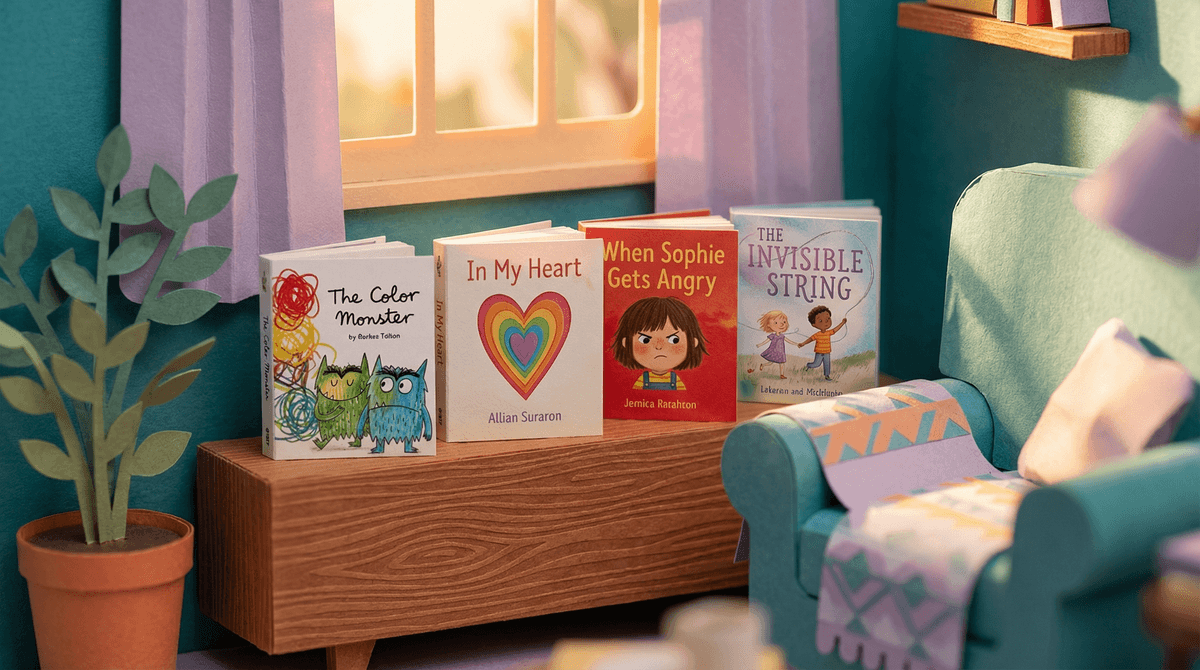
The Color Monster by Anna Llenas is the gold standard starter book. Each emotion gets a color (anger is red, sadness is blue, etc.), making abstract feelings concrete for young kids. The interactive element of sorting emotions into jars is brilliant for this age.
In My Heart: A Book of Feelings by Jo Witek uses die-cut hearts to show how different emotions feel physically in your body. Kids this age are very body-aware, and connecting "my stomach feels tight" with "I'm nervous" is huge.
When Sophie Gets Angry—Really, Really Angry by Molly Bang shows a realistic anger cycle and, critically, shows Sophie finding her own calming strategy (climbing a tree, taking space). Not every book does this well—some just validate the feeling without showing what comes next.
The Way I Feel by Janan Cain covers a wide range of emotions with simple, relatable scenarios. The rhyming text makes it accessible for emerging readers who want to "read" along.
Listening to My Body by Gabi Garcia takes a body-first approach, helping kids notice physical sensations before they become overwhelming emotions. This is actually teaching early mindfulness skills without being preachy about it.
The Invisible String by Patrice Karst is perfect for separation anxiety and big sad feelings about being apart from parents. The metaphor of an invisible connection is concrete enough for this age to grasp.
Don't just read these once at bedtime and call it done. These are reference books. Keep them accessible and return to them when emotions are calm, not mid-meltdown.
Read them multiple times. The first time, just experience the story. The second time, pause and ask questions: "How do you think that character feels? Have you ever felt like that?" The third time, your kid might start connecting dots on their own.
Create emotion check-ins using the language from the books. "Are you feeling red and angry like the Color Monster, or blue and sad?" It sounds cheesy, but shared vocabulary is everything at this age.
And here's the thing—these books work best when you model using them for yourself. "I'm feeling really frustrated right now, like my body is tight. I think I need to take some deep breaths like we read about." Kids learn emotional regulation by watching us, not just by reading about cartoon monsters.
Not all feelings books are created equal. Some are just... not helpful. Books that only validate feelings without offering any strategies can leave kids (and parents) feeling stuck. "It's okay to be angry!" Cool, but now what?
Also, watch out for books that make emotions seem scary or bad. The goal is to normalize feelings, not make kids afraid of their own emotional experiences.
Books won't magically fix big feelings—nothing will, because big feelings are part of being human. But they can give your kid a framework for understanding what's happening inside them, and that's genuinely powerful at ages 5-7.
The best part? These books also give YOU language to talk about emotions in ways that feel natural, not forced. And they create moments of connection when your kid realizes "oh, other people feel this way too."
Start with one or two books that resonate with your kid's specific challenges (anxiety, anger, sadness, etc.) and go from there. The Screenwise library has more recommendations as your kid grows and their emotional world gets more complex.
Your 5-7 year old is doing hard work figuring out their inner world. These books are like training wheels—supportive, helpful, and eventually, they'll ride on their own.