

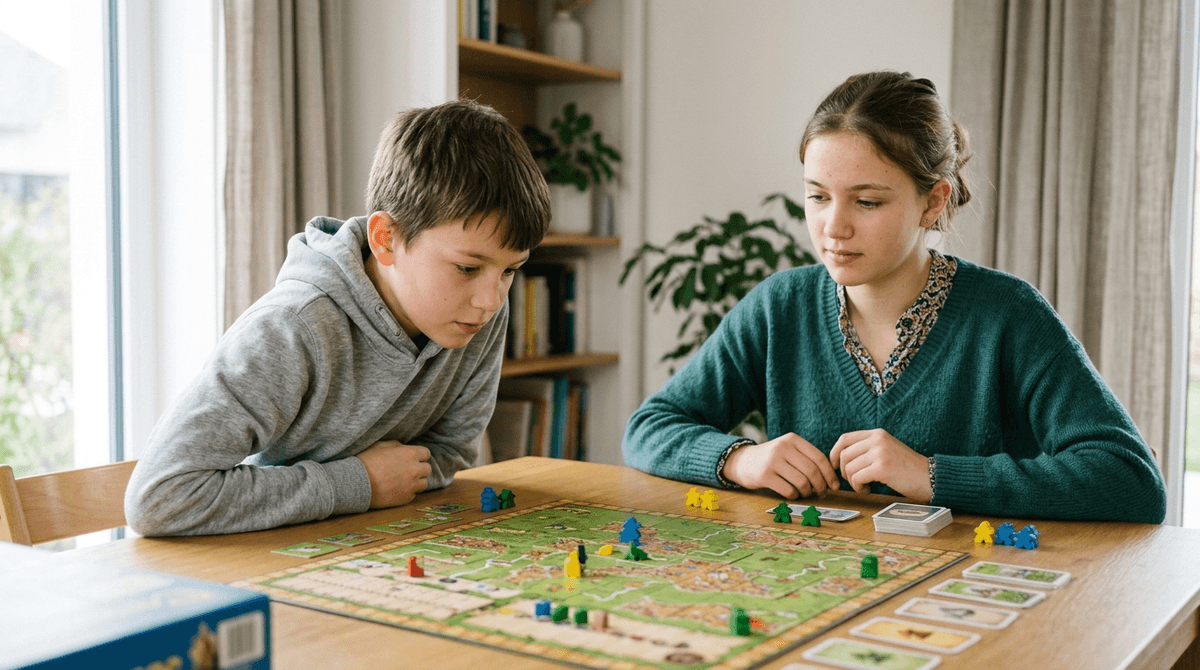
Board games are essentially training wheels for the social brain. New research suggests that tabletop play serves as a low-stress "third space" that lowers anxiety, sharpens executive function, and helps neurodivergent kids build genuine offline bonds through a predictable, rule-bound framework.
Prioritize tabletop board games over solo screen time to help your child build self-control and reduce social anxiety through structured, predictable interaction. Research indicates that the clear rules of a game act as a "social scaffold," particularly for kids with autistic traits who find open-ended social situations overwhelming.
Parents often treat board games as rainy-day filler, but they are actually clinical-grade tools for cognitive and emotional development. In an era where "digital-first" social lives often leave kids feeling isolated or overstimulated, board games provide a physical, high-engagement alternative that forces players to navigate real-world social cues in real-time.
Choosing the right game is a strategic decision for your household environment. Instead of generic play, you can select games that specifically target your child’s weaknesses—whether that is impulsivity, difficulty with turn-taking, or the "paralysis" that comes with unstructured conversation. This research moves board games from the toy chest to the developmental toolkit.
Researchers are increasingly worried about the erosion of "third spaces"—those community hubs outside of home and school where kids can congregate without the pressures of performance or digital monitoring. During the COVID-19 pandemic, while many turned to screens, those who maintained tabletop gaming habits reported significantly lower levels of stress and isolation.
Universities are now formalizing this. Programs like Kansas State University’s "Bonding thru Board Games" were designed to bridge the gap between simple fun and intentional skill-building. They identified that the mechanics of gaming—waiting for a turn, planning a move, and managing a loss—directly map to the executive functions kids need to succeed in the classroom and beyond.
The University of Plymouth confirmed that tabletop games are a "powerful tool" for fostering social inclusion and personal well-being. The findings highlight a specific "well-being boost" for individuals who display autistic traits, as the structured nature of the games removes the guesswork from social interaction.
- Executive function is the big winner. Structured play targets self-control and communication skills by forcing players to operate within a fixed set of possibilities.
- The "third space" is back. Independent game shops are seeing a massive resurgence. One Canadian retailer saw participation in community gaming events jump from 8,500 to over 9,100 attendees in a single year, signaling a desperate hunger for offline community.
- Stress reduction is direct. Retrospective data shows that board games acted as a primary buffer against the anxiety of the pandemic, providing a sense of agency when the outside world felt chaotic.
The "magic" of a board game isn't the cardboard—it’s the script. For many kids, "hanging out" is stressful because the rules of conversation are invisible and constantly shifting. A board game makes those rules visible and physical.
When a child plays a game like Cascadia or Patchwork, they aren't just placing tiles; they are engaging in a shared reality where the "right" thing to do is clearly defined by the rulebook. This lowers the cognitive load of being social. By the time the game is over, the child has successfully interacted with others for 45 minutes without once having to wonder, "What am I supposed to do now?" This builds a "competence loop" that can eventually carry over into unstructured environments.
The specific sample sizes and demographic breakdowns of the primary University of Plymouth study were not fully detailed in this synthesis. Much of the data also relies on qualitative reports—meaning people’s feelings about their stress levels—rather than long-term clinical brain scans.
Additionally, the retail participation data from Canada shows a trend in interest, but it doesn't prove that every child will experience a "well-being boost" just by sitting at a table. The effectiveness of board games often depends on the "table feel"—the attitude of the other players—which can vary wildly from a competitive home environment to a professional game shop.
- If your child struggles with open-ended social situations... introduce cooperative games like Cascadia to give them a shared goal and a conversational "script" that removes the pressure of small talk.
- If your child has trouble with impulsivity or waiting... use "mechanics-heavy" games like Cobra Paw to help them practice quick-reaction self-control within a strict, fair set of rules.
- If your teen is feeling isolated or stuck in a digital loop... find a local game shop or library board game night to introduce them to a non-digital "third space" where they can meet peers without the high stakes of a school social hierarchy.
- If your child finds two-player competition too intense... look for "Toy Battle" style games or low-conflict mechanics that allow for parallel play on a shared board.
- If you want to reduce post-school "meltdown" stress... swap 20 minutes of high-stimulation iPad time for a calm, tile-laying game to help them transition from the chaos of school to the calm of home.
Stop viewing board games as an "extra" activity and start seeing them as an essential social workout. They provide the structure anxious and neurodivergent kids need to build real-world confidence, one turn at a time.
Biz Nijdam (2026). Not just a fun hobby: Board games can help build connections and reduce stress. Phys.org. — https://phys.org/news/2026-05-fun-hobby-board-games-stress.html