

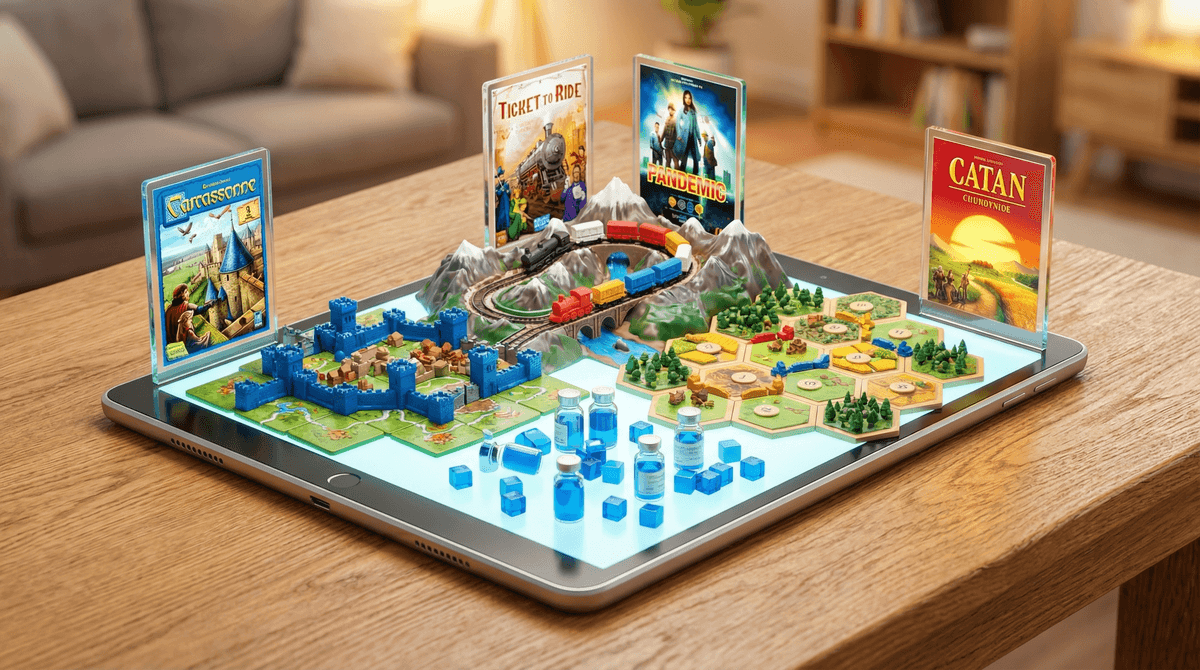
Board game apps are digital versions of physical board games—think Monopoly, Catan, Ticket to Ride—adapted for tablets, phones, and sometimes computers. Some are straight-up ports of classics you grew up with, while others are newer games that have made the jump to digital.
The pitch is compelling: no setup time, no lost pieces, automatic rule enforcement (goodbye, arguments about whether you can put a hotel there), and you can play with Grandma across the country. Plus, many apps cost $5-15 versus $40-60 for the physical version.
But here's the thing—not all board game apps are created equal. Some are genuinely great family experiences that capture the magic of game night. Others are cash-grab disasters loaded with ads, in-app purchases, and design choices that make you want to throw your iPad across the room.
Look, I get the irony of a digital wellness platform recommending screen time. But board game apps occupy a weird middle ground that's worth considering.
The good stuff:
- Actual turn-taking and social interaction - Unlike solo gaming, you're still sitting together, talking strategy, trash-talking your 8-year-old's terrible dice rolls
- Learning without the learning curve - The app handles the fiddly rules, so you can focus on strategy instead of constantly checking the rulebook
- Accessibility - Some kids (and adults) struggle with physical game components—digital versions can level the playing field
- Gateway to physical games - Trying a $7 app before committing to a $50 board game is honestly smart
The reality check: This isn't the same as physical board games. You're missing the tactile experience, the eye contact, the ability to read body language. And some games just feel wrong digitally—Jenga as an app is a crime against humanity.
The Winners
Ticket to Ride (Ages 8+, $6.99) This is the gold standard. Beautiful interface, teaches geography, involves strategy without being overwhelming. The pass-and-play mode works great for families, and there are no predatory monetization schemes. Just buy it once and you're done.
Carcassonne (Ages 7+, $4.99) Tile-laying strategy game that's even better digital than physical because the app handles scoring automatically (if you've played the physical version, you know). Great for spatial reasoning and planning ahead.
Splendor (Ages 10+, $6.99) Resource management and strategy without being too complex. The digital version moves faster than physical, which is actually a plus for shorter attention spans.
Chess apps (Ages 6+, free to $10) Not technically a board game app in the modern sense, but apps like Chess.com and [Lichess](https://screenwiseapp.com/media/lichess-website are fantastic for learning. Built-in tutorials, puzzles, and you can play at your own pace.
The "Proceed With Caution" Category
Monopoly apps There are multiple Monopoly apps and they're... fine? Some versions are ad-heavy, some have weird in-app purchases for "themes." The game itself is still Monopoly (which, let's be honest, isn't actually a great game—it's just nostalgic). If your kids love it, the app version at least moves faster.
Uno The official app has ads and wants you to watch videos for coins. For a card game that costs $6 in real life, this feels gross. There are better options.
The "Just No" List
Most free board game apps - If it's free, you're paying with ads, data collection, or aggressive monetization. There are exceptions, but generally: avoid.
Apps that add "energy" or "lives" systems - This is not how board games work. If you need to wait 4 hours to play another game or pay $2.99 for more "tokens," that's not a board game app—it's a mobile game wearing a board game costume.
Anything that makes you create an account before playing - Red flag for data collection, especially for kids.
Ages 4-6: Stick with simple apps like Candy Land or Chutes and Ladders if they exist in decent versions (honestly, at this age, physical is better—they need the tactile experience).
Ages 7-9: Ticket to Ride, Carcassonne, simpler strategy games. This is the sweet spot where digital actually helps because the app handles complex scoring.
Ages 10+: Catan, Splendor, Pandemic (cooperative game—great for family teamwork). More complex strategy becomes accessible when you're not also managing physical components.
Buy once, play forever: Look for premium apps ($5-15) with no ads or in-app purchases. Yes, it feels expensive compared to "free," but you're buying a complete game, not a monetization scheme.
Check the pass-and-play feature: This lets multiple people play on one device by passing it around. Essential for family play. Some apps force you to buy multiple copies or require online multiplayer only—skip those.
Tutorial quality matters: Good apps teach you how to play through interactive tutorials. Bad apps dump a PDF rulebook on you. This is especially important if you're new to the game.
Online multiplayer is a separate decision: Many apps offer online play with strangers. That's a whole different conversation about online interaction, chat features, and age-appropriateness. You can often disable this in settings.
Physical games still win for certain things: Dexterity games (Jenga), party games (Apples to Apples), anything that relies on hidden information or bluffing—these don't translate well digitally.
Board game apps can be a legitimate part of family game night—not a replacement for physical games, but a different tool in the toolkit. They're especially useful for:
- Travel and waiting rooms
- Testing games before buying physical versions
- Playing with relatives remotely
- Rainy afternoons when you can't face setting up Catan again
The rule of thumb: If you're all sitting together, engaged, talking, and strategizing—even if it's on a screen—that's quality time. If everyone's silently tapping their own devices, you've lost the plot.
Start with one premium app (Ticket to Ride is my top recommendation), play it together a few times, and see how it feels for your family. If it sparks good conversation and genuine fun, explore more. If it feels hollow or frustrating, stick with physical games.
And honestly? The best outcome is when a digital version gets your kids excited enough to want the physical game. That's the sweet spot—using screens as a gateway to unplugged time.
Want more game recommendations? Check out our guide on best cooperative games for families or strategy games that teach critical thinking.