

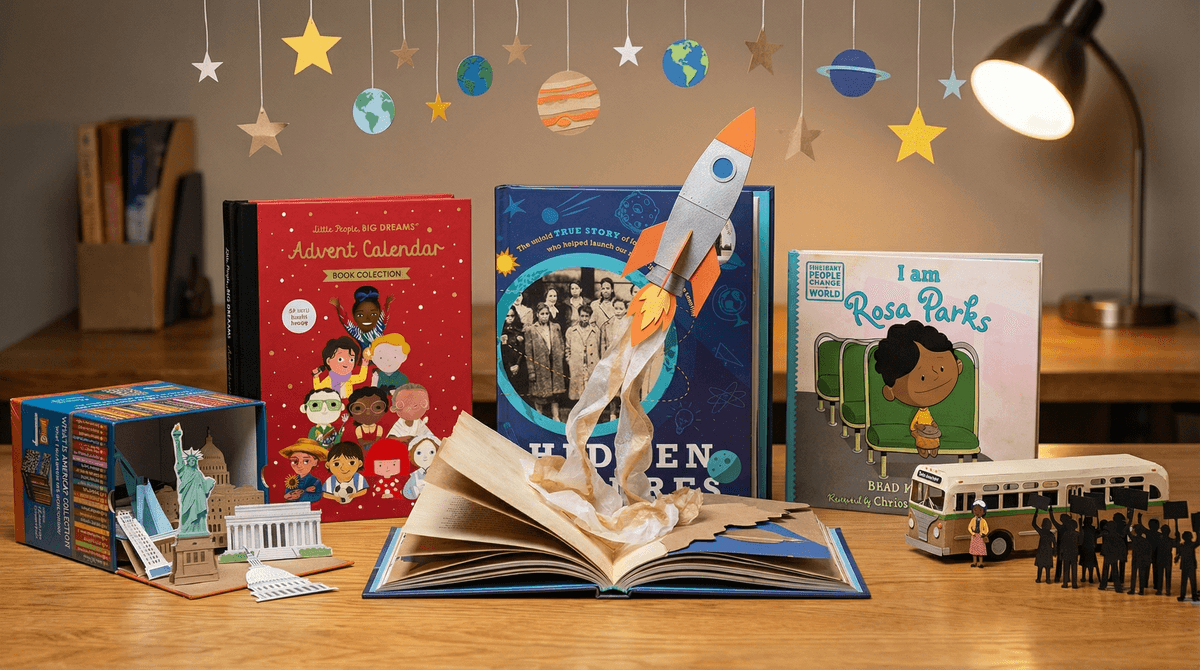
Biographies for kids are life stories of real people—scientists, athletes, activists, artists, leaders—written in ways that make history feel alive and personal. They range from picture books about Rosa Parks for kindergarteners to thick chapter books about Alan Turing for middle schoolers. Unlike fiction, these books say "this actually happened, and this person was real," which hits differently when you're a kid trying to figure out who you want to be.
The best ones don't just list achievements—they show the messy middle. The failures, the doubt, the "what if I'm not good enough?" moments. They humanize people who seem larger than life and show kids that extraordinary people started as ordinary kids who kept going.
Here's the thing about biographies: they're doing quiet, powerful work in your kid's brain that a lot of other content just can't touch.
They build a mental library of role models. When your kid reads about Katherine Johnson calculating rocket trajectories or Malala standing up for education, they're storing away possibilities for who they could become. Not in a "you should be like this" way, but in a "oh, humans can do that?" way.
They teach that character matters. Biographies show the connection between choices and outcomes over a lifetime. Your kid sees that Abraham Lincoln read by candlelight because he valued learning, that Marie Curie kept experimenting despite being told women couldn't be scientists, that Jackie Robinson showed up with dignity even when people were awful to him. These aren't abstract "be persistent" platitudes—they're real humans making hard choices.
They're stealth history lessons. Kids will absorb more about the Civil Rights Movement from reading March by John Lewis than from any textbook. They'll understand World War II differently after reading about Anne Frank. Biographies make history personal, which makes it memorable.
They develop critical thinking. Good biographies don't present people as perfect heroes. They show complexity, mistakes, evolution. Kids learn to think about historical context, to question narratives, to understand that people can do both great and terrible things.
Ages 4-7: Picture Book Biographies
These are gorgeously illustrated introductions to inspiring people. Look for books from series like "Little People, Big Dreams" or stand-alones like I Am Rosa Parks by Brad Meltzer. They're short, focus on one big idea, and make history feel accessible.
At this age, kids are building their first mental models of what's possible. Reading about astronauts, artists, and athletes plants seeds.
Ages 8-10: Early Chapter Books
This is when kids can handle more complexity. Series like "Who Was?" and "I Survived" (which blends biography with historical fiction) work well. Look for books about people your kid is already curious about—if they're obsessed with space, grab a book about Mae Jemison or Neil Armstrong.
These books start showing obstacles and setbacks, not just triumphs. That's important. Kids this age need to see that success isn't linear.
Ages 11-14: Full Biographies and Memoirs
Middle schoolers can handle nuance, controversy, and longer narratives. This is when you can introduce books like The Diary of a Young Girl by Anne Frank, Long Walk to Freedom by Nelson Mandela, or Hidden Figures by Margot Lee Shetterly.
At this age, biographies become tools for identity formation. Kids are figuring out their values, their interests, their place in the world. Reading about people who faced similar questions (or very different ones) helps.
Not all biographies are created equal. Some are hagiographies that sand off all the interesting edges. Others are so focused on "inspiration" that they skip the actual work and struggle. The best biographies show the full person—the brilliance and the flaws, the victories and the very real failures.
Representation matters here, maybe more than anywhere else. If your kid only reads about white male scientists and presidents, they're getting a distorted view of who gets to be "important." Actively seek out biographies of women, people of color, LGBTQ+ individuals, people with disabilities. Not as a checkbox exercise, but because these stories are genuinely fascinating and your kid deserves to know them.
Biographies are a gateway to interests. A kid who reads about Jane Goodall might suddenly want to learn about primates. A kid who reads about Lin-Manuel Miranda might get interested in theater or hip-hop or the American Revolution. Follow those threads. Use the library liberally.
They're conversation starters. After your kid reads about someone, ask questions: What do you think was their hardest choice? Would you have done the same thing? What would it have been like to live in that time? These conversations build critical thinking and help kids process what they're learning.
Audio biographies count. If your kid isn't a big reader, audiobooks work just as well. So do podcasts like Brains On! or Wow in the World that feature biographical episodes.
In a digital landscape full of algorithm-driven content designed to capture attention for 30 seconds at a time, biographies do something radically different: they ask kids to spend time with a real person's full story, with all its complexity and humanity.
They're not flashy. They won't go viral. Your kid won't beg for the next biography like they beg for the next Minecraft session.
But they build something deeper—a sense of historical connection, an understanding that ordinary people can do extraordinary things, and a mental library of humans who faced hard things and kept going.
That's the kind of content that shapes who your kid becomes, not just what they watch this afternoon.
Start with interest, not importance. Don't force the "important" biographies. If your kid loves soccer, start with Megan Rapinoe or Pelé. If they're into coding, try a book about Ada Lovelace or Steve Jobs. Interest is the door; everything else follows.
Make it a family thing. Read biographies alongside your kid and talk about them. Share biographies from your own childhood. Create a "people we want to learn about" list together.
Mix formats. Combine books with documentaries, podcasts, and museum visits. The goal is engagement, not checking boxes.
Check out alternatives to endless YouTube that include educational content about real people and real history. Sometimes a 10-minute video about Harriet Tubman is the perfect entry point to a longer book.
Biographies aren't a substitute for screen time limits or thoughtful media choices—they're part of a bigger ecosystem of helping your kid develop curiosity, empathy, and a sense of what's possible. And honestly? That's the whole game.