

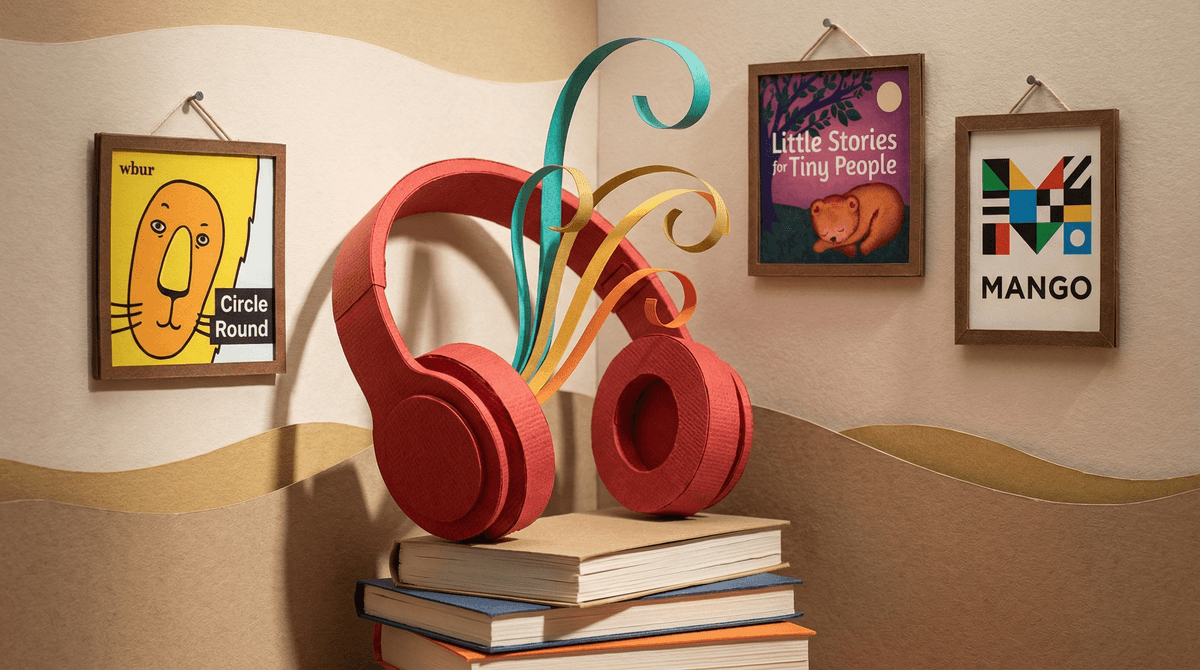
Bilingual podcasts for kids are audio shows that intentionally incorporate two languages—either through full episodes in each language, switching between languages within episodes, or teaching one language through another. They're basically screen-free content that can support language learning while kids play with LEGOs, ride in the car, or wind down before bed.
Unlike passive TV watching, podcasts require active listening, which is actually great for language development. Kids have to create mental images, follow storylines without visual cues, and process language in a more focused way. When you add a second language into the mix, you're giving their brains a genuine workout without it feeling like homework.
The format ranges widely: some podcasts tell stories entirely in Spanish one episode and English the next, others weave both languages throughout a single story, and some are explicitly designed to teach vocabulary and phrases in context. Think of them as the audio version of those bilingual picture books, but with sound effects, music, and often way more engaging production value.
Here's the thing about raising bilingual kids: consistency and exposure are everything. If you're a heritage language family trying to maintain Spanish, Mandarin, Arabic, or any other language while your kid is swimming in English all day at school, you need every tool you can get. Even if you speak the language at home, kids benefit massively from hearing different voices, accents, and contexts.
Research on bilingual language acquisition shows that kids need roughly 30% exposure to a language to develop productive fluency (not just understanding, but actually speaking it). For many families, especially when one parent isn't a native speaker or when both parents work, hitting that threshold is genuinely hard. Podcasts can help fill that gap.
But even for families just starting a second language journey—maybe you want your kids to learn Spanish because you live in California, or French because you're planning to move—podcasts offer low-pressure exposure. Kids can absorb pronunciation, rhythm, and vocabulary without the stress of having to respond or perform.
And let's be real: it's also about cultural connection. Hearing stories, jokes, and songs in another language isn't just about grammar—it's about belonging to a broader community and understanding different perspectives.
Duolingo Spanish for Kids (Ages 4-10) Yes, the same Duolingo with the slightly threatening owl mascot. But their podcast is actually solid—short episodes that teach Spanish vocabulary through stories and songs. Each episode focuses on practical themes like family, food, or animals. It's structured and repetitive in a good way, perfect for beginners.
La Biblioteca de Lety (Ages 3-8) This one's a gem for Spanish learners. Lety reads bilingual stories—sometimes full Spanish, sometimes English with Spanish woven in—and the production quality is warm and inviting. Great for bedtime or quiet time, and the stories often feature Latinx characters and themes.
Circle Round (Ages 4-10) While not strictly bilingual, Circle Round tells folktales from around the world and occasionally features episodes in Spanish or with bilingual elements. The storytelling is top-tier (seriously, the production is beautiful), and it's a great way to expose kids to diverse cultures through narrative.
Mango Languages Podcast (Ages 6-12) Mango offers podcast content for several languages beyond Spanish—think Mandarin, French, German. The format is more educational than story-driven, but it's engaging and moves at a good pace for elementary-aged kids who are actively trying to learn.
¡Listos, Ya! (Ages 5-10) This bilingual podcast from Encantos features songs, stories, and activities in both Spanish and English. It's high-energy and designed to get kids moving and participating, which is great for kinetic learners who can't sit still (so, like, most kids).
For families learning other languages, Little Stories for Tiny People occasionally features bilingual episodes, and there are growing podcast options in Mandarin, French, and Arabic—though honestly, the market is still heavily Spanish-English focused.
Ages 3-5: Start with short episodes (under 15 minutes) that are repetitive and song-heavy. At this age, kids are absorbing sounds and rhythms more than vocabulary. Don't stress if they seem to zone out—passive listening still counts. Duolingo Spanish for Kids and La Biblioteca de Lety are perfect here.
Ages 6-8: This is the sweet spot for story-driven podcasts. Kids can follow more complex narratives and are starting to pick up on language patterns. Try Circle Round or ¡Listos, Ya!. You can also start asking follow-up questions: "What was your favorite part?" or "Can you remember any Spanish words from that story?"
Ages 9-12: Older kids can handle more educational content and longer episodes. They might also enjoy podcasts that feel less "kiddie"—look for content that treats them like learners, not babies. Mango Languages works well here, as does branching into podcasts made for native speakers of the target language (even if they don't understand everything, exposure helps).
Practical tips:
- Make it routine: Car rides, breakfast time, before bed—consistency matters more than duration.
- Don't quiz them: Resist the urge to turn every episode into a test. Let language acquisition happen naturally.
- Mix it up: Rotate between story podcasts and educational ones so it doesn't feel monotonous.
- Model interest: If you're learning alongside them, show your own curiosity. "Oh, I didn't know that word!" goes a long way.
Let's address the elephant in the room: podcasts alone won't make your kid fluent. They're a supplement, not a solution. If your goal is true bilingualism, you need conversation, reading, and ideally immersion experiences. But as part of a broader strategy—especially when combined with speaking at home, bilingual books, or language classes—they're incredibly valuable.
Also, not all bilingual podcasts are created equal. Some are clearly made by educators who understand language acquisition; others feel like someone just recorded themselves reading a book in two languages with zero production value. Quality matters. If your kid tunes out after two minutes, try a different podcast. You can explore more options and see what fits your family .
.
One more thing: don't underestimate the power of podcasts in your heritage language, even if they're not bilingual. If you're trying to maintain Spanish, for example, a podcast entirely in Spanish (made for native-speaking kids) can be just as valuable—or more so—than a bilingual one. It normalizes hearing the language in different contexts and from different speakers.
Bilingual podcasts are one of the most underrated tools for multilingual families. They're portable, screen-free, and can turn dead time (car rides, chores, quiet time) into language exposure. They won't replace conversation or immersion, but they're a low-effort, high-reward addition to your language toolkit.
Start with one or two podcasts that match your kid's age and language level, build them into your routine, and see what sticks. And remember: even if your kid seems like they're not paying attention, their brain is still soaking it up. Language learning is a long game, and every bit of exposure counts.
Next Steps: Pick one podcast from the list above and try it for a week during a regular part of your routine—breakfast, car rides, or before bed. See if it sticks. If your kid isn't into it, try another. Need help figuring out which podcast fits your family best? The goal is consistency, not perfection.