

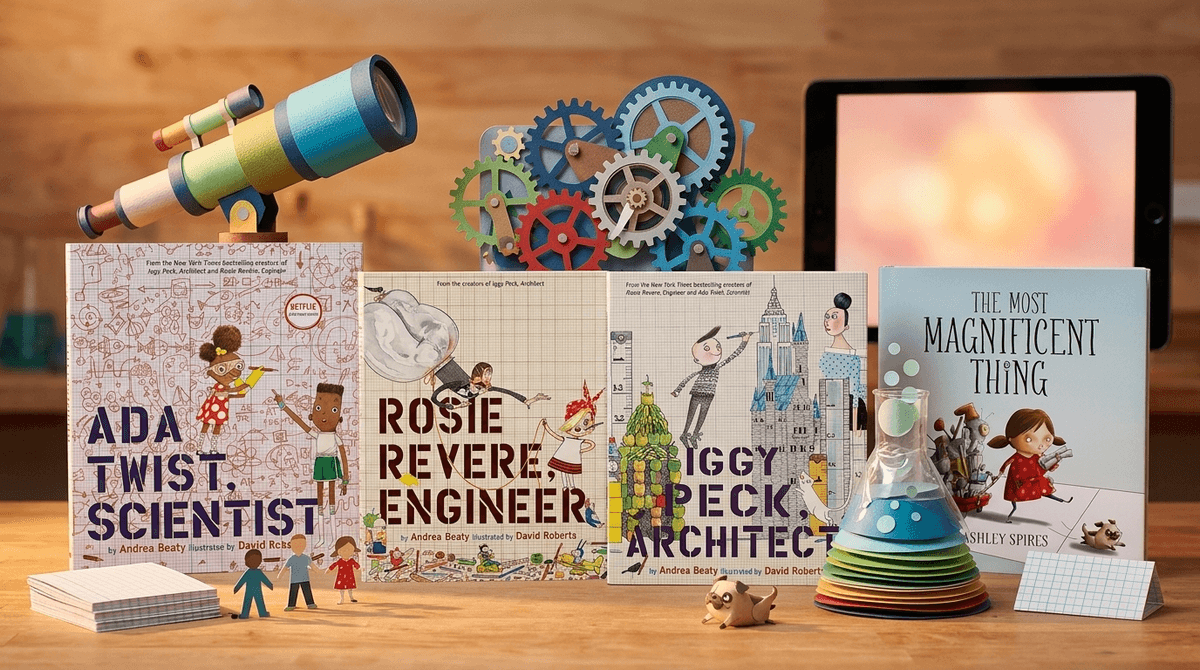
TL;DR: The STEM Shortcut If you’re looking to turn "just five more minutes" of Netflix into a weekend of backyard experiments, you’re looking for the Ada Twist Effect. By leveraging the high-quality storytelling of Ada Twist, Scientist (Netflix show), you can pivot your preschooler toward physical books that build "grit"—the ability to fail, try again, and not have a meltdown when the block tower falls.
Top Recommendations:
- The Gold Standard: Ada Twist, Scientist (book)
- For the Builders: Rosie Revere, Engineer (book)
- For the Artists/Designers: Iggy Peck, Architect (book)
- For Real-World Curiosity: National Geographic Little Kids First Big Book of Why
- For Emotional Resilience: The Most Magnificent Thing
We’ve all been there: your kid is obsessed with a show, and you’re just relieved it’s not some weird "Skibidi Toilet" derivative or a YouTube channel where adults unbox plastic eggs for twenty minutes. When Ada Twist, Scientist hit Netflix, intentional parents breathed a collective sigh of relief. It’s smart, it’s diverse, and it actually teaches the scientific method.
But here is the secret: the show is the "hook," but the books are the "anchor."
The "Ada Twist Effect" is the transition from passive consumption (watching Ada solve a mystery) to active inquiry (reading the book and then asking why the cat smells like old cheese). STEM books for preschoolers aren't about teaching them organic chemistry before they’re potty trained; they’re about fostering a mindset where "I don't know" is followed by "Let's find out."
Most STEM books are, frankly, a bit dry. They often feel like a textbook had a baby with a coloring book. Ada Twist, Scientist by Andrea Beaty changed the game because it focuses on the process of thinking rather than just the facts.
Ada is a kid who doesn't speak until she's three, and when she finally does, her first word is "Why?" She’s messy, she’s chaotic, and she fails—a lot. This is the "grit" factor. In a digital world where kids expect instant "likes" or immediate level-ups in Roblox, Ada Twist teaches them that the "stink" (literally and figuratively) is part of the discovery.
Learn more about why Grit is the most important skill for the digital age
If your preschooler is already a fan of the The Questioneers on screen, these books are your next logical step.
While Ada is about the "why," Rosie is about the "how." She builds gadgets out of trash. This is the perfect book to pair with a literal box of recycling. If your kid is constantly trying to "fix" things (or taking them apart), Rosie is their patron saint. It’s also a great lesson in overcoming the fear of being laughed at—a very real concern for kids as they enter the social world of preschool.
Iggy builds towers out of diapers and bridges out of fruit leather. It’s hilarious, but it also introduces the concept of structural integrity. If you have a Minecraft fan in the making, start here. It validates the "builder" personality type before they ever touch a screen.
This isn't strictly part of the Questioneers universe, but it belongs on the same shelf. It’s about a girl who has a brilliant idea for a "magnificent thing," but she keeps getting it wrong. She gets angry. She wants to quit. It’s the most honest depiction of the "engineering process" (and toddler tantrums) ever written.
Don't let the title fool you; these board books by Ruth Spiro (like Baby Loves Quantum Physics or Baby Loves Aerospace Engineering) are surprisingly accurate and great for the 3-year-old set. They simplify massive concepts into things a preschooler understands, like a ball or a bird.
We aren't anti-screen; we’re pro-context. If your child watches an episode of Ada Twist, Scientist about why pancakes are fluffy, that is the perfect time to pull out a book or head to the kitchen.
Here is how to make the transition seamless:
- The "Pause and Predict": When watching the show, pause it. Ask, "What do you think Ada's hypothesis is?" Then, find the corresponding page in the Ada Twist, Scientist (book).
- The Podcast Pivot: If you’re in the car and they’re asking for a tablet, try Wow in the World. It’s basically the audio version of Ada Twist—high energy, scientifically accurate, and genuinely funny for parents too.
- The "Research" Phase: Use National Geographic Kids to look up real-life versions of what Ada is studying. If she's looking at stars, show them real photos of the Hubble Telescope.
At this age, "STEM" is really just a fancy word for "Curiosity."
- Ages 3-4: Focus on the "What." What happens when we mix blue and yellow? What happens when we drop a feather vs. a rock? Stick to books with heavy rhythm and rhyme like Ada Twist.
- Ages 5-6: Focus on the "How." How does the water get to the sink? How does a bird stay in the air? This is the sweet spot for Rosie Revere, Engineer and ScratchJr to start introducing logic.
There is a lot of guilt around screen time, but not all content is created equal. Watching Ada Twist, Scientist or Storyline Online (where celebrities read STEM books aloud) is a fundamentally different neurological experience than scrolling through "Ohio" memes or watching mindless "surprise egg" videos.
The goal isn't to eliminate the screen; it's to ensure the screen is a springboard. If the show leads to a book, and the book leads to a question, and the question leads to a messy kitchen experiment—you’re winning.
Get a reading list based on your kids' favorite Netflix shows
Ada Twist, Scientist isn't just a book or a show; it’s a framework for how we want our kids to interact with the world. In a digital age where everything is curated and "perfect," Ada reminds us that the world is messy, confusing, and worth investigating.
By stocking your shelves with these STEM titles, you aren't just teaching science—you're teaching your child that their "Why?" is the most powerful tool they own.
Next Steps:
- Check out Ada Twist, Scientist on Netflix for your next movie night.
- Grab the The Questioneers box set for the bedtime rotation.
- The next time they ask a "Why" question you can't answer, don't Google it immediately. Say, "Let's make a hypothesis first," just like Ada.