

Best Space Documentaries for Kids: NASA-Approved Picks by Age
TL;DR: Skip the 2-hour snoozefests. The best space content for kids comes in 2-minute animated bursts (Space Kids), interactive NASA web portals, and National Geographic's quick-hit video series. For older kids ready for the real deal, Carl Sagan's Cosmos is still unmatched—just not for your 6-year-old.
Space content has this magical quality where it's simultaneously educational and mind-blowing. A kid can learn actual science (gravity, planetary orbits, the speed of light) while also grappling with existential questions that make adults uncomfortable at dinner parties. Plus, unlike a lot of educational content that feels like thinly veiled homework, space documentaries tap into genuine wonder.
The challenge? Most space documentaries are either too technical (hello, 90-minute lecture on spectroscopy) or too dumbed-down (cartoon aliens teaching colors). The good news: NASA, ESA, and National Geographic have finally figured out how to make content that's both scientifically accurate and actually watchable for kids.
Space Kids (Amazon Prime & Apple TV)
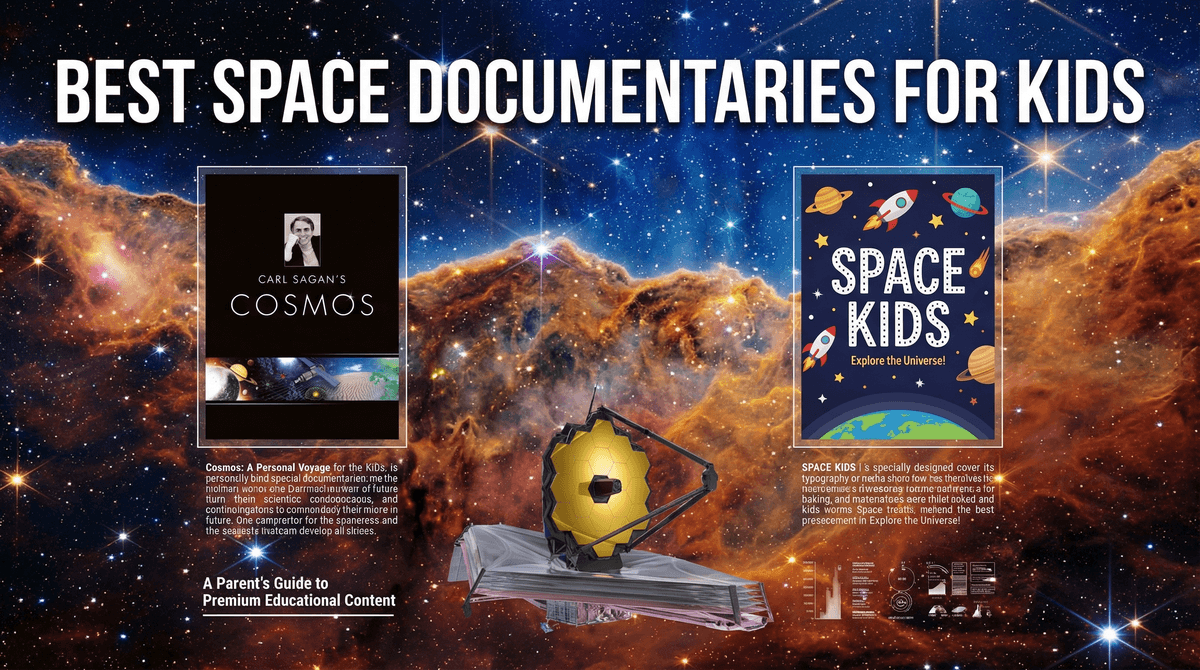
This is the gold standard for early elementary space education. Each episode runs 2 minutes—yes, two minutes—which is exactly the attention span of a kindergartener who just discovered that Jupiter has a storm bigger than Earth.
The series mixes actual NASA archive footage with bright, friendly animation. Episode titles like "What Is A Star?" and "Our Solar System" are straightforward, and the content is rated TV-Y, meaning it's vetted for all ages. With 35 episodes total, you can easily slot one into a morning routine or use it as a transition between activities.
Why it works: The bite-size format prevents the glazed-over look kids get around minute 12 of most documentaries. And because it uses real NASA footage, kids are seeing actual space missions, not just cartoons of rockets. It's the perfect gateway drug to space obsession.
NASA Space Place & ESA Space for Kids (Web-based)
If your kid is the type who needs to do something while learning, these interactive websites are perfect. NASA Space Place offers 2-5 minute video clips paired with games, printable activities, and simple articles about everything from the Sun's energy to how to spot the International Space Station from your backyard.
The European Space Agency's Space for Kids portal goes even deeper, with content about the Big Bang, gravity, and women in space history. It's multilingual, constantly updated, and—crucially—designed by actual space educators, not marketing teams.
Parent tip: These aren't passive viewing experiences. Set up a "space station" at the kitchen table with printouts from NASA Space Place, and you've got a rainy afternoon activity that's both screen time and hands-on learning.
National Geographic Kids: Passport to Space & Spaced Out
Once kids hit third or fourth grade, they're ready for slightly longer content with more narrative structure. National Geographic's Passport to Space video series (5-10 minutes per episode) explores planets, space technology, and the history of space travel with the production quality you'd expect from NatGeo.
The companion series, Spaced Out, offers 3-6 minute documentary-style clips about rockets, astronauts, and solar system fun facts. Both are free to stream, ad-free, and include quizzes so you can actually gauge whether your kid retained anything or just zoned out thinking about Roblox.
Why this matters: Around 80% of families in our community use Netflix or Disney+ for kids' content, but space documentaries on those platforms tend to skew older or more intense. National Geographic's free offerings fill the gap perfectly—no subscription required, no algorithm pushing you toward random content.
Cosmos: A Personal Voyage (Carl Sagan, 1980)
Here's where we get real: if your middle schooler is genuinely interested in space, skip the kid stuff and go straight to Carl Sagan's masterpiece. Yes, it's from 1980. Yes, the special effects look like a screensaver. No, it doesn't matter.
Cosmos is 13 episodes of poetic, philosophical exploration of the universe, narrated by arguably the most compelling science communicator of the 20th century. Sagan treats viewers—whether they're 12 or 42—as intelligent people capable of grappling with big ideas. He talks about the death of stars, the evolution of life, and our place in the cosmos without dumbing it down or sensationalizing it.
Fair warning: This isn't background noise. The pacing is slower than what modern kids are used to, and some episodes dive into heady philosophical territory. Preview episodes yourself first—some discussions about nuclear war and existential risk might be too much depending on your kid's anxiety levels. But for a curious 12-year-old who's outgrown "fun space facts," this is the real deal.
Streaming note: Cosmos is available on various free streaming platforms, and the entire series is often on YouTube. Just search "Cosmos Carl Sagan full episodes."
You might be wondering why this guide doesn't include more content from the big streaming services. The honest answer? Most space documentaries on those platforms aren't designed for kids. They're either too long (90+ minutes), too technical (aimed at adult space nerds), or too intense (graphic imagery of rocket explosions, existential dread about Earth's destruction).
About 40% of families in our community use Netflix with the regular profile (not Netflix Kids), and another 40% use the kids-specific profile. If you're browsing Netflix for space content, you'll find a few options, but they're hit-or-miss. Same with Amazon Prime (38% of families report no usage, 32% supervised, 30% free access) and Disney+ (50% watch together, 30% let kids watch independently).
The exception is Space Kids on Prime, which we already covered. Beyond that, you're better off with the free NASA and NatGeo resources, which are specifically designed for children and backed by actual scientists.
Start short: Begin with the 2-minute Space Kids episodes to spark interest. If your kid watches one and immediately asks "Can we watch another?", you've hooked them.
Go interactive: Follow up with NASA Space Place or ESA's web activities. Print out a worksheet, do a "design your own rocket" activity, or track the ISS together. This reinforces what they learned and turns screen time into a launching pad (pun intended) for hands-on exploration.
Build up to longer content: Once they're asking deeper questions ("How do black holes work?" "Why is Pluto not a planet anymore?"), move to the National Geographic series. The 5-10 minute runtime is perfect for kids who are engaged but not ready for a full documentary.
Save Cosmos for the right moment: When your 12-year-old starts asking questions about the universe's origin or what happens when stars die, that's when you pull out Cosmos. It's not about age—it's about readiness for big, philosophical ideas.
All the content recommended here is rated TV-Y or produced by reputable science organizations (NASA, ESA, National Geographic). You won't find jump scares, graphic imagery, or inappropriate content. The biggest "risk" is that your kid becomes insufferable at family dinners, correcting everyone's astronomy facts.
That said, Cosmos does touch on some heavier topics—nuclear war, the potential end of humanity, the vastness of space and our insignificance within it. For some kids, this is thrilling. For others, it's anxiety-inducing. You know your kid best.
Space documentaries don't have to be a compromise between "educational but boring" and "entertaining but useless." The resources from NASA, ESA, and National Geographic offer a clear progression: ultra-short clips for young kids, interactive web content for hands-on learners, slightly longer series for engaged middle-graders, and finally, the real deal (Cosmos) for kids ready to grapple with the big questions.
The best part? Most of this content is free. No subscription, no paywall, no algorithm trying to autoplay 47 other videos. Just vetted, scientifically accurate space content that might—just might—turn your kid into the next astronaut. Or at least give them something to talk about besides Roblox drama.
Quick wins: Queue up a few Space Kids episodes on Amazon Prime or Apple TV tonight. Bookmark NASA Space Place on your family tablet. Print out one activity sheet and leave it on the kitchen table with some markers.
Deeper dive: If your kid gets hooked, explore more educational shows and documentaries or check out science-focused YouTube channels for kids. And if they're asking questions you can't answer, find out how to explain black holes to an 8-year-old .
.
Space is one of those rare topics where learning genuinely feels like an adventure. Take advantage of it while it lasts—eventually, they'll discover TikTok and you'll be begging them to watch Carl Sagan again.