

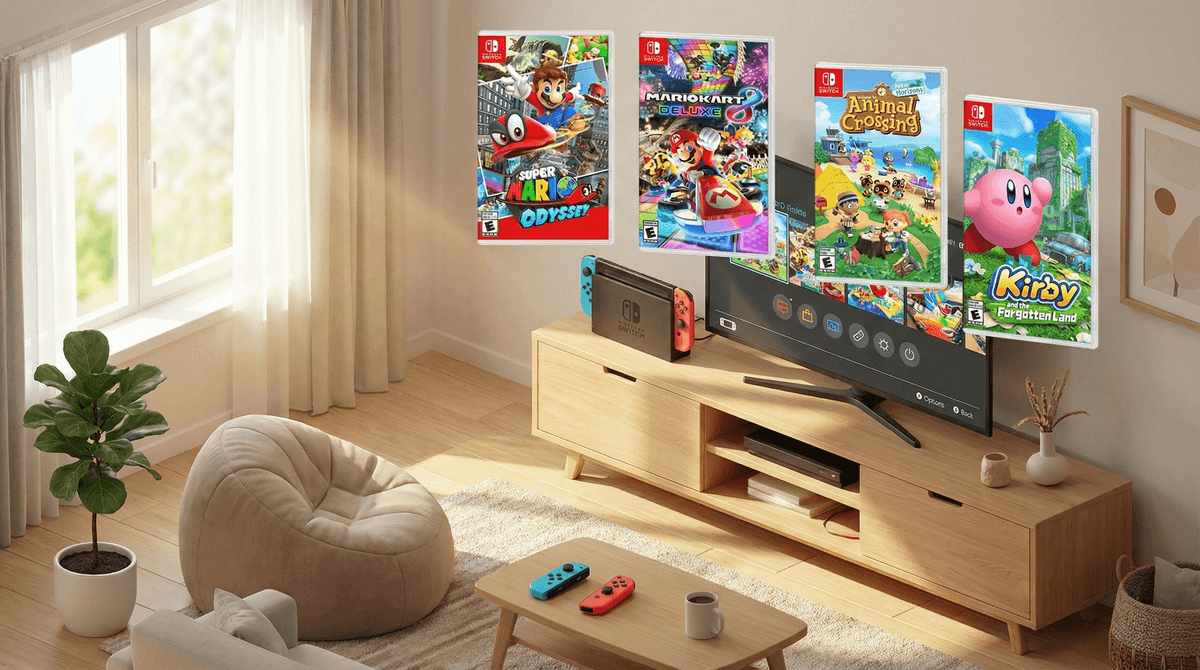
Best Nintendo Switch Games for 8-Year-Olds: A Parent's Guide
The Switch is genuinely great for this age—portable, durable, and packed with games that aren't just "kid versions" of adult titles. Here are the standouts:
Top picks:
- Super Mario Odyssey - Best first 3D platformer
- Mario Kart 8 Deluxe - Family racing gold standard
- Animal Crossing: New Horizons - Cozy creativity without pressure
- Pokémon Scarlet/Violet - Open-world adventure with reading practice
- Kirby and the Forgotten Land - Forgiving platformer with co-op
Honorable mentions: Splatoon 3 (if they're ready for online play), Minecraft (the Switch version is surprisingly solid), and Luigi's Mansion 3 (slightly spooky but not scary).
Eight is that sweet spot where kids can handle more complex games but still need guardrails. The Switch nails this because:
Physical design matters. It's actually portable (unlike "portable" tablets that never leave the couch), survives drops better than phones, and the Joy-Cons work for smaller hands. Plus, you can literally see what they're playing when it's docked on the family TV.
Better social dynamics. Local multiplayer means siblings can play together without needing separate devices or accounts. And when they do play online games like Splatoon 3, there's no voice chat with strangers by default—just colorful chaos.
The games are actually good. This isn't edutainment disguised as fun. These are legitimate games that adults enjoy too, which means you won't lose your mind watching them play.
This is the game for kids transitioning from 2D platformers to 3D worlds. Mario travels across kingdoms collecting Power Moons, and here's what makes it perfect for 8-year-olds:
The difficulty scales naturally. Early kingdoms are straightforward, later ones get trickier, but you can't actually get stuck—there are always multiple moons to pursue. If one challenge is too hard, try a different one.
Co-op mode is genius: A second player controls Mario's hat (yes, really) and can help without taking over. Perfect for when they need a hand but don't want you playing for them.
Reading level: Minimal text, mostly visual cues. If they can read Magic Tree House books, they're fine here.
Time commitment: Levels take 20-40 minutes, natural stopping points everywhere.
Every family needs a racing game, and this is the one. The "Smart Steering" and "Auto-Accelerate" options mean even younger siblings can participate without constantly driving into walls.
What parents love: Races are 3-5 minutes. No long campaigns, no progress to lose, just pick up and play. Also, the chaos of items means skill matters less than in realistic racing games—a well-timed banana peel is the great equalizer.
The online component: Yes, it has online play, but it's anonymous racing. No chat, no friend requests from strangers, just racing against other players' times. Check out how to manage online play settings if you want to disable it entirely.
Social dynamics: This is peak "one more race!" energy. Set a timer before starting or you'll be negotiating for 45 minutes.
The cozy game that took over pandemic life, and it's still excellent for 8-year-olds who like creative, low-pressure play.
You're on an island, you decorate it, you befriend anthropomorphic animals, you catch bugs. There's no losing, no game over, no stress. It runs in real-time, so if it's winter in real life, it's winter on your island.
Why it works at 8: Teaches delayed gratification (buildings take real days to construct), light resource management, and reading comprehension. The animals write letters, and kids actually want to read them.
The money thing: Yes, there's an in-game economy (Bells), but you earn them through gameplay—fishing, selling fruit, finding fossils. No real money involved unless you buy the optional DLC, which honestly, skip for now.
One account limitation: Only one island per Switch console, which is annoying if you have multiple kids. They can each have a house on the island, but they share the same world. This causes sibling drama. You've been warned.
The latest Pokémon games are open-world, which means kids can explore at their own pace instead of following a rigid path. You catch creatures, battle other trainers, collect gym badges—the classic Pokémon formula but with more freedom.
Reading requirement: Higher than Mario games. Lots of dialogue, battle descriptions, and item text. If they're comfortable with early chapter books, they'll manage, but expect questions about what words mean.
The collecting appeal: 400 Pokémon to find. This scratches the same itch as collecting trading cards but in digital form. Kids will absolutely want to trade with friends, which requires online connectivity—set up parental controls first.
Scarlet vs. Violet: Different exclusive Pokémon and slightly different aesthetics. Check which version their friends have if trading matters. Otherwise, flip a coin.
Battery warning: Open-world games drain the Switch battery faster. Expect 3-4 hours portable instead of the usual 4-5.
Kirby games are famously forgiving, and this one's no exception. Kirby inhales enemies, copies their powers, and bops through colorful levels. It's cheerful, it's silly, it's impossible to actually fail.
Perfect for less confident gamers: Extra health, frequent checkpoints, and a "Spring-Breeze Mode" that makes it even easier. Kids who get frustrated with harder platformers will succeed here.
Co-op mode: A second player can join as Bandana Waddle Dee. Unlike Mario Odyssey where player 2 is support, here both players are equally capable. Great for siblings close in age.
Playtime: The main story is 10-12 hours, but there's a post-game with harder challenges if they want them. Most 8-year-olds will play through once and be satisfied.
Not sure which Zelda fits your kid? See the whole series by age and play style.
Incredible game. Probably too much for most 8-year-olds. The open world is massive, enemies can be genuinely tough, and there's a lot of systems to juggle (weapon durability, cooking, stamina management). Some 8-year-olds will love it, but many will bounce off. Maybe wait until 9 or 10, or be prepared to play together.
This is Nintendo's take on team-based shooters—you're squids shooting ink, not bullets. It's colorful, fast-paced, and genuinely fun. The issue: it's primarily online multiplayer. If your 8-year-old is ready for competitive online play (even without voice chat), this is fantastic. If they're not, it's frustrating. There's a single-player campaign, but the game really shines online.
Yes, it's on Switch. Yes, it's the full version with cross-play. But honestly, if they're already playing Minecraft on another device, the Switch version doesn't add much. The controls are clunkier than PC/tablet, and the screen is smaller. It's fine, but not the best platform for it.
Fortnite is free on Switch, and yes, every 8-year-old wants to play it. Here's the reality: it's rated T for Teen for a reason—not because of graphic violence (it's cartoonish) but because of the online social dynamics and the aggressive monetization.
If you're considering it, read this guide to Fortnite for parents first. The game itself is fine. The voice chat, the pressure to buy skins, the "everyone's better than me" competitive stress—that's what's tricky at 8.
Some families make it work with strict settings (no voice chat, no friend requests, limited playtime). Others wait until 10-11. There's no wrong answer, but don't let "everyone plays it" pressure you into saying yes before you're ready.
The Switch has solid parental controls, but they're not enabled by default. Download the Nintendo Switch Parental Controls app on your phone—it lets you:
- Set daily playtime limits (and the Switch actually enforces them)
- Restrict online communication and purchases
- See what games they've played and for how long
- Pause gameplay remotely (nuclear option, use sparingly)
About Nintendo Switch Online: Many games require a $20/year subscription for online features. You can skip this entirely if you're only doing local multiplayer. If you do subscribe, set up purchase restrictions so they can't accidentally buy games or in-game items.
The eShop: Nintendo's digital store is accessible from the home screen. Kids can browse but can't purchase without a password. Still, they'll absolutely add things to their wishlist and campaign for them. Set expectations early.
Eight-year-olds have opinions about what games they want, often based on what friends are playing or what they've seen on YouTube. Here's how to navigate requests:
Check the rating. E for Everyone is safe. E10+ means mild cartoon violence or crude humor—usually fine but preview it. T for Teen means wait, or at least watch gameplay together first.
Watch gameplay on YouTube together. Search "[game name] gameplay no commentary" and watch 10 minutes. You'll know immediately if it's appropriate. Ignore the rating in the thumbnail—actual gameplay tells the truth.
Try before you buy. Many Switch games have free demos in the eShop. Download it, let them play, see if they actually like it or if they just liked the idea of it.
The friend pressure thing: "Everyone has it" is rarely true, and even when it is, that doesn't make it right for your family. If you're unsure, ask other parents directly—not your kid's report of what other kids say they're allowed to do.
Let's be honest: most games are just fun, and that's fine. But if you're looking for games that sneak in learning:
Pokémon builds reading stamina. Kids will read thousands of words of dialogue because they're invested in the story.
Animal Crossing teaches resource management and delayed gratification. You can't buy everything immediately—you have to save, plan, and prioritize.
Mario Odyssey develops spatial reasoning and problem-solving. Figuring out how to reach a tricky Power Moon requires experimentation and persistence.
Mario Kart improves hand-eye coordination and teaches losing gracefully (hopefully).
None of these replace actual reading, math practice, or outdoor play. But they're not brain rot either.
The Switch is legitimately one of the best gaming choices for 8-year-olds. The games are high-quality, the parental controls actually work, and the physical design encourages both solo and social play.
Start with Super Mario Odyssey and Mario Kart 8 Deluxe—they're crowd-pleasers that work for the whole family. Add Animal Crossing if your kid likes creative play, or Pokémon if they're into collecting and adventure.
Set up parental controls before handing over the device, have a conversation about screen time expectations, and remember: the goal isn't zero gaming, it's intentional gaming. These games are designed well, they're age-appropriate, and they're actually fun to play together.
And when they inevitably ask for Fortnite or some game you've never heard of, you'll know how to evaluate it instead of just saying yes or no based on vibes.
- Set up parental controls using the Nintendo Switch Parental Controls app
- Check your local library—many now loan out Switch games
- Look for sales—Nintendo games rarely discount, but when they do (Black Friday, holiday sales), stock up
- Explore more age-appropriate games for kids if you want options beyond the Switch