

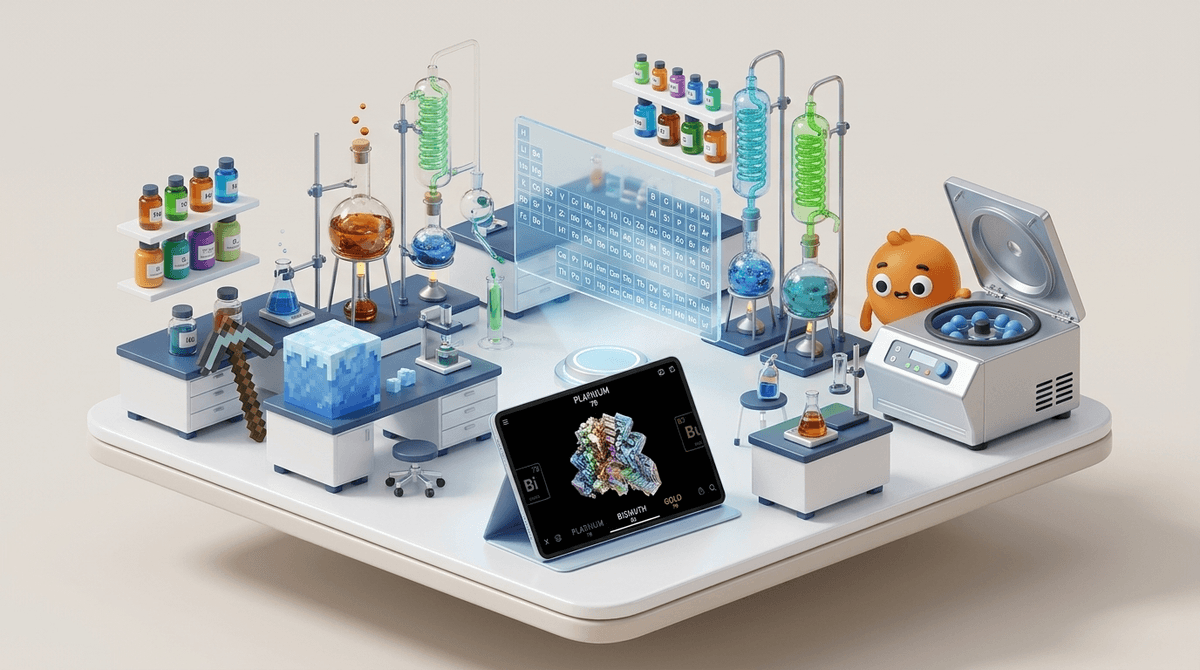
TL;DR: If you want to skip the "it’s for school" groans and get straight to the good stuff, here are the heavy hitters for digital chemistry:
- The Creative Powerhouse: Minecraft (specifically the Chemistry Resource Pack)
- Best for Littles: Toca Lab: Elements
- The "One More Try" Puzzle: Little Alchemy 2
- The Visual Masterpiece: The Elements by Theodore Gray
- The RPG Experience: [ChemCaper](https://screenwiseapp.com/media/chemcaper-app
Let’s be real: when most of us think of "chemistry," we either think of high school spreadsheets that smelled like sulfur or those viral "elephant toothpaste" videos that look like a nightmare to clean up.
But for our kids, chemistry is basically magic that actually works. It’s the "how" behind why things explode, change color, or turn from a solid into a weird goo. The problem is that most parents aren't exactly thrilled about the idea of a 9-year-old mixing random household cleaners in the bathroom sink to see what happens.
This is where digital chemistry games are a total parenting win. They allow for the "messy" trial-and-error phase of scientific discovery without the actual mess (or the risk of burning a hole in the carpet). Whether your kid is currently obsessed with Roblox or just wants something to poke at on an iPad, there are ways to turn that screen time into actual molecular knowledge.
We talk a lot about "brain rot" content—those mindless, infinite-scroll videos or games that offer zero friction. Chemistry games are the literal opposite. They require logic, memory, and spatial reasoning.
When a kid plays a game like Little Alchemy 2, they aren't just clicking buttons; they’re learning how systems build on each other. It’s the foundation for the kind of critical thinking they’ll need when they eventually hit the "real" science curriculum in middle school. Plus, it’s a great way to pivot them away from the "Ohio" memes for five minutes and toward something that might actually help them pass a test one day.
Ages 7+ Most parents don't realize that the version of Minecraft sitting on their kid's iPad or console has a full-blown chemistry lab hidden in the settings. If you toggle on "Education Edition" in the world settings, your kid gets access to the Element Constructor, Compound Creator, and Lab Table.
They can literally build elements by balancing protons, neutrons, and electrons. They can make helium balloons that fly away, sparklers that work underwater, and even "ice bombs." It is, hands down, the most effective way to teach the periodic table because it ties the science to things they actually want to build in their favorite game.
Learn how to enable chemistry in your child's Minecraft world
Ages 4-8 If you have a younger kid, Toca Boca is likely already a staple in your house. Toca Lab: Elements takes the periodic table and turns each element into a cute, reactive character.
Your kid can put "Oxygen" in a centrifuge, heat "Gold" over a Bunsen burner, or freeze "Nitrogen." Each element reacts differently based on its real-world properties. There’s no text and no stressful "fail" state—just pure experimentation. It’s the perfect "intro to lab equipment" without the risk of shattered glass.
Ages 8+ This is a browser-based classic. You start with four basic elements: Air, Earth, Fire, and Water. By dragging and dropping them onto each other, you create new things. Earth + Water = Mud. Air + Fire = Energy.
Eventually, you’re creating complex molecules, life forms, and even "Skibidi-adjacent" weirdness if you play long enough. It’s a logic puzzle wrapped in a science skin, and it’s incredibly addictive. It’s one of those rare "educational" games that kids will actually play without being forced.
Ages 10+ If your kid is more of a visual learner or a "fact-collector," this is the gold standard. It’s less of a "game" and more of a highly interactive, 3D periodic table. Every element has a high-res 360-degree rotation of an object made from that element.
It’s beautiful, it’s deep, and it’s the kind of app that makes an iPad feel like a $500 encyclopedia rather than a YouTube machine. It’s great for older kids who are starting to ask more technical questions about why certain metals are used in electronics or what "rare earth elements" actually are.
[ChemCaper](https://screenwiseapp.com/media/chemcaper-app
Ages 10-14 For the kid who loves Pokemon or RPGs, [ChemCaper](https://screenwiseapp.com/media/chemcaper-app is a unique find. It’s a fantasy adventure where the combat mechanics are based on real chemistry. You have to craft potions and "Petticles" (creatures) using actual chemical bonds and apparatus. It’s a bit more "educational" in its tone than Minecraft, but for a kid who likes a story and a quest, it’s a solid way to memorize chemical properties through gameplay.
When picking a chemistry game, the "age" isn't just about the difficulty of the science—it's about the complexity of the interface.
- Preschool / Early Elementary (Ages 4-7): Stick to tactile, "poking" apps like Toca Lab: Elements. They don't need to know what an "isotope" is yet; they just need to see that heating things up changes them.
- Late Elementary (Ages 8-11): This is the sweet spot for Minecraft and Little Alchemy 2. They are old enough to follow recipes and understand that "A + B = C."
- Middle & High School (Ages 12+): Look for simulators that don't pull punches. The Elements or even Chemistry 101 provide the technical depth they'll actually use in a lab.
The "Roblox" Warning
You’ll find plenty of "Chemistry Lab" or "Science Simulator" games on Roblox. While some are great, many are just "clicker" games where you click a beaker 1,000 times to buy a "cool" neon skin for your character. If your kid says they are "learning chemistry" on Roblox, take a quick peek. If they are just clicking a button to make a number go up, they aren't learning science—they’re just being conditioned by a reward loop. Check out our guide on how to spot "brain rot" games on Roblox
Is there a "Social" Risk?
Most chemistry-focused apps are single-player, which is great for digital wellness. You don't have to worry about strangers in a Toca Lab or The Elements. The only exception is Minecraft or Roblox if they are playing on public servers. For chemistry experimentation, it’s usually best to keep them in a "Local" or "Single Player" world so they can focus.
If you see your kid playing one of these, don't kill the vibe by asking, "So, what did you learn about Covalent Bonds today?" (Unless you want them to close the app immediately).
Instead, try:
- "Wait, how did you make that balloon float in Minecraft?"
- "Which element in Toca Lab is the weirdest one you've found yet?"
- "I bet you can't figure out how to make 'Life' in Little Alchemy." (A little healthy competition goes a long way).
Chemistry games are the perfect example of "Active" vs. "Passive" screen time. Instead of leaning back and consuming content, your kid is leaning in, testing hypotheses, and probably failing a few times before they succeed. That’s the heart of the scientific method, even if it’s happening on an iPad while they’re wearing pajamas.
If you’re looking to swap out some of the mindless scrolling for something that might actually spark a career in STEM, Minecraft chemistry or Toca Lab are the best places to start.