

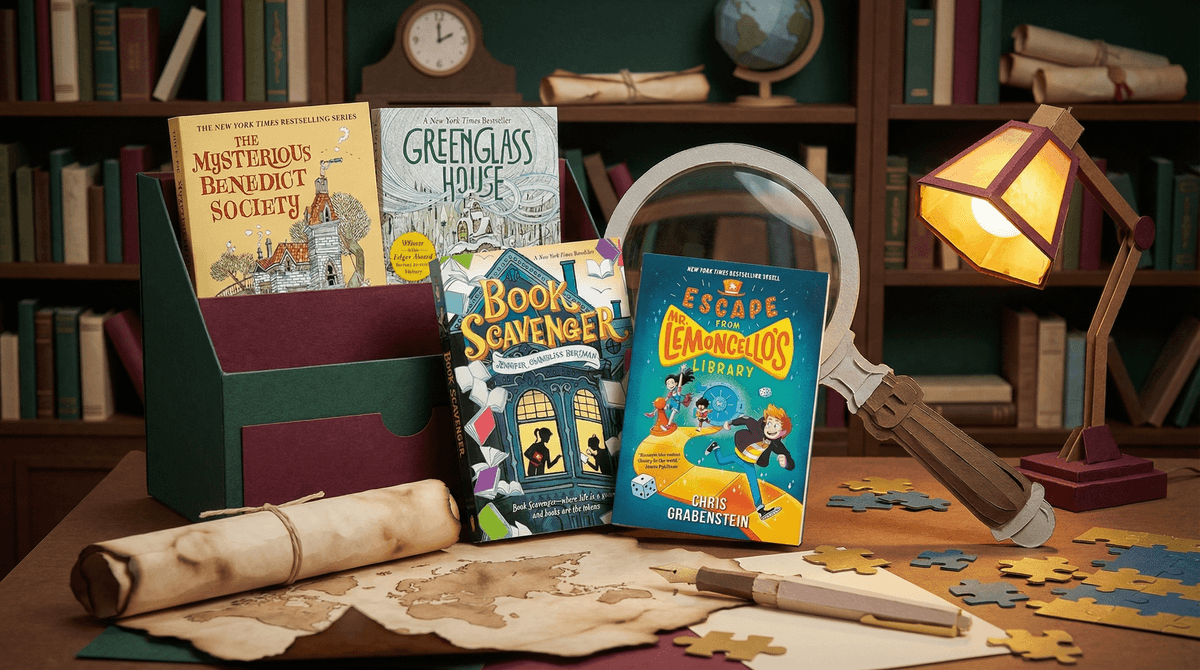
If your kid devoured The Mysterious Benedict Society and is now wandering around the house looking lost, you're in the right place. Trenton Lee Stewart's series hit that sweet spot: smart kids using their actual brains to solve problems, found-family vibes, puzzles that respect young readers' intelligence, and villains you can outsmart rather than outfight.
The good news? There's a whole category of middle-grade fiction that delivers this same energy. These are books where being clever matters more than being strong, where misfits become family, and where the plot actually requires readers to think alongside the characters. No chosen ones with magic swords here—just kids (and sometimes adults) using observation, logic, and teamwork to save the day.
Kids who love MBS aren't just looking for any adventure story. They're drawn to narratives that:
Celebrate intelligence as a superpower. These books make being observant, curious, and analytical feel genuinely cool. The protagonists win because they notice details, solve puzzles, and think creatively—not because they're the strongest or most popular.
Feature found families and loyal friendships. Like Reynie, Sticky, Kate, and Constance, the characters in these books often start as outsiders who build deep, authentic connections. The relationships feel earned, not manufactured.
Trust young readers to keep up. These aren't dumbed-down mysteries. They include codes to crack, clues to piece together, and plot threads that require attention. Kids feel respected as readers.
Balance tension with warmth. Yes, there's danger and high stakes, but these books also have humor, heart, and moments of genuine coziness. They're exciting without being traumatizing.
Ages 8-12
Ada Lovelace and Mary Shelley solve mysteries in Victorian London. Yes, THOSE Ada and Mary—reimagined as 11-year-old best friends running a detective agency. The historical setting is rich, the mysteries are clever, and the friendship between two brilliant girls is everything. Bonus: your kid learns about real historical figures while solving cases.
The Mysterious Benedict Society Extended Universe
Ages 8-12
If they haven't read ALL of them yet: there are four main books plus a prequel (The Extraordinary Education of Nicholas Benedict). The prequel is genuinely excellent and might be the best book in the series—it's a standalone origin story that hits even harder than the original.
Ages 8-12
A governess must educate three children who were raised by wolves. Sounds wacky, but it's actually a clever mystery series with Victorian manners, wordplay, and a protagonist (Penelope Lumley) who solves problems through education, kindness, and observation. The humor is dry and sophisticated—think Lemony Snicket meets Jane Austen.
Ages 9-13
Emily and James solve puzzles and ciphers hidden in books around San Francisco. If your kid loves the puzzle-solving aspect of MBS, this series delivers codes, book-related mysteries, and a friendship between two smart kids who don't quite fit in. The Bay Area setting is vivid, and the stakes feel real without being too intense.
Ages 9-13
A smuggler's inn, mysterious guests, a snowstorm, and a kid who loves role-playing games. This is a locked-room mystery where Milo and his new friend Meddy investigate the strange visitors at his family's inn. The puzzle-solving is intricate, the atmosphere is cozy-creepy, and the found-family themes are strong. It's like The Westing Game meets The Chronicles of Narnia.
Ages 9-13
Two best friends—one who wants to be a warrior, one who wants to be a mage—both get drafted into the dangerous Adventurers Guild instead. It's fantasy, but the emphasis is on teamwork, strategy, and using your brain to survive. The friendship between Zed and Brock feels authentic, and the world-building is solid without being overwhelming.
Ages 10-14
An apothecary's apprentice solves a murder mystery in 1665 London using codes, chemistry, and deductive reasoning. Christopher Rowe is a great protagonist—curious, loyal, and genuinely smart. The historical details are fascinating (alchemy! the plague! secret societies!), and the puzzles are complex enough to engage older middle-grade readers.
Ages 8-12
Twelve kids get locked in a futuristic library and must solve puzzles to escape. It's Charlie and the Chocolate Factory meets The Westing Game, with a heavy emphasis on teamwork, library science, and clever problem-solving. The puzzles reference classic children's books, making it a love letter to reading itself.
Ages 9-12
Two sixth-graders investigate the theft of a Vermeer painting using pentominoes (geometric puzzles) and pattern recognition. The mystery is genuinely complex, the art history is fascinating, and the book includes visual puzzles hidden in the illustrations. If your kid likes both MBS and math/logic puzzles, this is a perfect match.
Ages 8-12
Okay, this one's different—it's not a mystery—but hear me out. Roz is a robot who washes up on an island and must learn to survive by observing, adapting, and building relationships with the animals. The problem-solving is constant, the found-family theme is powerful, and the emotional intelligence required matches what MBS fans love. It's also beautifully written and works for a wide age range.
Reading level vs. interest level: Most of these books are accessible to strong 3rd-grade readers but have enough depth to engage 7th graders. Don't worry if your 11-year-old is reading "younger" books—complexity of thought matters more than Lexile scores.
Series commitment: Several of these are multi-book series. If your kid is a completionist who needs to finish everything, maybe start with standalones or shorter series. The Wollstonecraft Detective Agency has just four books. Greenglass House can be read as a standalone even though there are sequels.
Screen adaptations: The Mysterious Benedict Society has a Disney+ series that's... fine. It's different from the books (more action-y, less puzzle-y), but some kids enjoy both. The Wild Robot has a DreamWorks movie coming in 2024 that looks promising.
Historical content: Several of these books (The Blackthorn Key, The Wollstonecraft Detective Agency) are set in the past and include period-appropriate references to disease, class differences, and social inequality. They're handled thoughtfully, but you might get questions about why people didn't have medicine or why girls couldn't go to school.
If your kid loved The Mysterious Benedict Society, they're showing you something important: they want stories that respect their intelligence, celebrate friendship, and let them solve problems alongside the characters. These books deliver exactly that.
The best part? This genre is having a moment. Publishers are finally recognizing that kids want complex plots, clever protagonists, and mysteries that require actual thinking. You're not going to run out of options anytime soon.
Start with whatever sounds most interesting to your kid—whether it's the historical setting of The Blackthorn Key, the puzzle-focus of The Book Scavenger, or the cozy-mystery vibes of Greenglass House. You really can't go wrong here.
And if they blow through all of these? Come back and Get more recommendations —we've got plenty more where these came from.