

Look, evolution isn't exactly light bedtime reading material. We're talking about deep time, natural selection, fossils, human origins, and the fact that we share ancestors with bananas. It's genuinely mind-bending stuff that raises big questions about where we came from and how life works.
The good news? There are actually some incredible books out there that make evolution accessible, engaging, and age-appropriate for kids. The bad news? There are also some truly terrible ones that either dumb it down to the point of uselessness or go so deep into technical jargon that even adults need a PhD to follow along.
This guide will help you build a solid evolution library for your family—books that actually explain the science without being condescending, preachy, or mind-numbingly boring.
Evolution is foundational to understanding biology, medicine, ecology, and honestly just how the world works. It's not controversial in the scientific community (let's be clear about that in 2026), but it is complex. Kids are naturally curious about where things come from, why animals look the way they do, and how humans fit into the bigger picture.
The right books can:
- Build genuine scientific literacy
- Spark curiosity about the natural world
- Provide a framework for understanding biology and life sciences
- Answer the "why" questions kids constantly ask about animals and nature
- Prepare them for actual science education (because evolution is taught in schools, full stop)
Ages 4-7: The Foundation
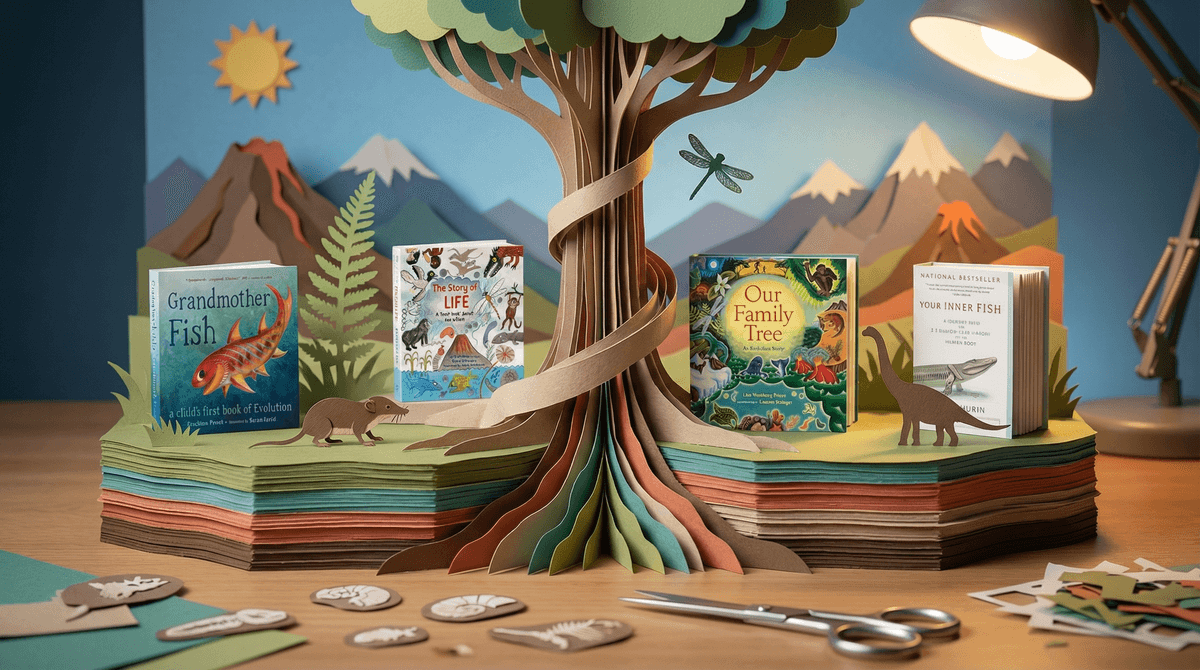
Grandmother Fish by Jonathan Tweet is hands-down the best starting point for little kids. It's a picture book that traces evolutionary history through "grandmothers"—Grandmother Fish, Grandmother Reptile, Grandmother Mammal. The illustrations are charming, and it includes actions kids can do (wiggle, chomp, snuggle) that connect them to different ancestors. It's simple without being simplistic.
Our Family Tree: An Evolution Story by Lisa Westberg Peters takes a similar approach but focuses more on the human evolutionary tree. The illustrations are gorgeous, and it does a great job showing how we're connected to other living things without getting too technical.
Ages 8-12: Building Understanding
The Story of Life: Evolution by Catherine Barr and Steve Williams is perfect for this age range. It covers everything from the first single-celled organisms to modern humans in a way that's genuinely engaging. The illustrations are fun, the explanations are clear, and it doesn't shy away from the science while keeping it accessible.
Evolution: How We and All Living Things Came to Be by Daniel Loxton is more detailed and works well for older kids in this range (10+). It's thorough, scientifically accurate, and includes actual evidence for evolution—fossils, DNA, observed changes. This is the book for kids who want the real deal.
Charles Darwin's On the Origin of Species (adapted by Rebecca Stefoff) is a proper adaptation of Darwin's actual work, made accessible for middle-grade readers. It's not dumbed down—it's just translated into language that 10-12 year olds can actually understand. Great for kids who are ready for more serious science reading.
Ages 13+: Going Deeper
The Greatest Show on Earth by Richard Dawkins is technically written for adults, but bright teens can handle it. Dawkins lays out the evidence for evolution in exhaustive detail. Fair warning: he's not subtle about his views on religion, so if that's going to be an issue in your household, maybe skip this one. But as a pure science text, it's excellent.
Your Inner Fish by Neil Shubin is more accessible than Dawkins and focuses on the evolutionary history written in our own bodies. Why do we have hiccups? Why do we get hernias? The answers lie in our fishy ancestors. It's fascinating and genuinely readable for high schoolers.
The Tangled Tree by David Quammen is for serious teen readers who want to understand how modern genetics has complicated and enriched our understanding of evolution. It's about horizontal gene transfer, the microbiome, and how the "tree of life" is actually more of a tangled web. Not light reading, but incredibly rewarding.
Start early, start simple. You don't need to wait until middle school to introduce evolution. Picture books for preschoolers work great because they focus on the wonder and connection between living things rather than getting bogged down in mechanisms.
Evolution isn't just about humans. The best books spend time on the full scope of life—bacteria, plants, animals, fungi. Understanding that humans are just one tiny branch on a massive tree helps kids grasp the scale and scope of evolutionary time.
Evidence matters. Good evolution books don't just say "this is how it works"—they show the evidence. Fossils, DNA, anatomical similarities, observed changes in populations. Books that skip the evidence are missing the point.
It's okay to not have all the answers. Evolution is still an active area of research. Scientists are constantly learning new things about how it works, how fast it happens, and what mechanisms drive it. Books that acknowledge uncertainty and ongoing research are actually more scientifically accurate than ones that present everything as settled fact.
The Magic School Bus and the Science Fair Expedition technically covers evolution but does it so briefly and superficially that it's basically useless. The Magic School Bus is great for many topics, but evolution isn't one of them.
Most "creation science" books marketed as alternatives to evolution are not science books—they're religious texts dressed up with scientific-sounding language. If you want your kids to understand actual biology, these won't help. (And if you want them to understand your family's religious beliefs, that's totally valid—just don't confuse it with science education.)
Building a good evolution library doesn't require dozens of books—just a few solid ones at each age level. Start with Grandmother Fish for little kids, move to The Story of Life for elementary age, and graduate to Your Inner Fish for teens.
The goal isn't to turn your kid into an evolutionary biologist (though that would be cool). It's to give them a scientifically accurate understanding of how life works, where we came from, and how we're connected to everything else on this planet. That's foundational knowledge that will serve them well in science classes, in understanding environmental issues, in making sense of medicine and disease, and honestly just in being a scientifically literate human in 2026.
Start with one book at your kid's current reading level. Read it together if they're younger, or just put it on their shelf if they're older. Get advice on how to talk to your kids if you're not sure how to approach conversations about evolution in your household, especially if you're navigating different beliefs between co-parents or extended family.
And if your kid gets really into this stuff? Lean into it. Take them to natural history museums, watch documentaries about evolution, visit fossil sites, get them involved in citizen science projects. Scientific curiosity is something to encourage, not manage.