

Fifth grade math is where things get real. We're talking fractions, decimals, percentages, multi-digit multiplication, and the dreaded "order of operations." This is the year when some kids start saying "I'm just not a math person" — and honestly, that breaks my heart a little because it's usually less about ability and more about confidence.
Math learning games are digital (and sometimes physical) games designed to make practicing these concepts feel less like homework and more like... well, a game. The best ones disguise the learning so well that kids don't even realize they're solving 20 division problems in a row. They're getting immediate feedback, leveling up, earning rewards, and building that crucial sense of "hey, I can actually do this."
The market is flooded with options ranging from genuinely excellent to straight-up garbage that just slaps some math problems over a clicker game. So let's talk about what actually works.
Fifth grade is a pivotal year. Kids are transitioning from concrete arithmetic to more abstract mathematical thinking. They need to understand fractions as parts of wholes AND as division AND as ratios. They're working with decimals and percentages and starting to see how math connects to real life.
The problem? Traditional practice can feel soul-crushing. Worksheets and timed tests create anxiety, and anxiety kills learning. Games, when done right, create a low-stakes environment where failure is just "try again" instead of a red X on a paper coming home in the backpack.
The key is finding games that actually teach concepts, not just drill facts. There's a place for fact fluency (yes, they still need to know their times tables), but 5th grade math is about understanding WHY the math works, not just memorizing procedures.
This is the one your kid's classmates are probably already playing. It's a fantasy RPG where kids battle monsters by solving math problems. The game adapts to their level and covers the full curriculum.
The good: It's genuinely engaging, the adaptive learning actually works, and it aligns with curriculum standards. Kids will voluntarily play this. The free version is robust.
The catch: The paid membership ($9.99/month or $59.88/year) unlocks cosmetic items, and the game REALLY wants kids to bug you about it. There are constant prompts to upgrade. You'll need to have a conversation about in-game purchases and why we're not buying every sparkly pet. But if you can handle that conversation (and honestly, it's good practice for future money talks), the free version is genuinely useful.
Best for: Ages 8-13, kids who like RPGs and don't mind a little grinding.
These apps teach number sense and operations through play. Kids manipulate cute "Nooms" (little creatures that represent numbers) to solve puzzles. It builds genuine conceptual understanding of how numbers work.
The good: Beautiful design, no ads, no subscriptions after purchase ($7.99 each), and it actually teaches mathematical thinking rather than just procedures.
The catch: It's not curriculum-aligned in an obvious way, so it won't necessarily help with tomorrow's homework on long division. It's building deeper understanding, which pays off long-term.
Best for: Ages 8-12, kids who struggle with number sense or need to understand the "why" behind operations.
A game-based learning platform where kids practice math skills through various mini-games and can compete with classmates or kids worldwide.
The good: Adaptive, curriculum-aligned, works on any device, and many schools have subscriptions so it's free for students. The competitive element motivates some kids.
The catch: The free home version limits play time to about 25-30 minutes per week unless your school has a subscription. The mini-games can feel a bit dated compared to modern mobile games.
Best for: Ages 5-14, kids who are motivated by competition and leaderboards.
This is a website (not an app) with hundreds of free math games, logic puzzles, and problem-solving activities. Think of it as the cool math teacher's website.
The good: Completely free, no login required, no data collection, covers everything from basic operations to logic puzzles and word problems. The variety means kids can find something they like.
The catch: It's a website from the 2010s, so the graphics aren't going to compete with modern games. Also, because there's SO much content, it can be overwhelming to know where to start.
Best for: Ages 8-14, kids who like variety and don't need flashy graphics, great for targeted practice on specific concepts.
From the Art of Problem Solving curriculum, this is a game-based platform that teaches problem-solving and mathematical reasoning through comics and interactive puzzles.
The good: Focuses on deep understanding and problem-solving, not just procedures. The content is legitimately challenging and engaging. Great for kids who find regular math too easy or boring.
The catch: Subscription is $15/month or $120/year. It's designed for kids who are ready for challenge and enrichment, not necessarily for kids who are struggling with grade-level content.
Best for: Ages 8-13, kids who love puzzles and need more challenge than school provides.
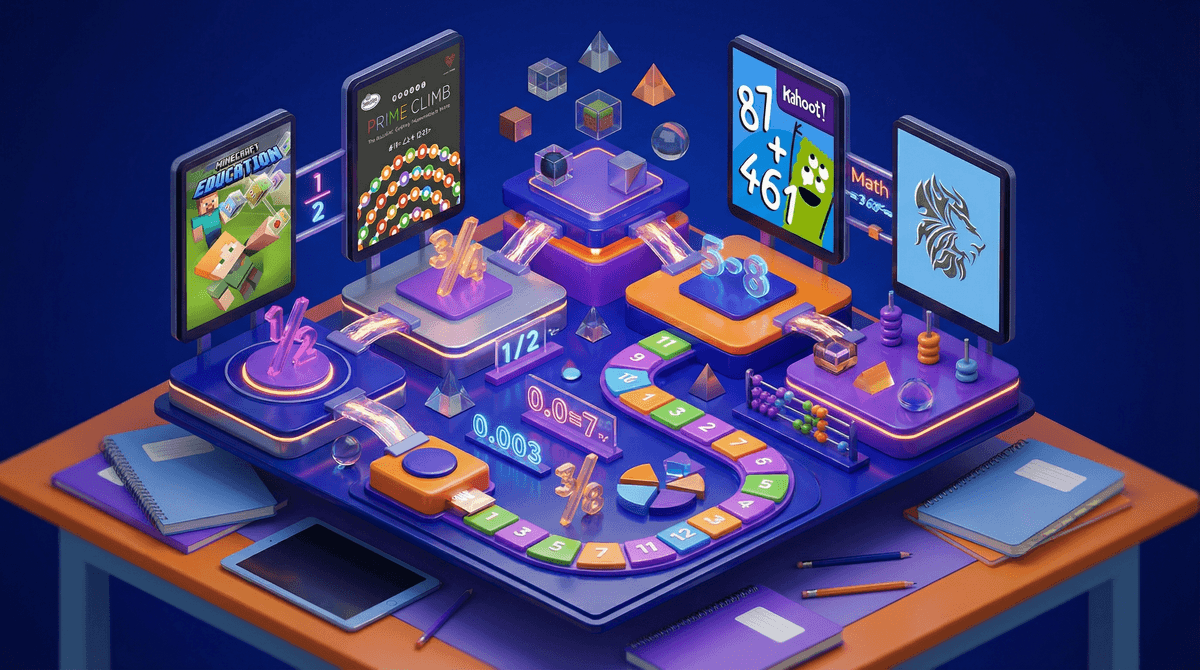
Yes, really. The education version has specific math lessons and challenges built in, plus kids can practice spatial reasoning, geometry, and problem-solving in creative mode.
The good: If your kid already loves Minecraft, this leverages that engagement for learning. The math lessons are actually well-designed.
The catch: It requires a subscription ($12/year for home use) and adult setup. It's not as plug-and-play as other options.
Best for: Ages 8-14, kids who are already Minecraft obsessed and learn best through building and exploration.
A beautiful board game that teaches prime numbers, multiplication, and division through gameplay. Kids race to get both pawns to the center of the board by rolling dice and applying operations.
The good: It's genuinely fun for the whole family, builds number sense and strategic thinking, and the color-coding system helps kids see patterns in numbers. No screen time required.
The catch: It's about $30 and requires at least one player who understands the rules well enough to teach others.
Best for: Ages 10+, family game night, kids who do better with hands-on learning.
Timed drill apps that just flash math facts: These create anxiety without building understanding. If your kid already knows their facts, they don't need this. If they don't, this won't help them learn.
Games that are 90% game, 10% math: You know the ones — solve one problem, then watch 30 seconds of animation. These are time-wasters pretending to be educational.
Anything that requires constant parent supervision: If you have to sit there and click "next" between every problem, it's not actually saving you time or helping your kid become independent.
Here's the thing: these games work best as supplements, not replacements for actual math instruction. They're for practice, building confidence, and keeping skills sharp — not for introducing new concepts cold.
Set clear expectations: "You can play Prodigy for 20 minutes after homework" is different from "Prodigy IS your math homework." The first one works, the second one might not cover what they're actually learning in class.
Check the settings: Most of these games let you set grade level and focus on specific skills. If your kid is struggling with fractions, you can often customize the game to give them more fraction practice.
Don't make it a punishment: "You got a bad grade, so now you have to play math games for an hour" is a great way to make them hate both math AND games.
Play together sometimes: Especially with games like Prime Climb or even watching them play Prodigy, your engagement shows that math is something worth caring about.
The best math game is the one your kid will actually play. Prodigy is popular for a reason — it works for a lot of kids and it's free. Math Playground is a fantastic free resource that deserves more love. DragonBox is worth the investment if your kid needs to build number sense. And Beast Academy is excellent for kids who need more challenge.
Fifth grade math doesn't have to be a battle. Sometimes the right game can turn "I hate math" into "can I play one more level?" And honestly? That's worth way more than a perfect score on a worksheet.
Want help figuring out which game is right for YOUR kid? See which game is right for your kid — we can help you sort through the options based on what your kid actually needs and enjoys.