

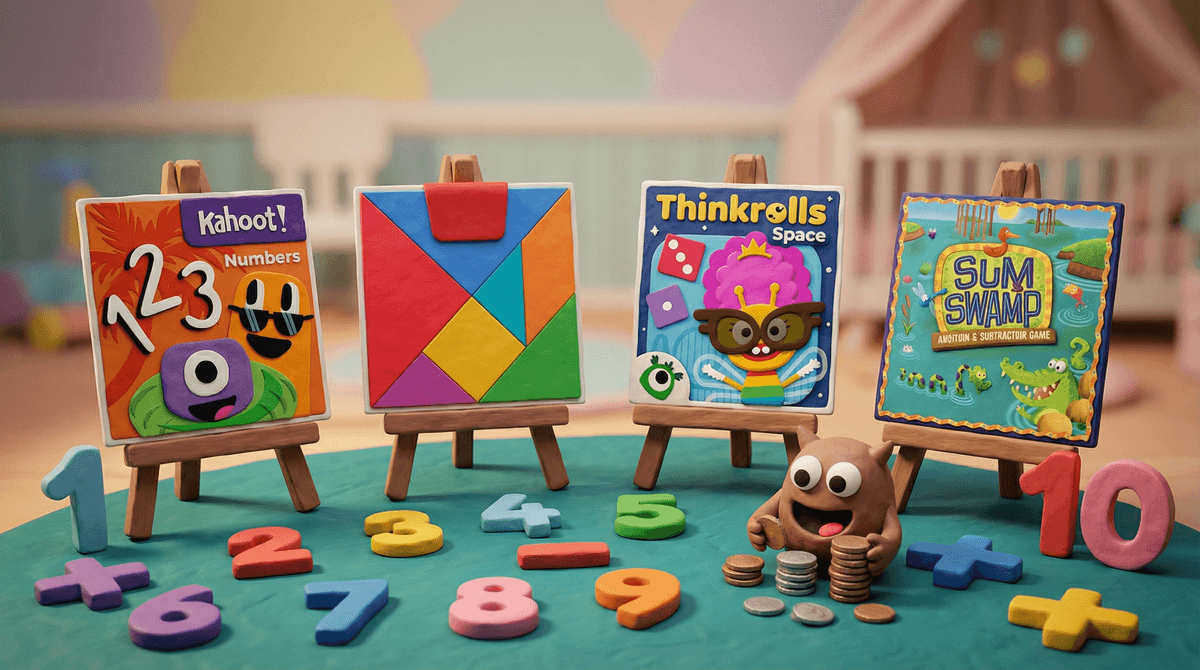
Look, I get it. Your first grader comes home with math homework that somehow feels harder than anything you remember from elementary school, and you're thinking "there's got to be a better way than me trying to explain place value for the 47th time while dinner burns on the stove."
The good news? There are actually some legitimately excellent math games that make learning addition, subtraction, and number sense feel more like play than work. The bad news? You have to wade through approximately 8 million "educational" apps that are basically just digital worksheets with annoying sound effects.
So let's cut through the noise. Here are the math games that actually work for 1st graders—the ones that build real skills without making everyone want to throw the iPad out the window.
This is the one your kid's classmates are probably already playing. Prodigy wraps math practice in a fantasy RPG adventure where kids battle monsters by solving math problems. It adapts to your child's level automatically, which means it's actually meeting them where they are.
The catch: The free version is solid, but your kid will 100% beg you for the premium membership because other kids have fancy pets and gear. You can absolutely say no—the educational content is identical. But be prepared for that conversation.
Best for: Kids who love Pokémon-style games and respond well to the "just one more battle" motivation.
This requires the Osmo base and iPad setup (it's an investment, around $80-100), but it's genuinely clever. Kids use physical numbered tiles to solve problems, and the iPad camera recognizes what they're doing. It bridges that crucial gap between concrete and abstract thinking that 1st graders need.
Why it works: There's something about moving physical objects that helps math concepts click in a way that tapping a screen doesn't. Plus, it's great for kids who need to fidget while learning.
Best for: Hands-on learners who do better with physical manipulatives.
From the same folks who made the excellent reading game, this one focuses on early number sense—counting, comparing quantities, basic addition and subtraction. The design is genuinely charming (not overstimulating), and there's no ads or in-app purchases nonsense.
The reality: It's a bit more basic than some others, which makes it perfect for kids who are still building confidence with numbers. Not great for kids who are already solid with basic concepts.
Best for: Kids who need to build foundational number sense or who get overwhelmed by busier games.
This is the weird artsy one that somehow makes number composition and decomposition (fancy words for understanding that 7 can be 5+2 or 4+3) actually make sense. It uses these cute little creatures called Nooms that combine and split apart.
Why it's different: It teaches the conceptual understanding of numbers rather than just drill-and-kill practice. Your kid might not even realize they're doing math, which is kind of the point.
Best for: Visual learners and kids who need to understand the "why" behind math concepts.
Popular in schools, Sumdog gamifies math practice with multiplayer competitions and a variety of mini-games. It covers all the 1st grade standards and adapts to your child's level.
The school connection: Many schools use this, so your kid might already have an account. Check with their teacher before paying for a home subscription.
Best for: Competitive kids who are motivated by leaderboards and challenges.
Not all "educational" games are created equal. Here's what actually matters for 1st grade math:
Adaptive difficulty: The game should adjust to your kid's level. Too easy and they're bored, too hard and they're frustrated. Good games find that sweet spot automatically.
Conceptual understanding over speed: At this age, we want kids understanding why 6+3=9, not just memorizing it. Games that encourage thinking over rapid-fire answers are better.
Aligned with what they're learning: First grade math focuses on addition and subtraction within 20, place value (understanding tens and ones), and measurement. Games should hit these areas.
Actual feedback: "Try again!" isn't helpful. Good games show kids why an answer is wrong and guide them toward the right thinking.
Here's the thing—these games are genuinely educational, but they're still screen time. The sweet spot for 1st graders is usually 15-20 minutes of math game time, not an hour-long session.
Think of these as a supplement to, not a replacement for, hands-on math practice. Counting actual objects, playing board games like Uno or Sum Swamp, and doing real-world math (cooking, shopping, measuring) are all still crucial.
Most of these games have free versions with premium upsells. Here's my honest take: start with free. See what your kid actually engages with. If they're using it regularly and it's genuinely helping, then consider paying.
The premium versions usually offer more content, fewer ads, and better reporting for parents. But the core educational value is typically the same. Don't let your kid guilt you into paying because their friend has a sparkly dragon—that's not about learning math.
Skip games that:
- Have more ads than actual gameplay
- Push in-app purchases constantly
- Focus purely on speed and memorization
- Use anxiety-inducing timers for young kids
- Have chaotic, overstimulating design
Also watch for: Games that let kids skip the math problems or advance without actually solving them correctly. That's just... not educational.
The best math game for your 1st grader is the one they'll actually use. Prodigy Math is probably your best bet if you want one solid all-arounder—it's free, comprehensive, and most kids find it genuinely fun.
If your kid needs more hands-on learning, Osmo Numbers is worth the investment. For building foundational skills without overwhelm, Teach Your Monster Number Skills is great.
But here's the real talk: no game is going to magically make your kid a math genius. These are tools. Good tools, but still just tools. Use them for 15-20 minutes a few times a week, alongside other math activities, and you're doing great.
And if your kid still doesn't get place value after all this? That's what 2nd grade is for. They'll get there.
- Try 2-3 free versions and see which one your kid actually gravitates toward
- Set a timer—seriously, 15-20 minutes is plenty
- Check if your kid's school already uses any of these (free accounts!)
- Balance with offline math games and activities

Want to understand how your family's gaming habits compare to other families with 1st graders? Take the Screenwise survey to get personalized insights and recommendations.