

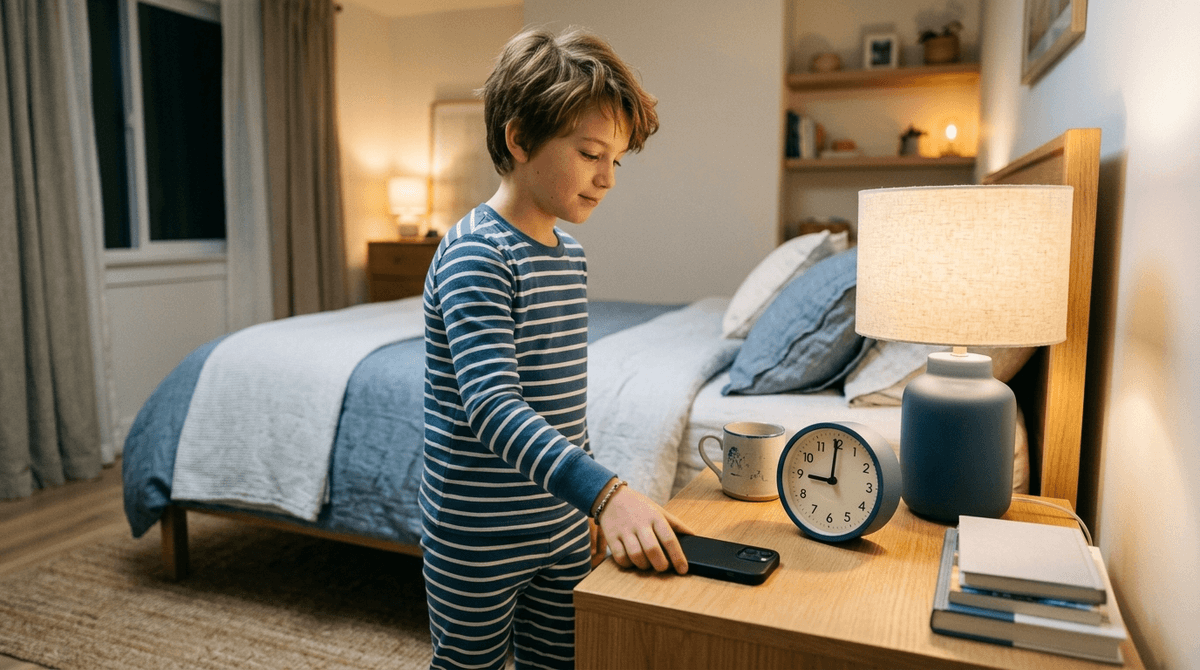

A consistent bedtime protects your child’s sleep more than a strict screen-time limit does. New data suggests that the primary reason devices ruin sleep isn't some unavoidable biological interference, but the simple fact that they scramble a family’s schedule.
Screens disrupt children’s sleep primarily by eroding bedtime consistency rather than through a direct effect of the screen itself. Keeping a predictable lights-out time matters more for your child’s rest than policing the total number of minutes they spend on a device.
Most parenting advice focuses on "how much" screen time a kid gets, leading to constant negotiations, timers, and guilt. This research shifts the focus from the quantity of tech to the quality of the routine. If you can keep the bedtime clock steady, you can mitigate most of the sleep-related damage caused by digital media.
For parents, this is a permission slip to stop obsessing over every extra ten minutes of Minecraft and start obsessing over the 8:00 PM lights-out rule. A regular schedule acts as a buffer, ensuring that even if a child has a high-tech day, they still get the nine-plus hours of sleep their developing brains require.
Researchers have long observed a link between heavy screen use and exhausted children, but the "how" was always murky. The prevailing theories focused on blue light suppressing melatonin or high-octane content over-stimulating the brain.
This study tested a third possibility: the "displacement" effect. Researchers wanted to know if screens were simply pushing bedtime later and later, creating an erratic schedule that makes it impossible for a child’s internal clock to settle. By analyzing a massive national dataset, they sought to find out if the schedule was the real culprit behind the sleep crisis.
A regular bedtime schedule is the single most important factor in whether a school-aged child gets enough rest. The numbers show a clear hierarchy of influence:
- Consistency is king. Children with consistent bedtimes had 61% lower odds of "short sleep" (less than nine hours) compared to those with erratic schedules.
- Screens are a schedule-killer. Kids who used screens for less than three hours a day were 52% to 73% more likely to maintain a consistent bedtime than those who used them more.
- The link is indirect. Once researchers accounted for bedtime consistency, the direct statistical connection between screen time and sleep loss basically disappeared.
This means that screens aren't a "sleep poison" in and of themselves; they are a distraction that makes parents and children lose track of time. If you fix the timing, you fix the sleep.
This finding is a major win for parental sanity because it identifies a high-leverage habit. It’s much easier to enforce one "hard" rule—lights out at 8:30 PM—than it is to monitor and litigate every minute of device use throughout the afternoon.
It also suggests that the "blue light" panic might be overstated for school-aged children compared to the simple "staying up too late" problem. While light exposure does matter, the behavioral pull of the "infinite scroll" or the "one more level" loop is what’s actually keeping kids awake. The study implies that if you can break that loop and stick to the schedule, the biological impact of the screen is manageable.
The data comes from the 2021–2022 National Survey of Children's Health, which means it relies on parent-reported estimates. Parents are notoriously bad at estimating exactly how many minutes their kids spend on tablets and exactly when they fall asleep.
The study is also observational. It can prove that screen use and erratic bedtimes go hand-in-hand, but it can’t technically prove that the tablet caused the schedule to break. It’s possible that families who are naturally less structured simply have more screen time and more erratic bedtimes simultaneously. Lastly, the survey didn't track what the kids were doing—watching a calming movie is likely different from playing a competitive online game.
- If your child is getting less than nine hours of sleep, stop counting their total screen minutes for a week and focus exclusively on hitting the exact same lights-out time every night, including weekends.
- If you allow your child to have a "big screen day" (like a rainy Saturday), do not allow the bedtime to slide; the consistency of the schedule is what protects their brain from the extra stimulation.
- If screens are causing bedtime battles, move the "digital sunset" to at least 60 minutes before the target bedtime to ensure the transition doesn't push the actual sleep start time late.
- If you are choosing between different types of media, prioritize content that has a clear "end point" (like a 22-minute episode) rather than an infinite loop (like YouTube shorts), which makes it easier to maintain the schedule.
You don't need to be a screen-time minimalist to raise a well-rested child, but you do need to be a scheduling maximalist. Focus your energy on the clock, not just the apps, and let the routine do the heavy lifting.
Knowlden AP, Flora SM, Merianos AL (2026). Bedtime Consistency as a Behavioral Pathway Linking Screen Time to Short Sleep Duration Among U.S. School-Aged Children. Behavioral sleep medicine. doi:10.1080/15402002.2026.2673890 — https://pubmed.ncbi.nlm.nih.gov/42142028/