

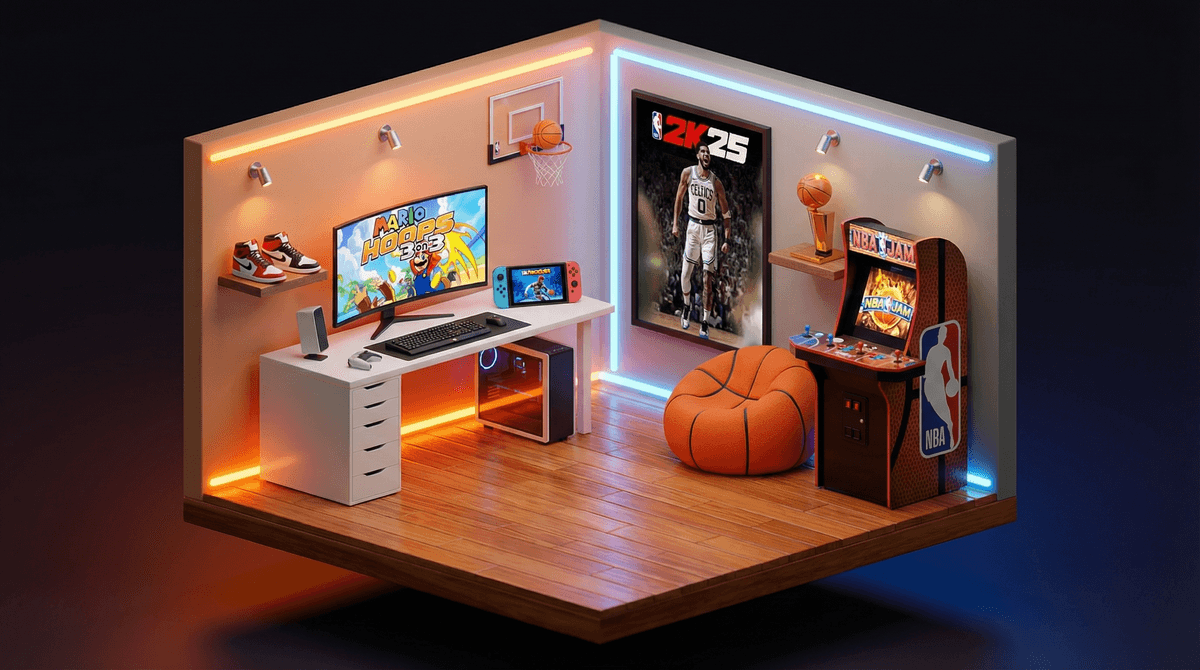
Basketball video games range from ultra-realistic NBA simulations to cartoon characters dunking in fantasy worlds. The landscape is way more diverse than you might think—we're talking everything from NBA 2K25 with its photorealistic graphics and complex gameplay to Mario Hoops 3-on-3 where Bowser can drain three-pointers while riding a go-kart (okay, maybe not the kart part, but you get it).
The main categories you'll encounter:
Simulation games like the NBA 2K series that attempt to recreate real basketball with actual NBA players, teams, and physics. These are the games that make kids suddenly know the starting lineup of the 2011 Miami Heat.
Arcade-style games like NBA Playgrounds or NBA Jam that are more about over-the-top dunks and less about realistic free-throw percentages.
Fantasy/character games where established gaming characters play basketball—think Mario, Sonic, or even Fortnite's basketball mini-games .
.
Mobile games like Basketball Stars that kids can play on phones and tablets, often with simplified controls.
Basketball games hit different than other sports games for a few reasons. First, basketball translates really well to gaming—it's fast-paced, high-scoring, and visually exciting. A sick dunk in a video game feels almost as satisfying as pulling one off in real life (and way safer for your ankles).
The connection to real NBA culture is huge. Kids aren't just playing a game—they're building their dream team with their favorite players, recreating buzzer-beaters they saw on YouTube, and arguing with friends about whether LeBron or Jordan is better in the game. It's sports fandom meets gaming.
For kids who actually play basketball, these games offer a different way to engage with the sport. They're learning plays, understanding positioning, and thinking strategically—even if it's through a controller. And for kids who don't play IRL, it's a low-pressure way to understand and appreciate the sport.
Plus, let's be real: the customization is addictive. Creating your own player, designing their look, choosing their shoes, building their stats—it's basically character creation meets sports fantasy.
Ages 5-8: Start with the arcade stuff
Young kids need simple controls and forgiving gameplay. Nintendo Switch Sports has a basketball mode that uses motion controls—they're literally just throwing their arms up to shoot. Mario-themed basketball games work well here too because the characters are familiar and the gameplay is intuitive.
Ages 9-12: The sweet spot for most basketball games
This is when kids can handle more complex controls but aren't necessarily ready for the full simulation experience. NBA Playgrounds, older NBA 2K games (maybe 2K18 or 2K19 if you can find them cheap), and mobile options like Basketball Stars all work. The online interactions here need monitoring—more on that in a sec.
Ages 13+: Welcome to NBA 2K territory
Teenagers can handle the full simulation experience of current NBA 2K games. The gameplay is sophisticated, the modes are deep, and honestly, the game can teach them a lot about basketball strategy. But (and this is a big but), this is also where the microtransaction nightmare really kicks in.
The Microtransaction Situation Is... A Lot
NBA 2K games have an ESRB rating of E for Everyone, which technically seems fine. But here's what that rating doesn't tell you: the in-game economy is basically designed to push purchases.
In MyCareer mode (the most popular mode where you create your own player), your character starts as basically terrible. To improve them, you need Virtual Currency (VC). You can earn VC by playing... very, very slowly. Or you can buy it with real money. We're talking $50-100 of real money to get your player to a competitive level.
This is worth understanding deeply because kids don't always grasp that VC costs real money. They just know their friends' players are better and they're getting destroyed online.
Online Play = Online Culture
When kids play NBA 2K online, they're not just playing basketball—they're entering a competitive gaming space with all that entails. Voice chat can get toxic fast (lots of trash talk, some of it crossing lines). The "Park" mode where players hang out and challenge each other is basically a social space, and kids as young as 8 or 9 are in there interacting with teenagers and adults.
Most basketball games have online components, but the NBA 2K community is particularly intense. If your kid is playing online, they need to understand how to mute players, report harassment, and when to just exit a match.
The Gambling-Adjacent Stuff
NBA 2K has "MyTeam" mode, which is essentially a card-collecting game where you build your team by opening packs. Sound familiar? It's the same loot box mechanic that's gotten games in hot water for resembling gambling. You can buy packs with real money, and you never know what you'll get. Kids can develop some genuinely problematic spending patterns here.
The Good Stuff (Yes, Really)
Okay, not everything is doom and gloom. Basketball games can actually teach:
- Strategic thinking: Understanding plays, spacing, and timing
- Stats and math: Kids start caring about percentages and averages
- Sports appreciation: They learn players' names, team dynamics, and basketball history
- Hand-eye coordination: Obviously
And for kids who play actual basketball, these games can reinforce concepts their coaches are teaching. Understanding a pick-and-roll in NBA 2K might help them execute it better in their rec league game.
For younger kids (5-10):
- Stick with offline modes or games without online components
- Avoid any game with in-app purchases, or disable purchases entirely through your device settings
- Play together—it's actually pretty fun and you can teach good sportsmanship
- Set time limits before they start playing (30-45 minutes is plenty)
For tweens (10-13):
- Have a direct conversation about virtual currency and real money before they start playing
- If allowing online play, keep it to friends-only matches initially
- Check in on who they're playing with and what the interactions are like
- Consider setting up a "gaming budget" if they want to make purchases—it teaches financial literacy
- Learn how to set up parental controls for whatever platform they're using
For teens (13+):
- They can probably handle the full experience, but the money conversation is still critical
- Set clear spending limits on in-game purchases (and enforce them)
- Talk about online behavior—both what they say and what they tolerate from others
- Encourage a balance with other activities (including actual basketball if they're into it)
If the NBA 2K microtransaction machine feels like too much:
- Older NBA 2K games (2K16-2K19) are often available cheap and have less aggressive monetization
- Rocket League isn't basketball, but it scratches the same competitive sports-game itch with cars playing soccer
- Actual basketball outside—radical concept, I know, but the graphics are incredible
- NBA Playgrounds for a more casual, less monetized experience
- Board games like Rivals for Catan (okay, not basketball, but strategic and screen-free)
Basketball games aren't inherently problematic—they're actually pretty great for kids who love the sport. But the current state of NBA 2K specifically requires parents to be way more involved than you'd expect from an E-rated game.
The move: Start younger kids with simpler, offline games. For older kids interested in NBA 2K, have the money conversation first, set up parental controls, and monitor online interactions. And maybe, just maybe, suggest they also pick up an actual basketball occasionally.
The good news? If you navigate this thoughtfully, basketball games can be a legitimate hobby that combines sports knowledge, strategic thinking, and yes, fun. Just keep your credit card far away from the PlayStation.
- Check what basketball games your kid's friends are playing—peer pressure is real
- If they're already playing NBA 2K, review purchase history and have a conversation
- Set up spending limits on your gaming platform
- Consider playing a few games yourself to understand what they're experiencing
- Join the Screenwise community to see what other parents in your area are doing with sports games