

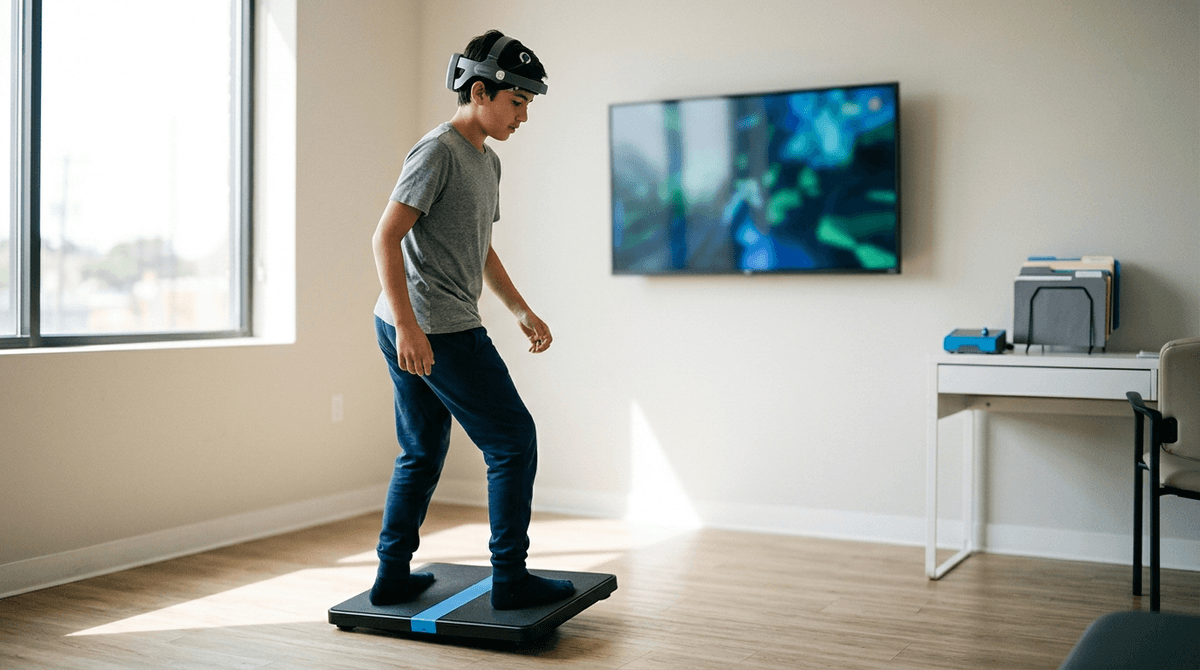
Pairing gentle brain stimulation with active video games may significantly boost motor skills and mental flexibility in children with autism compared to exercise alone.
Combining low-current brain stimulation (tDCS) with active video games like Xbox Kinect improves balance and cognitive flexibility in children with ASD more effectively than gaming by itself. This dual-intervention approach suggests that "priming" the brain can help kids lock in the benefits of physical activity faster and more deeply.
Therapy for autism is often siloed into separate sessions for the body and the mind, but this research suggests that treating them as a single system is more efficient. For parents, this means that physical activity shouldn't just be viewed as "burning off energy"—it is a cognitive workout that can be supercharged with the right clinical tools.
The study highlights that "screen time" doesn't have to be a passive drain or a social obstacle. When used as a clinical tool, active gaming (exergaming) provides a motivating environment that kids actually enjoy, which significantly reduces the resistance many children feel during repetitive physical therapy.
The link between movement and thinking is a major hurdle in neurodevelopmental progress. Because many kids struggle with both physical balance and the mental ability to switch tasks, researchers are testing if non-invasive brain stimulation can "unlock" the brain's plasticity. The goal is to make a 40-minute play session as effective as hours of traditional, isolated drills.
Researchers are specifically looking for ways to bridge the gap between "executive function"—the brain's command center—and motor coordination. By using the Xbox Kinect, the study utilized a standardized, accessible way to test these connections in a format that feels like play rather than work.
The results showed a dramatic gap between children who received the combined treatment and those who only played the video games. The data points to significant shifts in how the children processed information and controlled their bodies:
- Mental flexibility nearly doubled. In tests of cognitive agility, the group receiving brain stimulation saw their average correct responses jump from about 19 to 29.
- Balance improved across the board. Children showed significantly better static balance (standing still) and dynamic balance (moving safely) after the four-week program.
- Fewer "stuck" moments. The researchers measured "perseverative" errors—when a child repeats a behavior or rule even after it's no longer appropriate. These errors dropped significantly more in the stimulation group.
- Rapid results. These changes were observed after just 12 sessions of 40 minutes each over a one-month period.
The success of the Xbox Kinect in this study is a "stealth" win for home-based technology. While the brain stimulation requires a clinical setting, the physical component of the therapy relies on hardware that many families already have. This suggests that the future of ASD therapy may move toward a "clinic-to-living-room" model where professional treatments are paired with familiar home gaming.
There is also a clear implication that motor skills are the foundation for higher-level thinking. By improving a child's ability to balance and move, we may be clearing the "neurological bandwidth" they need to handle complex cognitive tasks like task-switching, following multi-step directions, or emotional regulation.
This study was very small, following only 30 children in a clinical setting. With such a limited group, it is difficult to say for certain that every child will see the same "doubled" scores in cognitive flexibility. Furthermore, the participants were 83% boys and all were classified as "Level 1" (high-functioning), meaning these results may not apply to children with higher support needs or different sensory profiles.
The study also lacked a long-term follow-up. While the children improved over four weeks, it is unclear if those gains in balance and thinking stayed with them months later. Parents should view this as a promising "proof of concept" for multimodal therapy rather than a definitive cure for coordination or cognitive challenges.
- If your child is already in physical therapy... ask your therapist about incorporating "exergaming" or active video games to increase engagement and provide a more varied range of motor challenges.
- If your child struggles with "getting stuck" on rules or transitions... look for physical activities that require "switching" gears quickly, such as tag, sports, or games where the rules change frequently to help build cognitive flexibility.
- If you are considering neurostimulation (tDCS)... ensure you are working with a licensed clinical facility. While "at-home" kits are marketed online, this research specifically utilized professional protocols paired with structured physical activity.
- If you have an old motion-gaming console... consider setting it up for "movement breaks" that challenge balance (like yoga or sports games) rather than just cardiovascular health, as balance is more closely linked to cognitive agility.
Brain stimulation combined with active play can help kids with autism move more confidently and think more flexibly. While the specific stimulation used here is still a clinical tool, the underlying lesson is clear: the most effective way to help a child's brain develop is often by getting their whole body into the game.
Fallahiyan S, Sheikh M, Qeysari SF et al. (2026). The Combined Effect of Active Video Games and tDCS on Balance and Cognitive Flexibility in Children With ASD. Basic and clinical neuroscience. doi:10.32598/bcn.2026.8350.1 — pubmed.ncbi.nlm.nih.gov