

Look, we've all been there. Your kid spends 45 minutes on an app, and you're like "well, at least they're learning Spanish!" But are they? Or are they just... tapping green buttons and collecting cartoon coins?
Language learning apps range from genuinely effective tools that build vocabulary and comprehension to glorified digital flashcards that feel productive but don't actually stick. The difference matters, especially when you're trying to justify screen time or paying $12.99/month for a subscription.
The good news: some apps actually work. The bad news: the ones kids gravitate toward aren't always the ones that teach best.
Kids will tell you they love Duolingo because of the owl. The actual reason is the gamification—streaks, XP points, leaderboards, and that hit of dopamine when you level up. It's the same psychology that makes Roblox addictive, just wrapped in educational packaging.
Story-based apps like Duolingo ABC or interactive reading apps work because they feel like play, not homework. Kids don't realize they're practicing phonics or building vocabulary—they just want to see what happens next in the story.
But here's the thing: motivation matters less than method. An app can be fun as hell and still not teach effectively. You want apps that require kids to produce language (speaking, writing, constructing sentences), not just recognize it (tapping the right picture when they hear "gato").
The Good Stuff
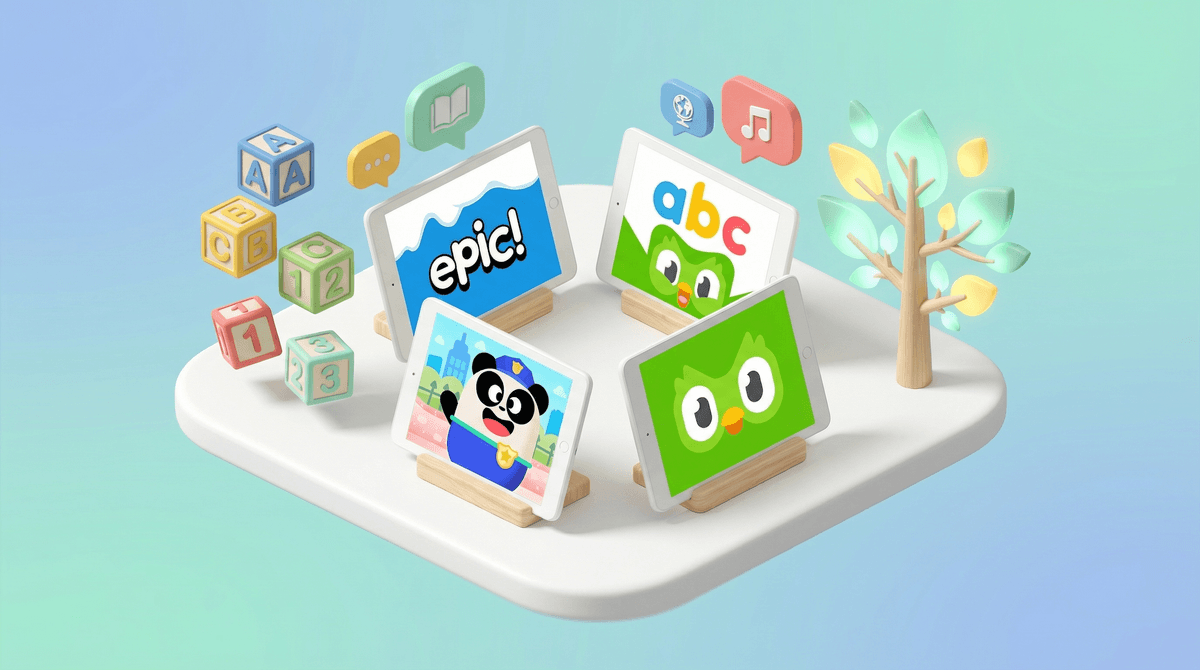
Duolingo (Ages 8+): Yes, it's meme-famous for the passive-aggressive owl, but it's legitimately effective for building vocabulary and basic grammar. The speaking and listening exercises force actual language production. That said, it won't make your kid fluent—it's a supplement, not a replacement for conversation or immersion.
Lingokids (Ages 2-8): Solid for early language learners. It teaches through songs, games, and interactive activities that actually require kids to engage with words, not just tap randomly. The content is age-appropriate and doesn't feel like a cheap reskin of a casino game.
Epic! (Ages 3-12): A digital library with thousands of books, including read-aloud options in multiple languages. The real learning happens when kids read (or listen) to full stories, not just isolated vocabulary. Bonus: it tracks reading time, so you can see if they're actually reading or just scrolling.
Chatterpix Kids (Ages 4+): Kids take a photo, draw a mouth on it, and record themselves talking. It's goofy and creative, and it gets kids speaking—which is the whole point of language learning. Great for practicing pronunciation or storytelling in a target language.
Story-based apps like Teach Your Monster to Read (Ages 3-6): Phonics-focused, game-based, and actually effective for early readers. Kids progress through levels by sounding out words and building reading skills, not just memorizing sight words.
The Questionable Stuff
Most "educational" apps that are just digital flashcards: If the app is basically "tap the picture that matches the word" for 20 minutes straight, it's not teaching language—it's teaching pattern recognition. Kids can ace these without understanding context, grammar, or how to use the word in a sentence.
Apps with zero speaking or writing components: Passive recognition (hearing a word, seeing a picture) is the easiest cognitive task. If an app never asks kids to produce language—say a word, write a sentence, construct a phrase—they're not building the skills they need for actual communication.
Anything that feels like a slot machine: If the app is more about collecting coins, unlocking characters, or maintaining streaks than about actual language practice, it's probably more addictive than educational. See if an educational app is actually educational
Ages 3-5: Focus on apps that build phonemic awareness and vocabulary through songs, stories, and play. Lingokids, Duolingo ABC, and Teach Your Monster to Read are solid. Keep sessions short (10-15 minutes) and co-play when possible.
Ages 6-8: Kids can handle more structured learning. Duolingo works here, as do reading apps like Epic!. Encourage them to read aloud or retell stories to practice output, not just input.
Ages 9-12: This is prime time for language apps that require real cognitive effort. Duolingo can work if kids are motivated, but also consider apps that connect them with native speakers (like pen pal apps with parental controls) or story-based apps that require comprehension and critical thinking.
Teens: Honestly, at this age, apps are best as supplements to real-world practice. Encourage them to watch shows in their target language (with subtitles), follow social media accounts in that language, or use language exchange apps (with supervision). Learn more about how to support teen language learning beyond apps.
Screen time for language learning still counts as screen time. Don't let "but it's educational!" trick you into unlimited app use. A 15-minute focused session is way more effective than an hour of distracted tapping.
Apps work best as supplements, not solo solutions. No app will make your kid bilingual on its own. Pair app time with conversation practice, books, shows, or real-world use of the language.
Watch for the gamification trap. If your kid is more excited about maintaining their streak than actually learning, the app might be working against you. Duolingo is notorious for this—kids will rush through lessons just to keep the owl happy, not to actually absorb the material.
Check if they're actually learning. Every few weeks, casually ask your kid to use what they've learned. Can they construct a sentence? Tell you what a word means? If not, the app might not be working.
Language learning apps can absolutely work—if they require kids to produce language, not just recognize it, and if you use them as part of a broader language-learning strategy. Duolingo, Lingokids, and Epic! are solid bets. Random "educational" apps that are just dressed-up flashcard games? Skip 'em.
And remember: the best language learning happens through conversation, immersion, and real-world use. Apps are tools, not magic bullets.
- Audit your kid's current language apps: Are they actually producing language, or just tapping buttons? Use this framework to evaluate educational apps.
- Set a time limit: Even good apps lose effectiveness after 20-30 minutes. Quality over quantity.
- Pair app time with real practice: Watch a show together in the target language, cook a recipe with foreign-language instructions, or just practice basic phrases at dinner.
- Check in regularly: Ask your kid to teach you what they learned. If they can't explain it, they probably didn't learn it.