

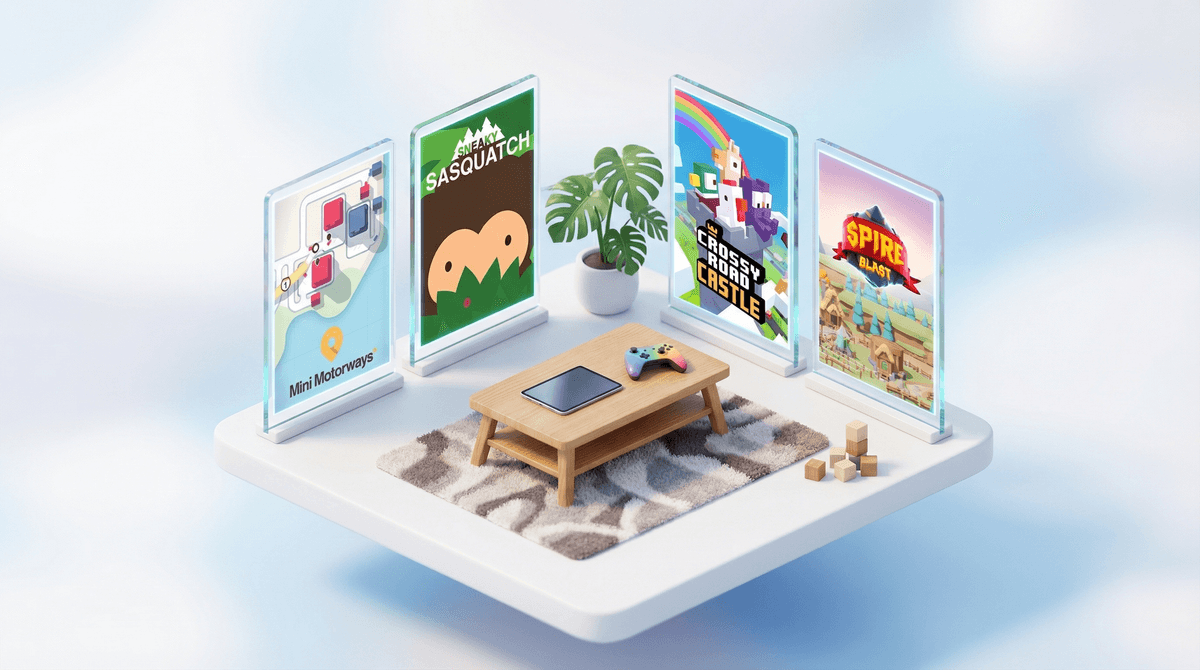
Apple Arcade is Apple's gaming subscription service—think Netflix, but for games. For $6.99/month (or bundled with Apple One), you get unlimited access to 200+ games across iPhone, iPad, Mac, and Apple TV. No ads, no in-app purchases, no surprise charges. Just download and play.
Here's what makes it different from the free-to-play chaos dominating most kids' devices: every game is actually designed to be a game, not a money extraction machine. No timers telling your kid to wait 6 hours unless they pay $4.99. No pop-ups for V-Bucks or Robux. No "watch this ad to continue." It's honestly kind of wild how refreshing this feels in 2026.
The library includes everything from puzzle games to adventure titles to sports games—many are exclusive to Apple Arcade, and a bunch are actually good. Like, legitimately engaging and well-designed, not just "educational" games that feel like homework with cartoon characters.
Let's be real: most "free" mobile games are psychological warfare disguised as entertainment. They're engineered to create desire, frustration, and eventually spending. Your 8-year-old doesn't stand a chance against a team of behavioral psychologists optimizing for in-app purchases.
Apple Arcade sidesteps this entire mess. Because the business model is subscription-based, game developers aren't incentivized to manipulate players into spending. They're incentivized to make games people actually want to play. Revolutionary concept, right?
The privacy piece matters too. Apple Arcade games can't track users across apps or sell data to third parties. Given how much data harvesting happens in free mobile games (and how much kids are being tracked online ), this is not nothing.
Plus, family sharing is built in—up to 6 people can access one subscription. So if you've got multiple kids fighting over devices, everyone can play on their own device without separate accounts or purchases.
Not all 200+ games are created equal. Here's what actually holds up:
For younger kids (ages 6-10):
- LEGO Builder's Journey - Gorgeous, meditative puzzle game. Like playing with actual LEGOs but without stepping on them at 2am.
- Sneaky Sasquatch - Open-world adventure where you're a sasquatch stealing food and causing mild chaos. Weirdly charming, genuinely funny.
- Sago Mini collection - If you've got a preschooler, these are gentle, creative, no-pressure games.
For tweens/teens (ages 10+):
- What the Golf? - Golf, but make it absurd. You're golfing with houses, cars, cats. It's hilarious.
- Crossy Road Castle - Great for couch co-op with siblings. Actually encourages cooperation instead of sibling warfare.
- Mini Motorways - Strategy/puzzle game about building road networks. Oddly addictive, teaches actual planning skills.
For the whole family:
- Spire Blast - Simple but satisfying puzzle game anyone can pick up.
- NBA 2K24 Arcade Edition - Simplified basketball without the microtransactions that plague the main NBA 2K games.
The good:
- Truly ad-free and purchase-free—this is the killer feature
- Works offline for most games (hello, road trips)
- Games are curated by Apple, so quality bar is generally higher
- Parental controls integrate with Screen Time settings
- Many games support controllers, which can be better for longer play sessions
The less good:
- Requires Apple devices (obviously)—if you're Android or PC-only, this isn't for you
- Game library can feel overwhelming to navigate
- Not every game is a winner—there's definitely some filler
- Kids who are deep into Roblox or Fortnite might find these games "boring" because they lack the social/multiplayer chaos
Age ratings are there for a reason. Apple Arcade games have standard App Store ratings (4+, 9+, 12+, etc.). Unlike some platforms where ratings feel arbitrary, these are generally accurate. A 9+ game usually involves some mild cartoon violence or slightly complex themes—nothing that'll give you nightmares, but maybe not for your 5-year-old.
Start with a trial. Apple usually offers a free trial (often 1-3 months with new device purchases). Use this time to actually explore with your kids and see if they engage with it.
Set it up as a replacement, not an addition. If your kid is drowning in screen time across multiple platforms, adding Apple Arcade doesn't help. But if you're trying to transition away from manipulative free-to-play games, this can be a solid swap.
Use Screen Time limits. Just because games don't have built-in manipulation doesn't mean unlimited play is healthy. Set daily limits through Screen Time—Apple Arcade respects these boundaries.
Play together, at least initially. Download a few games and actually try them with your kids. You'll get a sense of what they're drawn to, and you might actually have fun. Sneaky Sasquatch is legitimately entertaining even for adults.
Apple Arcade isn't perfect, but it's one of the few gaming options designed with families in mind from the ground up. For $7/month, you're buying peace of mind—no surprise charges, no manipulative design, no data harvesting.
Is it going to replace Minecraft or make your kid forget about Among Us? Probably not. But it can be a solid part of a more intentional gaming diet, especially for younger kids who haven't yet been fully captured by the free-to-play ecosystem.
If you've been feeling like every gaming option is either predatory or educational broccoli disguised as fun, Apple Arcade is worth exploring. It's actual games that respect both your kid's attention and your bank account.
- Try the free trial and download 5-6 games across different genres
- Set up Family Sharing so everyone in your household can access it
- Configure Screen Time limits before handing devices over
- Check in after a week—are your kids actually playing these games, or are they begging to go back to the free-to-play stuff?
And if you want to dig deeper into specific games or compare Apple Arcade to other platforms, See gaming alternatives for your family's situation.