

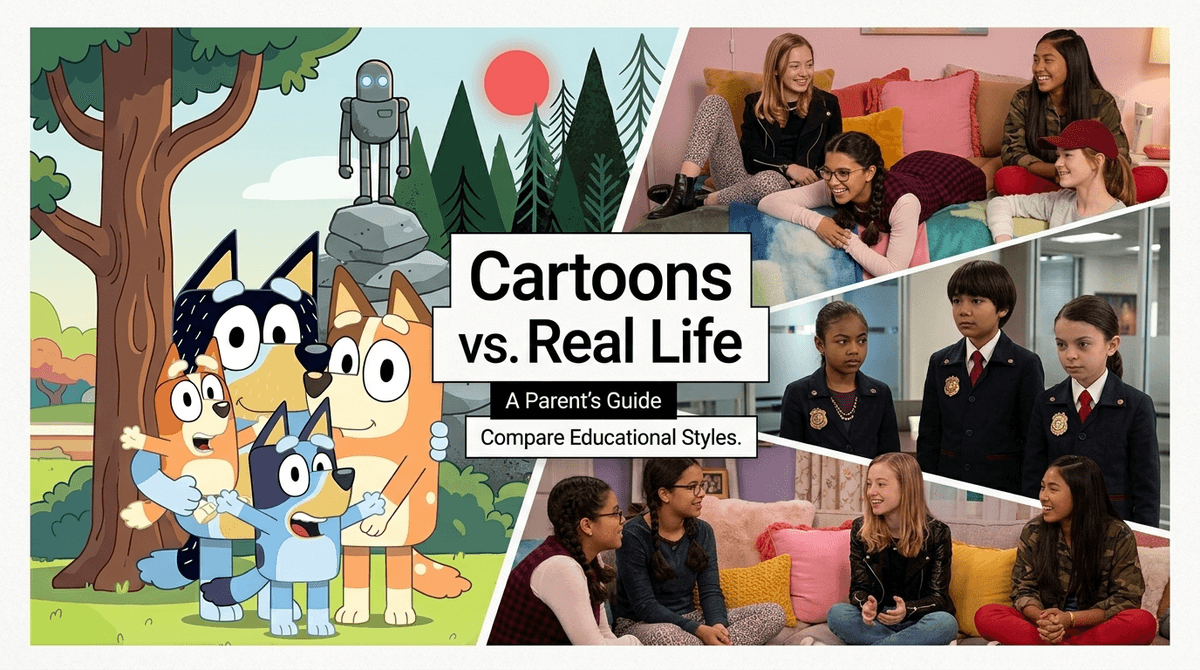
TL;DR: Animation is "visual shorthand" for a developing brain—it strips away the noise and highlights the emotions, making it the ultimate learning tool for younger kids. Live-action content, however, is the "social simulator" they need as they get older to decode subtle facial expressions, empathy, and the messy reality of human relationships.
Quick Recommendations:
- Best for Early Learning: Bluey and Daniel Tiger’s Neighborhood
- Best for the Live-Action Transition: Odd Squad and The Baby-Sitters Club
- Best High-Art Animation for Big Kids: Spider-Man: Across the Spider-Verse and The Wild Robot
If you’ve ever wondered why your five-year-old can watch Bluey on a loop but loses interest the second you try to show them a "real" movie, it’s not because they have a short attention span. It’s actually because their brain is doing some heavy lifting, and animation is providing the assist.
There’s a reason animation dominates the "under 8" demographic, and it’s not just the bright colors. It’s about cognitive load. For a small child, the real world is incredibly "noisy." When you look at a human face, there are thousands of micro-movements, shifting shadows, and subtle social cues. Animation simplifies all of that. It gives kids a focused, exaggerated version of reality that their developing brains can actually process without getting overwhelmed.
For toddlers and preschoolers, animation acts as a set of training wheels for emotional intelligence. In shows like Daniel Tiger’s Neighborhood, the characters have giant eyes and very clear, exaggerated facial expressions. When Daniel is sad, his whole face is "Sad." There’s no ambiguity.
This visual shorthand allows kids to:
- Identify emotions faster: They don't have to guess if a character is joking or serious.
- Focus on the message: Because the background is often simplified, the "lesson" (like sharing or using your words) takes center stage.
- Engage in imaginative play: It’s much easier for a kid to pretend to be a square-shaped dog like Bluey than to mimic the complex movements of a live-action actor.
But here’s the kicker: as kids hit the 7-to-10-year-old range, their brains start craving the "noise" they previously avoided. They start wanting to see how real people navigate the world. This is where the transition to live-action becomes a vital part of their social-emotional development.
Ask our chatbot for a personalized list of shows based on your kid's age
Around second or third grade, you might notice your child gravitating toward shows like Odd Squad or Ghostwriter. This shift is huge. Live-action content requires kids to decode much more complex information:
- Sarcasm and Subtext: You can’t really "draw" sarcasm the same way you can act it. Live action teaches kids to listen for tone of voice and look for "the look" that means someone is kidding.
- Relatability: Seeing a kid who looks like them navigating a school hallway in The Baby-Sitters Club hits differently than a cartoon character doing the same. It bridges the gap between "story time" and "my life."
- Empathy for "The Other": Live action forces kids to recognize the humanity in people who are different from them. It’s one thing to feel for a cartoon monster; it’s another to feel for a real person experiencing a real struggle.
We have to talk about the elephant in the room: YouTube. There is a massive difference between the intentional, high-budget animation of Hilda and the high-speed, sensory-overload "brain rot" often found in the depths of Skibidi Toilet or low-effort toy unboxing channels.
High-quality animation (think Pixar or Studio Ghibli) is art. It’s paced to allow for reflection. "Brain rot" content is paced to trigger dopamine hits. If the cuts are happening every 1.5 seconds and the characters are just screaming, that's not "animation" in the educational sense—that's just a digital fidget spinner.
Check out our guide on how to spot "Brain Rot" content on YouTube
Ages 2-102. Honestly, if you aren’t watching Bluey, are you even parenting in the 2020s? It uses animation to tackle incredibly complex "real life" parenting and childhood themes (infertility, aging, friendship dynamics) in a way that feels lighter because it’s colorful dogs. It’s the gold standard for using animation to teach live-action lessons.
Ages 5-9. This is the perfect "gateway" live-action show. It’s absurdist and funny, which appeals to the cartoon-loving brain, but it uses real kid actors. It’s great for teaching math concepts, but even better for showing kids how to collaborate in a "professional" (albeit weird) environment.
Ages 6+. Based on the The Wild Robot by Peter Brown, this movie is a masterclass in using animation to explore the "real" feeling of motherhood and survival. It’s visually stunning but emotionally heavy—a great middle ground for kids who are outgrowing "baby" shows but still love the magic of animation.
Ages 8-13. This is top-tier live-action. It deals with real issues—divorce, health, activism, and friendship—without being "cringe." It’s the kind of show that helps a middle-schooler realize their own life is a story worth telling.
Ages 8+. I’m talking about the original animated series here. It proves that animation isn't just for "little kids." It handles war, genocide, and redemption with more nuance than most live-action dramas. If your kid thinks cartoons are "for babies," sit them down with Zuko’s redemption arc.
- Ages 0-4: Stick mostly to high-quality animation. Their brains are still building the "emotional dictionary" they need to understand real-world faces. Avoid fast-paced edits.
- Ages 5-7: Introduce hybrid content or "gentle" live action. Shows like Sesame Street are great because they mix puppets (simplified) with real humans (complex).
- Ages 8-12: Lean into live-action social dramas. This is the peak age for "friendship fires," and seeing real kids resolve conflicts on screen is basically a lab for their own social lives.
- Ages 13+: At this point, the distinction matters less than the quality of the storytelling. A teen can get as much out of a live-action documentary as they can from a complex animated series like Arcane.
The most important thing to remember is that "animation" is a medium, not a genre. Just because it’s a cartoon doesn’t mean it’s for kids (looking at you, Family Guy), and just because it’s live-action doesn’t mean it’s "educational."
When choosing content, look at the pacing. If a show—animated or live-action—is so fast that your kid looks like they’re in a trance, it’s probably not doing much for their brain. If they’re laughing, asking questions, or acting out the scenes later with their LEGOs, you’ve found a winner.
Learn more about the "Trance Effect" and how to manage screen time
Don't feel like you have to "graduate" your kid to live-action content. Animation is a powerful tool for visual learning that even adults benefit from. However, if your older child is only watching animation, they might be missing out on the subtle social "rehearsal" that live-action shows provide.
The goal isn't to pick a side; it's to balance the "visual shorthand" of animation with the "social reality" of live action.
Next Steps:
- Audit the YouTube diet: Switch out one "screamer" channel for a high-quality animated series like Hilda.
- Try a "Family Movie Night" bridge: Pick a movie like Paddington 2 that perfectly blends a CGI character with a live-action world.
- Talk about the "Real": When watching live action, ask your kid, "How do you think that character is feeling?" Since it’s not as obvious as a cartoon, it’s a great way to build their empathy muscles.
Check out our full list of the best live-action shows for "Cartoon-Obsessed" kids