

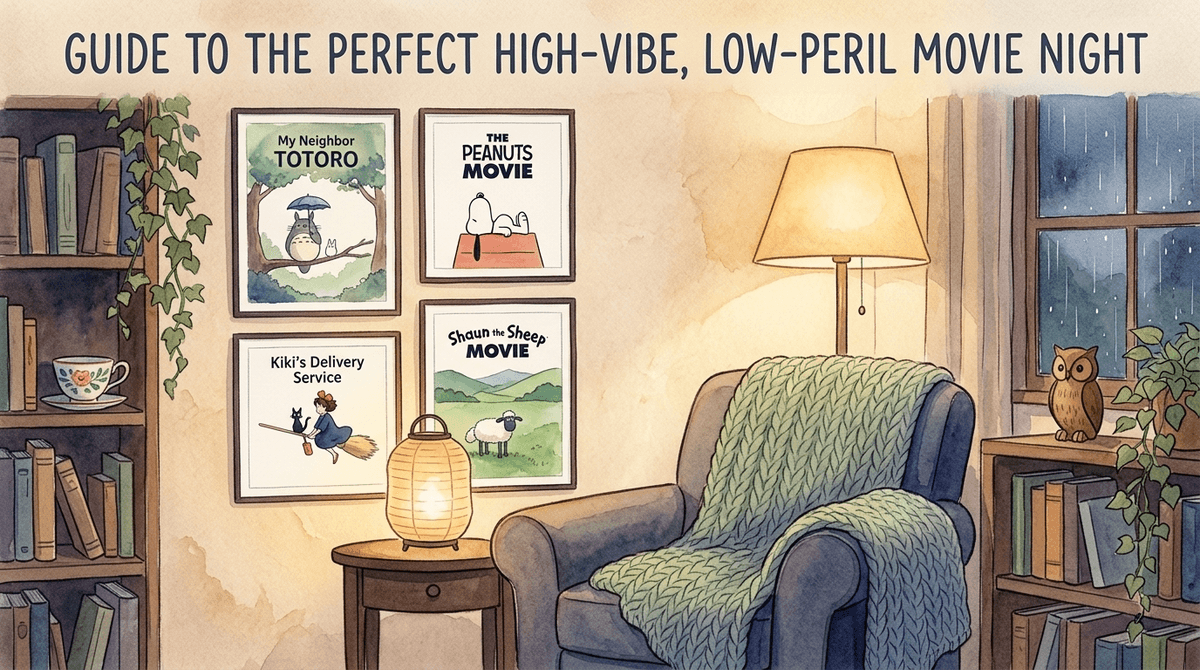
TL;DR: The Chill List If you need a movie night that won’t end in tears or a 3:00 AM visit to your bedside, here are the heavy hitters for low-peril, high-vibes viewing:
- My Neighbor Totoro – The gold standard of "nothing bad actually happens."
- The Peanuts Movie – Pure, wholesome, low-stakes anxiety (the relatable kind).
- The Many Adventures of Winnie the Pooh – Gentle, episodic, and zero villains.
- Kiki's Delivery Service – A coming-of-age story where the "conflict" is just a creative block.
- Shaun the Sheep Movie – Slapstick brilliance with no scary dialogue.
I was talking to a friend at soccer practice last week who was venting about how she tried to show her five-year-old The Lion King and ended up spending forty dollars on a "night light that looks like a galaxy" because her kid is now convinced every shadow is a stampeding wildebeest.
It’s a recurring theme in modern parenting: the "Disney Trauma" trap. We forget that almost every "classic" animated film starts with a dead parent, an existential threat, or a villain who is genuinely terrifying. We’ve been conditioned to think that for a story to be "good," there has to be high-stakes peril. But for sensitive kids—or even just kids who have had a long week of school and don’t need more cortisol—that "inciting incident" can be a total dealbreaker.
Sometimes you don’t want a hero’s journey. Sometimes you just want a "vibe" journey.
We talk a lot about "brain rot" content like Skibidi Toilet or the endless, flashing neon loops of some YouTube channels, but there’s another side to digital wellness: sensory and emotional regulation.
High-peril movies trigger the fight-or-flight response. For a "hardy" kid, that’s a thrill. For a sensitive kid (or a kid with sensory processing differences), that’s a one-way ticket to overstimulation. When we choose low-stress media, we aren't "coddling" them; we’re providing a regulated environment where they can actually enjoy the artistry of film without being on the defensive.
If your kid calls things "Ohio" when they’re weird or "low-key mid" when they’re boring, they might actually appreciate these films for being "low-key chill."
See movies for highly sensitive children
If you haven't explored the world of Hayao Miyazaki, you’re missing out on the ultimate solution to the "Dead Mom" trope. While some Ghibli films like Princess Mononoke are definitely for older kids (and quite violent), his "junior" tier is perfection.
This is the ultimate low-peril movie. Two sisters move to the countryside to be near their mother, who is in the hospital. In a Disney movie, the mom would die in the first ten minutes. In Totoro, she just... gets better. The "conflict" is a missing shoe and a brief moment of being lost. The rest is just giant forest spirits, cat-buses, and the joy of discovery. It is the cinematic equivalent of a warm blanket.
A young witch moves to a new city for her year of independence. There’s no evil warlock. There’s no world to save. The "villain" is Kiki’s own self-doubt when she temporarily loses her ability to fly. It’s a beautiful story about burnout and finding your spark again, and it’s visually stunning without being frantic.
Think The Little Mermaid, but without the terrifying sea witch and the soul-crushing stakes. It’s about a goldfish princess who wants to be human. There is a "storm" scene that might be a bit loud for the very sensitive, but the resolution is rooted in love and friendship rather than a violent battle.
You don't have to go back to the 80s to find good stuff. Some modern creators are finally realizing that we don't need a villain to have a plot.
Blue Sky Studios did something miraculous here: they kept the quiet, melancholic, gentle soul of Charles Schulz’s world alive in 3D. Charlie Brown just wants to talk to the Little Red-Haired Girl. That’s it. That’s the movie. It’s funny, it’s sweet, and it respects the child's intelligence without scaring them.
From the creators of Wallace & Gromit, this is a masterclass in silent storytelling. Because there’s no dialogue, kids have to pay attention to visual cues and body language. It’s hilarious slapstick that never feels "mean." There’s a "villain" (an animal containment officer), but he’s more of a bumbling obstacle than a source of genuine fear.
This French animated film (you can get the English dub) looks like a watercolor painting come to life. It’s about the unlikely friendship between a bear and a mouse. It deals with social prejudice in a way that is accessible but very gentle. It’s one of those movies that makes you feel like the world might be okay after all.
Check out our guide on cozy media for kids
Sometimes the best way to avoid modern "peril inflation" is to go back to the classics that were designed for the youngest audiences.
I’m talking about the 1977 episodic film. It’s literally just Pooh getting stuck in a rabbit hole or trying to get honey. There is zero peril. Even the "Heffalumps and Woozles" dream sequence is more psychedelic than scary. It’s a great "first movie" for a toddler or preschooler.
A wordless, beautifully scored short film (about 26 minutes). It’s about a boy whose snowman comes to life. They fly to the North Pole, meet Santa, and head home. Yes, the snowman melts at the end—it’s a lesson in the transience of things—but it’s handled with such grace and quiet beauty that it rarely causes the "meltdown" (pun intended) that a more violent loss would.
When we're looking at "low-peril" content, age ranges aren't just about "can they understand the plot?" but "can they process the emotional intensity?"
- Ages 2-4: Stick to episodic content like Bluey or the 1970s Winnie the Pooh. Their brains are still figuring out the difference between "pretend" and "real," so even a slightly loud "bad guy" can feel like a literal threat to their safety.
- Ages 5-7: This is the prime time for My Neighbor Totoro or The Peanuts Movie. They can handle a 90-minute narrative, but they still benefit from the "low-stimulation" aesthetic.
- Ages 8+: By this age, many kids want the peril. They want Minecraft survival mode and Percy Jackson battles. But even for older kids, having a "palette cleanser" movie that isn't about saving the world can be a great way to decompress after a stressful school week.
"Low-peril" doesn't mean "boring." One of the biggest mistakes we make is assuming that if a movie isn't loud and fast-paced, our kids won't like it.
The truth? Kids are often mirrored by the media they consume. If you give them high-octane, high-peril, "brain rot" style editing, they’re going to be buzzed and irritable when the screen turns off. If you give them something like Kiki's Delivery Service, you might find they transition back to "real life" much more smoothly.
How to Talk About It
If your kid asks why there isn't a "bad guy" in the movie, it’s a great opening to talk about different types of stories:
- "In this story, the 'challenge' is just Charlie Brown learning to be brave enough to say hello. Sometimes the biggest adventures are the ones that happen inside our own hearts."
- "Not every story needs a villain. Sometimes a story is just about how beautiful a place is or how much friends care about each other."
We live in a world that feels pretty high-peril right now. Our kids feel that, too—whether it’s through the news, social media, or just the general "vibe" of 2025. You don't always need your family movie night to be a lesson in grief or a battle between good and evil.
Sometimes, the most "intentional" thing you can do is put on a movie where a giant cat-bus takes two kids to see their mom in the hospital, and everyone gets home in time for dinner.
Learn more about the impact of high-stimulation media on child development
Next Steps:
- Check the "Parental Guidance" sections on Screenwise for movies you're considering—look specifically for "Violence & Scariness."
- Try a "Silent Night" with Shaun the Sheep Movie to see how your kids react to visual storytelling.
- Audit your "Classics" list. Just because you loved The Land Before Time doesn't mean your sensitive six-year-old needs to watch Littlefoot's mom die this weekend. Save it for later (or never).