

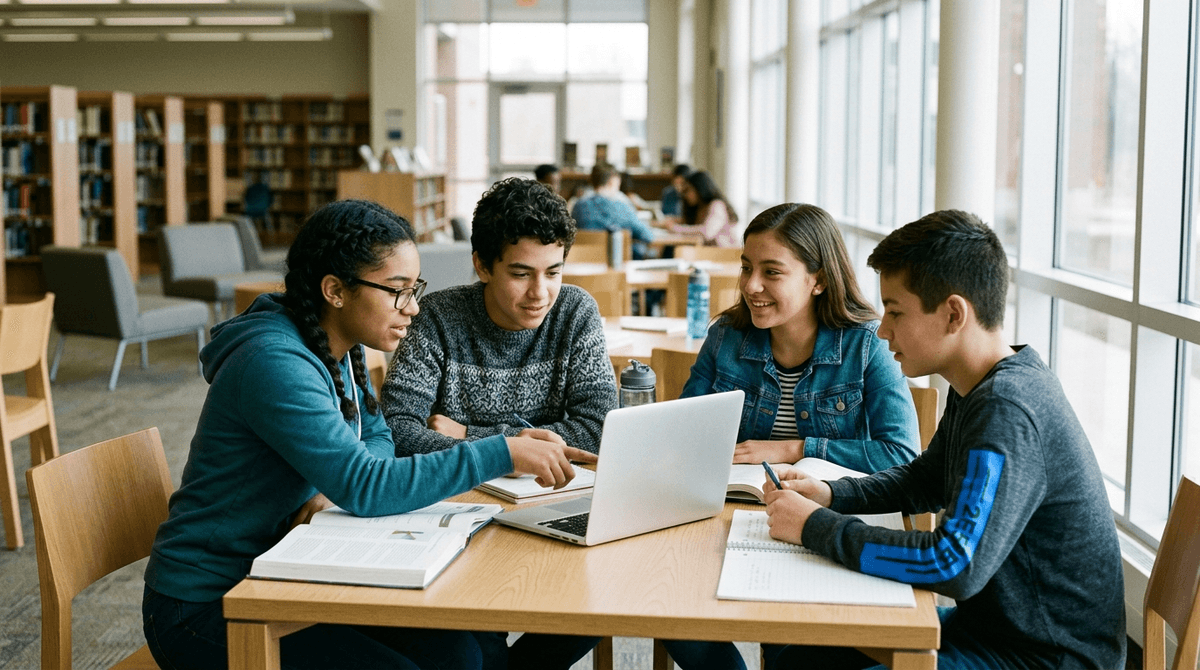
Schools can stop the group-project nightmare by using algorithms that prioritize both friendship and fairness simultaneously.
A two-step algorithm eliminates group project complaints by keeping friends together while mathematically ensuring no single team is unfairly stacked with high achievers or socially isolated.
Group projects are a primary source of school-related stress for both students and parents. When students pick their own teams, they often form "super-teams" that leave others behind; when teachers assign teams randomly, kids lose their social safety net and high achievers often end up doing all the work. This model proves that schools do not have to choose between a child’s social comfort and their academic grade.
Educators usually face a "pick your poison" scenario: let students self-select (leading to inequity) or assign teams manually (leading to resentment). Researchers wanted to solve the "free-rider" problem and the social anxiety of being "the odd one out" by treating team formation as a complex optimization problem. By using a two-phase approach, they aimed to satisfy student preferences first and then adjust those groups to meet diversity and GPA targets.
Formal student complaints dropped to zero when this system was implemented, down from a baseline where nearly a third of the class typically complained.
- Ninety-four percent of students were placed with their preferred teammates.
- Academic balance was nearly perfect, with the gap between the strongest and weakest teams shrinking from a historical high of 9.74 to just 0.005.
- Isolation disappeared. The algorithm ensured no student was the only representative of their gender on a team, preventing the "token" effect that often leads to marginalized students withdrawing from group work.
The real breakthrough is the "triad" strategy. By grouping kids in threes first to secure their social bonds, the algorithm creates a stable "unit" that can then be merged with another triad to create a larger, diverse team of six. This suggests that "socially-aware" technology can actually make the classroom feel more human and less transactional by protecting a child's inner circle while forcing them to collaborate with a broader range of peers.
The study is currently a preprint and has not yet completed the formal peer-review process. While the data includes a historical look at over 1,500 teams, the live deployment was limited to a single university engineering department. Middle school or high school social dynamics are often more volatile, and the success of the algorithm depends entirely on students being honest about who they actually want to work with.
- If your child is anxious about being "left out" of a group... ask the teacher if they use tools that allow students to nominate a "safety" friend before groups are formed.
- If your child is consistently carrying the weight of a low-performing group... advocate for GPA-balanced team formation rather than random assignment or total self-selection.
- If your child is frequently the only girl or minority in a STEM group... suggest the school adopt "cluster" grouping where underrepresented students are placed in pairs or trios to prevent social isolation.
Group projects do not have to be a gamble between social misery and academic unfairness. Using tools that respect social bonds while enforcing equity can make the "group work" drama a thing of the past.
Yiwei Sun, Xinru Deng, Dimitrios G Papageorgiou (2026). Two-Phase Simulated Annealing for Equitable Team Formation: Eliminating Complaints in Large Engineering Cohorts. arXiv (preprint). — arxiv.org