

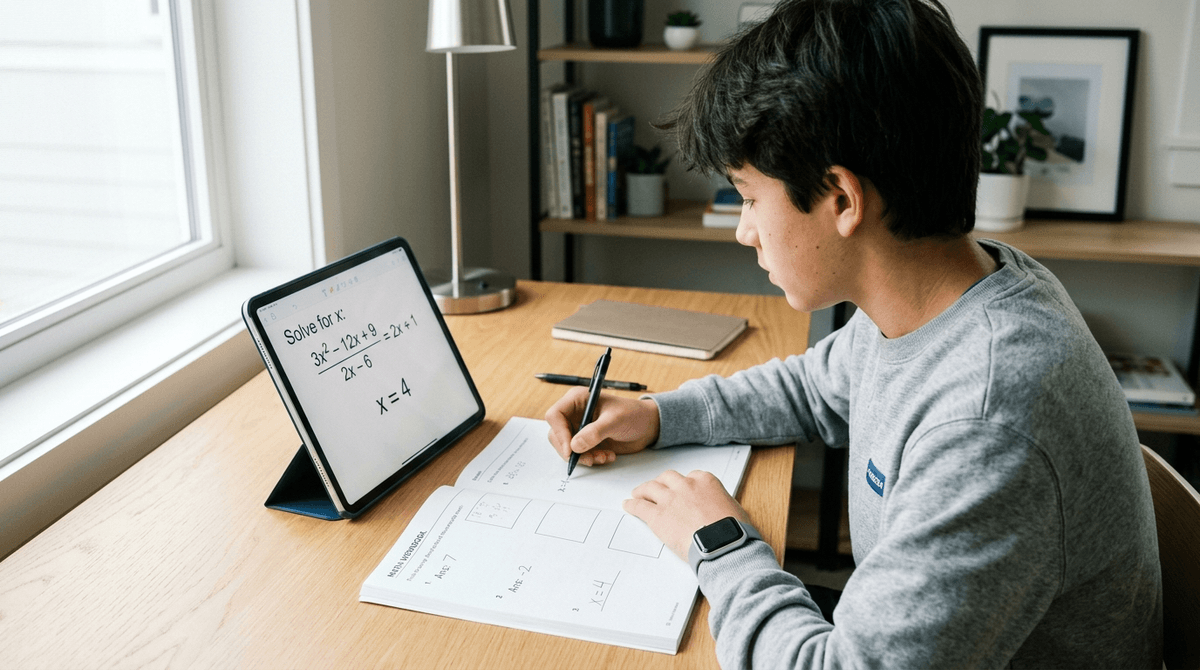
High schoolers who use AI for math help frequently end up with lower test scores because they use the tool to bypass thinking rather than to learn.
Adolescents default to asking AI for shortcuts and direct answers even when they intend to use it for tutoring, resulting in a measurable drop in math performance.
AI tools are marketed as personalized tutors that will "democratize" learning, but for many teens, they act as an "easy button" that erases the mental effort necessary for actual understanding. If your child is using ChatGPT or a math AI to finish homework, they may be creating a "knowledge illusion"—feeling like they understand the work while actually losing the ability to solve the problems on their own.
Using these tools without specific training creates a passivity that is difficult to break. Because the AI is designed to be helpful and conversational, students often stop questioning the logic provided to them, leading to a decline in the very skills they are trying to sharpen.
Educational AI is surging in classrooms, but we don't yet know how students actually interact with these chat interfaces when no one is watching. Researchers wanted to see if a student's intention to learn actually translates into better behavior when faced with a chatbot that can just provide a solution. The study focused on whether students could "self-regulate"—essentially, whether they could stop themselves from taking the easy way out.
The researchers observed a "negative learning" effect where math performance significantly decreased after the AI session. Post-test scores actually fell below the students' initial pre-test levels, suggesting the AI use was worse than no help at all.
- Intention doesn't match action. Despite initially choosing "scaffolded support" (hints), students' actual interactions were dominated by instrumental requests for immediate answers.
- Zero skepticism. Chat logs showed almost no evidence of students monitoring the AI's accuracy or evaluating their own understanding. They accepted the bot's output as ground truth.
- Mental clutter. Students who reported high "cognitive load" while using the tool performed the worst. The effort required to manage the chat interface—typing, reading, and interpreting the bot—distracted them from the actual math.
- The "Easy Button" trap. When faced with a difficult problem, the psychological "path of least resistance" led students to ask for the answer rather than the explanation.
The conversational nature of AI makes it too easy to be passive. Unlike a textbook that requires active searching or a human teacher who might push back, a chatbot is designed to be compliant. This compliance is exactly the opposite of what a student needs when they are struggling with a difficult concept.
The "negative learning" effect is the most alarming signal. It suggests that AI isn't just failing to teach; it might be confusing students or overriding their existing knowledge with poorly explained logic that the students don't have the skills to vet. It turns out that watching an AI solve a problem is not the same thing as learning how to solve it yourself.
This study is a "work-in-progress" preprint and has not yet undergone formal peer review. The researchers looked at a single learning session, which may not reflect how students might adapt to AI tools over a longer period as the novelty wears off.
Additionally, the population was limited to 98 high-track German Gymnasium students. These are generally high-performing students; the impact on students who are already struggling with basic literacy or math foundations might be different, or perhaps even more severe.
- If your child uses AI for math homework, require them to show you the chat logs to ensure they aren't just asking for the final answer.
- If you are choosing a learning tool, look for AI products with "hard guardrails" that are specifically programmed to never provide the final solution, only hints.
- If your teen is feeling overwhelmed by a topic, avoid AI chats entirely until they have a baseline understanding; the "cognitive load" of managing the bot while learning a new concept can lead to total confusion.
- If your child is using AI for any subject, assign them the role of "Fact Checker" and require them to find at least one thing they would explain differently in the AI's response to keep them from passive acceptance.
AI "tutors" are currently more likely to act as homework-completers than actual educators, often leaving kids knowing less than when they started. Until these tools are built to resist a student's urge for the easy path, they should be used with extreme caution and active adult supervision.
Rania Abdelghani, Peter Kaiser, Kou Murayama (2026). Regulating the AI Tutor: Intentions, Help-Seeking, and Self-Regulated Learning in Adolescent GenAI Use. arXiv (preprint). — arxiv.org