

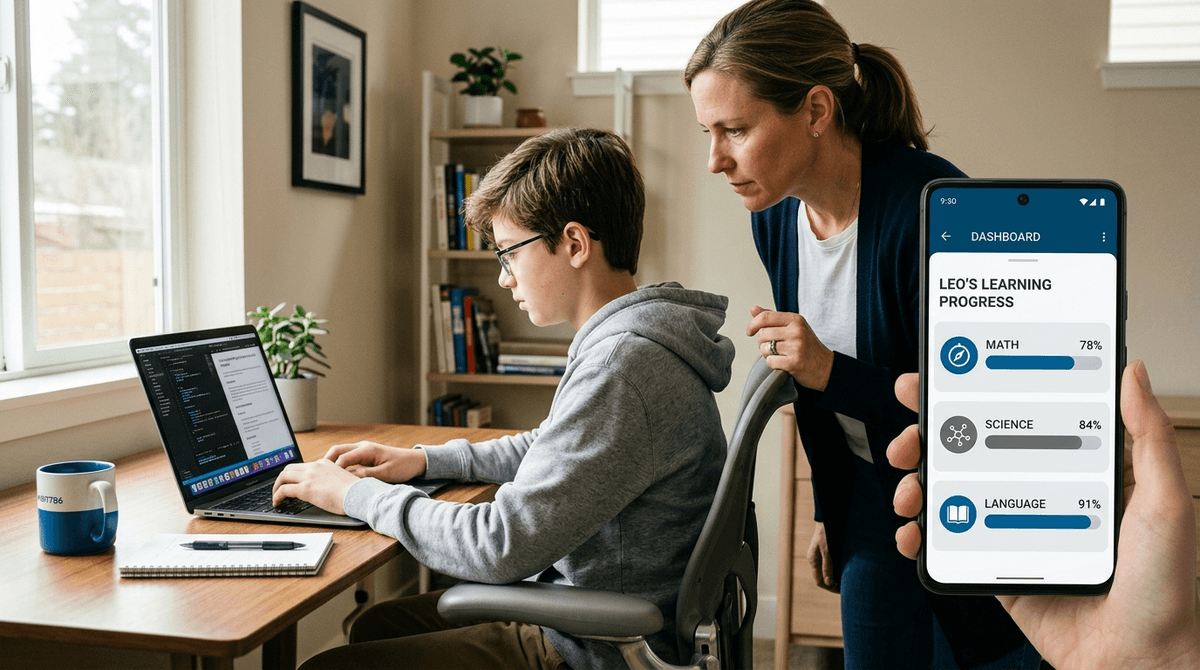
A new universal data system allows different AI tutors to "talk" to one another, paving the way for a single, consistent view of a child’s progress across multiple subjects.
Researchers developed a modular data pipeline that integrates learning data from various AI assistants, making it easier for teachers and parents to see how a student is performing across different academic areas without juggling separate, disconnected dashboards.
Education technology is currently a fragmented mess of "walled gardens." One app tracks math, another tracks reading, and they rarely share notes. This research suggests the "plumbing" is finally being built to connect these tools. For parents, this means the eventual end of managing five different logins to understand one child's academic standing; instead, you can expect a single, holistic report that identifies exactly where a student is getting stuck, regardless of the subject.
Building custom data analysis for every new educational app is slow, expensive, and redundant. Researchers at Georgia Tech wanted to see if they could build a "universal translator" for AI tutoring data. By creating a system that works across different domains—from computer science to biology—they aim to help developers build high-quality, personalized tutoring apps faster and at a lower cost.
The researchers successfully tested a new system, called the A4L Data Analytics Pipeline, across three different AI-driven learning environments.
- Flexibility is key: Statistical methods developed for one subject were effectively reused to analyze learning patterns in others.
- Scalability: The modular design lets researchers quickly add new analytical tools to multiple apps at once without rebuilding the entire infrastructure.
- Reliability: The system accurately reproduced key research findings across different datasets, proving that the centralized "plumbing" doesn't distort the data.
While the paper focuses on technical architecture, the real win for families is transparency. When AI tools use a shared language, it becomes much harder for "black box" algorithms to hide how they are assessing a child. This shift forces educational tech companies to compete on the actual quality of their teaching rather than just locking parents into a proprietary data ecosystem.
This was a technical case study of data architecture, not a direct evaluation of student learning outcomes. The research was also confined to a single institution (Georgia Tech) using their specific suite of AI tools. Additionally, as a preprint, this paper has not yet completed the formal peer-review process.
- If you are choosing between AI-driven learning apps for home use... prioritize platforms that emphasize data integration or "interoperability," as these are more likely to provide a clear picture of your child's long-term growth.
- If your child’s school is adopting new AI tutors... ask the administration if the data from those tools feeds into a central dashboard for teachers to monitor.
The era of isolated, "black box" learning apps is ending as researchers build the infrastructure to connect them. Expect more cohesive, actionable insights into your child's learning journey as these universal data systems move from university labs into mainstream classrooms.
Yallen Bai, Ploy Thajchayapong, Ashok Goel (2026). Generalizing a Highly Configurable Analytics Pipeline to Replicate and Support Educational Research Across Multiple Domains. arXiv (preprint). — arxiv.org