

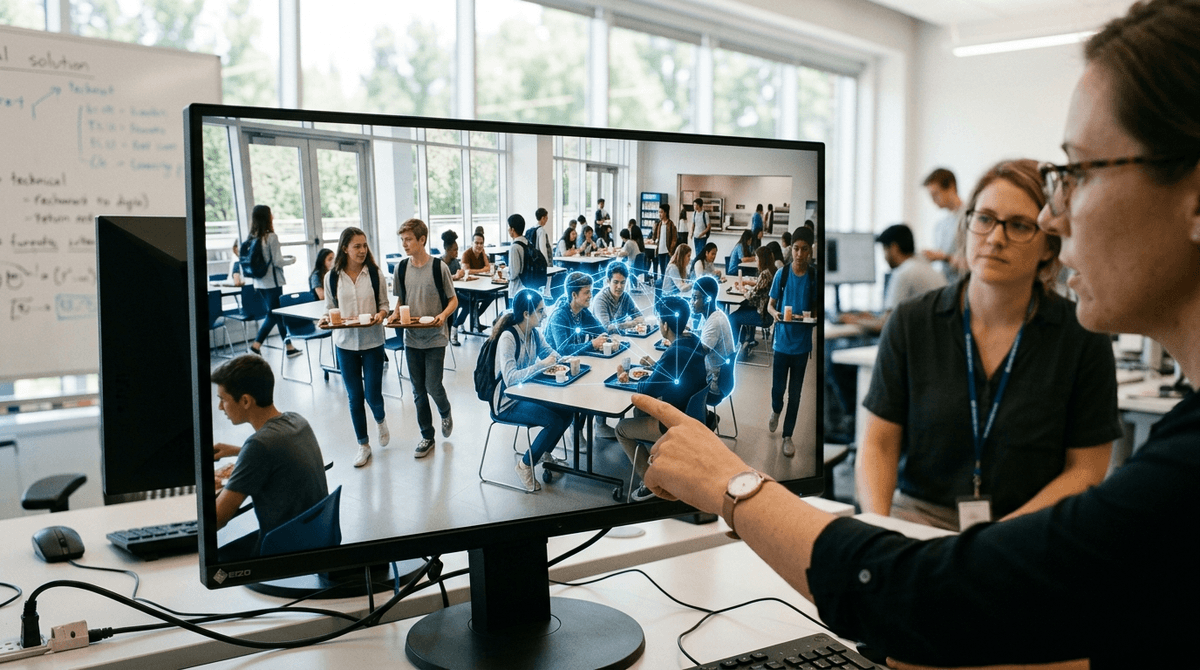
School districts are beginning to use "digital twins" of classrooms to test anti-bullying programs and social policies before they ever reach your child’s desk. This shift toward computational modeling means the next generation of school interventions will likely be rehearsed by AI agents long before they are implemented on real students.
Researchers built an AI simulation called EduMirror that uses digital agents to replicate complex school social behaviors like bullying and peer pressure. This allows administrators to "stress test" interventions in a virtual world to see what actually works before risking the social well-being of real children.
Your child's school experience is often shaped by "trial-and-error" policies—programs that sound good on paper but may not work, or could even backfire, once they hit the playground. If these simulations become a standard part of educational planning, the "pilot programs" your kids participate in will be backed by predictive data rather than just administrator intuition.
This technology marks a transition from reactive parenting to proactive, systemic prevention. Instead of waiting for a bullying incident to happen and then responding, schools could use these models to identify which classroom seating charts or group project structures are most likely to trigger social friction. It moves the burden of experimentation off of your child and onto a digital proxy.
Traditional social research in schools is notoriously difficult, slow, and often unethical. You cannot intentionally create a bullying situation just to see how to stop it, and observing real students for months on end is intrusive and produces "noisy" data. Researchers needed a way to model the "hidden" psychological states of students—what they are feeling versus how they are acting—without using real children as test subjects.
The team behind EduMirror wanted to bridge the gap between abstract psychological theory and the messy reality of a lunchroom. By using Large Language Models (LLMs) to power digital students, they can now simulate hundreds of days of school social interaction in a matter of seconds, filling a gap in how we understand the "invisible" social forces that dictate a child's day.
The simulation doesn't just mimic movement; it mimics values. The researchers programmed digital agents with internal needs, such as the desire for status or the need for belonging, and then turned them loose in a virtual school.
- The "Dual-Track" system: The tool monitors both visible behaviors (who talked to whom) and internal psychological states (how "safe" or "popular" a student feels).
- Validated Realism: In test cases, the AI agents spontaneously replicated well-known social dynamics, such as forming "cliques" or engaging in bullying behavior, without being specifically told to do so.
- Testing Interventions: The researchers demonstrated that they could introduce a "teacher intervention" into the digital world and measure exactly how it rippled through the social group, affecting the digital students' stress levels and cooperation.
We are entering an era where social engineering in schools is becoming a computational science. While the researchers frame this as a tool for positive intervention, it suggests a future where school social life is managed by algorithms designed to optimize for specific behavioral outcomes.
This treats the playground less like a natural environment for social growth and more like a flight simulator. There is an unspoken implication here: if we can predict social outcomes with AI, schools may eventually feel pressure to "optimize" your child’s social circle for maximum academic performance or minimum conflict, potentially at the cost of authentic, organic relationship building.
This study is a preprint, meaning it has not yet undergone formal peer review by other scientists. Furthermore, the researchers are measuring robots, not humans. The AI agents are powered by Large Language Models, which are known to carry the biases of the internet data they were trained on.
A digital middle schooler might behave logically based on its programming, but real middle schoolers are notoriously driven by hormones, lack of sleep, and home lives that an AI can't fully simulate. The "low" confidence rating on this research reflects its status as a simulation; what works for an AI agent may still fail when faced with the unpredictable reality of a physical classroom.
- If your school board is proposing a major change to anti-bullying curricula, ask if they are using any predictive modeling or evidence-based simulations to justify the change.
- If your child is struggling with a specific social dynamic, realize that these patterns are increasingly viewed as systemic "loops" rather than just individual "bad" behavior—understanding the "system" of the classroom can help you coach your child through it.
- If you are concerned about "behavioral data," start asking your school how they protect the social observations teachers make, as this data is becoming the "fuel" for the next generation of educational AI.
AI is moving beyond homework help and into the social fabric of the classroom. While digital simulations cannot replace the intuition of a great teacher, they offer a powerful way to weed out ineffective school policies before they ever affect your child. We are finally trading "best guesses" about school culture for digital rehearsals.
Jingzhe Lin, Hengbin Yu, Yongdan Zeng et al. (2026). EduMirror: Modeling Educational Social Dynamics with Value-driven Multi-agent Simulation. arXiv (preprint). — arxiv.org