

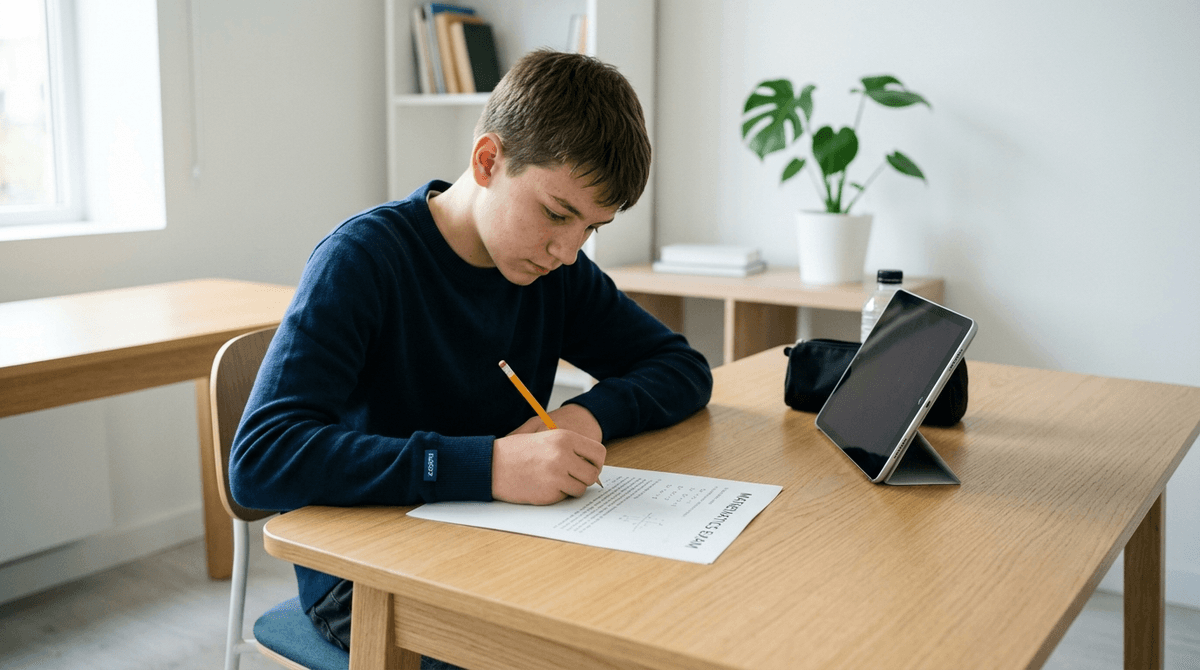
Schools may soon stop forcing students to choose between screen-based exams and slow-to-grade paper tests by using AI to read and score handwritten work.
Schools can finally ditch multiple-choice "bubble sheets" without losing the speed of computer grading. AI tools are now capable of reading handwritten answers on paper exams, allowing students to show their work and solve complex problems while receiving nearly instant feedback.
This shift protects the tactile experience of writing, which aids memory and focus, while removing the "black hole" waiting period for grades. For parents, this means a potential end to the era of "test-taking strategies" focused on guessing one of four circles. If schools adopt hybrid grading, the emphasis shifts back to the process of solving a problem—writing out a math equation or a short explanation—rather than just the final answer.
Immediate feedback is one of the most powerful tools in learning. When a student waits three weeks for a graded paper, the "learning moment" has passed. If an AI can scan a paper and provide a score or feedback by the next morning, the student can correct their misunderstandings while the material is still fresh in their minds.
Fully digital testing often forces teachers into a corner. Because manual grading is slow and expensive, digital platforms rely heavily on multiple-choice formats to provide scale. This "multiple-choice-ification" of education limits how deeply a student can be tested. Researchers are worried that the rush to digital exams has sacrificed the cognitive benefits of paper-and-pencil work, where students are free to sketch diagrams, cross out errors, and think spatially.
The current challenge is the grading bottleneck. In a university or large school district, thousands of written exams can take weeks for humans to process. Researchers are filling the gap by creating a middle ground: use the paper for the student’s sake, but use the AI for the teacher’s sake.
Vision-capable AI models can now process handwritten text in specific "answer fields" with high reliability, moving far beyond the primitive OCR (Optical Character Recognition) of the past.
- The "Two-Pass" Method: The system uses two different AI validations to ensure it isn't just "hallucinating" or misreading a messy "8" as a "B."
- Structured Paper: Instead of blank sheets, students use forms with specific boxes for final answers. The AI scans the box for the grade but preserves the "work shown" for human review if the student appeals.
- Reliability: The study suggests that semi-automated systems can achieve the fairness of a strict rubric while handling the sheer volume of a standardized test.
This technology could bridge the gap between "standardized" and "authentic" assessment. For years, "standardized" has been synonymous with "reductive." By making it cheap and fast to grade long-form work, school districts can move away from the "process of elimination" test prep that has dominated classrooms since the No Child Left Behind era.
It also signals a shift in how we view AI in the classroom. Instead of AI being something students use to cheat (like ChatGPT writing an essay), this is AI being used as infrastructure to support traditional, analog student work. It puts the burden of proof back on the student’s actual handwriting, which is much harder to "prompt engineer" in a proctored room.
The paper is currently a preprint, meaning it has not yet undergone formal peer review by other scientists. It is also a technical framework—a proposal for how it should work—rather than a massive study of how it did work in a real-world elementary school.
Accuracy depends entirely on legibility. If a child has dysgraphia or extremely poor fine motor skills, the AI may flag their work for human review constantly, potentially negating the speed benefits. Furthermore, the system requires "structured" forms, which might still feel more restrictive to a student than a completely blank sheet of notebook paper.
- If your child performs better with a pen than a keyboard, support school initiatives that explore "hybrid" or "paper-based digital" testing rather than moving to 1:1 laptop-only exams.
- If your child has messy handwriting or fine motor delays, speak with their teacher about how AI-scanned forms might handle their work and ensure they aren't unfairly penalized by an algorithm.
- If your child is practicing for math competitions or state tests, emphasize the importance of writing final answers clearly within designated spaces, as "box-entry" is likely the future of all paper testing.
- If you are concerned about your child's data privacy, ask the school district if the AI grading software is processed locally or if student handwriting samples are being used to train third-party AI models.
Paper is making a tech-fueled comeback. AI grading doesn't have to mean more screen time; it can mean a return to the thoughtful, handwritten work that helps kids learn best, without the weeks-long wait to find out how they did.
Hartwig Grabowski, Michael Canz (2026). Hybrid E-Assessment in Higher Education: Semi-Automated Grading of Paper-Based Written Examinations. arXiv (preprint). — arxiv.org