

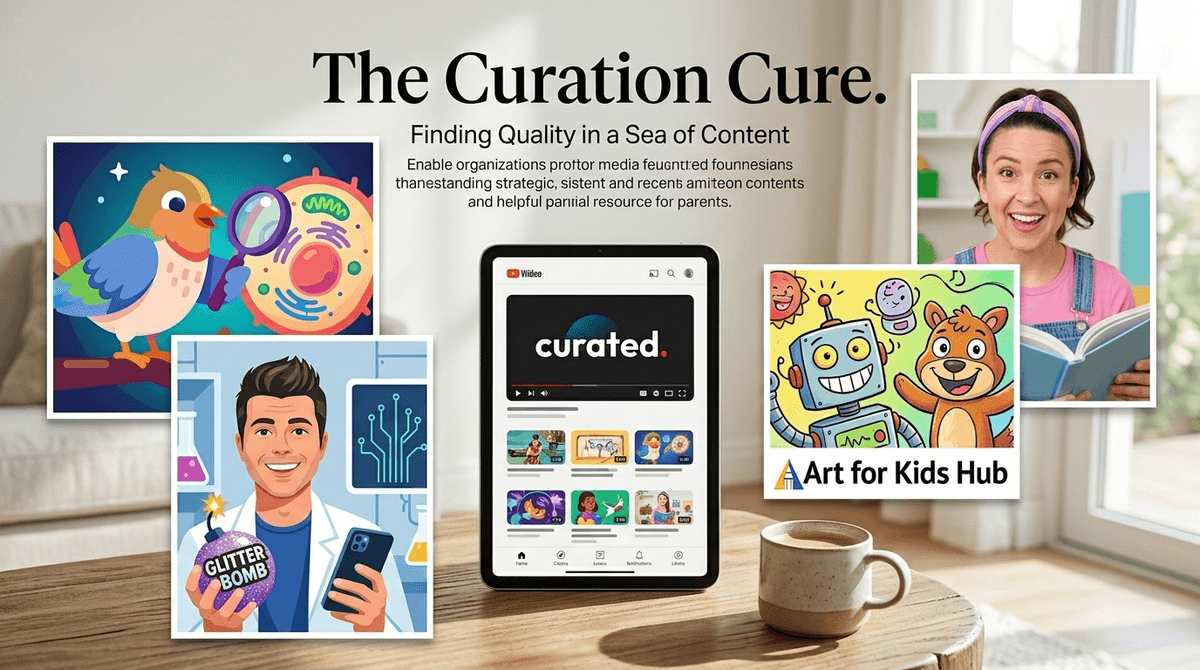
TL;DR: The Best YouTube Channels for 2026
If you’re just looking for the "safe list" to plug into your kid’s tablet so you can drink your coffee while it’s still hot, here are the heavy hitters:
- Best for Littles (Ages 0-4): Ms. Rachel (Low-stim, language development)
- Best for Creative Kids (Ages 5-12): Art for Kids Hub (Drawing tutorials that actually work)
- Best for STEM & Curiosity (Ages 7+): Mark Rober (Former NASA engineer, high-budget science)
- Best for Deep Thinkers (Ages 10+): Kurzgesagt – In a Nutshell (Complex topics explained with beautiful animation)
- Best for Movement: Cosmic Kids Yoga (Screen time that burns energy)
Check out our full guide on setting up YouTube supervised accounts
We’ve all been there. You hand your kid the iPad so you can finish a work email, and fifteen minutes later you hear the aggressive, synthesized beat of Skibidi Toilet. Suddenly, your seven-year-old is talking about "Ohio rizz" and "sigmas" and you feel like you need a translator and a stiff drink.
The YouTube algorithm isn't designed to educate your child; it’s designed to keep them watching. This leads to "brain rot"—content that is high-stim, fast-paced, and ultimately empty. It’s the digital equivalent of feeding your kid a bowl of pure frosting. It’s fun for five minutes, but the crash is inevitable, and the long-term nutritional value is zero.
But YouTube doesn't have to be a wasteland. It is also the greatest library of human knowledge ever assembled. The trick is moving from passive consumption (letting the algorithm choose) to intentional curation (you choosing the creators).
For toddlers and preschoolers, the biggest concern isn't just "bad words"—it's over-stimulation. Shows with rapid-fire cuts and neon colors can actually make kids more irritable because their brains can’t process the information that fast.
She is the gold standard for a reason. Her pacing mimics actual speech therapy techniques. She uses slow movements, clear enunciation, and plenty of pauses for the child to respond. It’s one of the few channels where the "educational" label isn't just marketing fluff.
While technically a Netflix show, their YouTube clips are fantastic. It’s gentle, the colors are muted, and the stories are about friendship and curiosity rather than loud slapstick. It’s the "vibe check" every parent needs.
If you have a kid obsessed with Monster Jam or trucks, this is a much calmer alternative to the high-octane "crashing" videos that dominate the car-obsessed corner of YouTube.
Learn more about the effects of high-stimulation media on toddlers
This is the age where kids move from watching "shows" to watching "creators." They want to see people doing things they can replicate.
This is quite possibly the best channel on the platform. A dad sits with one of his kids and they draw together. The "mistakes" are left in, the pacing is perfect, and it results in actual, physical art on your kitchen table instead of just glazed eyes.
Mark Rober is the "cool uncle" of the internet. He’s a former NASA engineer who builds squirrel obstacle courses and glitter bombs for package thieves. It’s high-energy, but it’s rooted in real physics and engineering. If your kid likes Minecraft or Roblox, this is the real-world equivalent of that "builder" mindset.
Hosted by Jessi and her robot rat friend, Squeaks, this channel tackles the "Why?" questions that parents usually don't have the energy to answer at 7:00 AM. Why is the sky blue? Why do we have boogers? It’s smart, fast-paced but not frantic, and scientifically accurate.
At this age, kids are starting to develop a sense of irony and a desire for more complex information. They are also most at risk of falling down the "MrBeast clone" rabbit hole—channels that are just loud men screaming at the camera for 20 minutes.
Beautiful, minimalist animation that explains existential dread, black holes, and biology. It’s sophisticated enough that you’ll actually want to watch it with them. It treats kids like they’re smart, which—spoiler alert—they love.
Derek Muller takes a "truth-seeking" approach to science. He debunks myths and explores counter-intuitive concepts. It’s great for developing critical thinking skills and showing kids that it's okay to be wrong as long as you're learning.
They take fictional items (like Captain America’s shield or a lightsaber) and try to build real-world working versions. It’s heavy on engineering and "maker" culture. It’s a great bridge for kids who are aging out of "kid" content but aren't ready for the more toxic corners of general YouTube.
Find YouTube channel recommendations based on your kid's specific hobbies
You might be wondering why, given the choice between a NASA engineer and a guy screaming about Skibidi Toilet, your kid chooses the toilet.
It’s because brain rot is low-stakes community. When every kid at school is talking about the same weird meme, your kid wants to be in on the joke. It’s the 2026 version of "Pogs" or "Beanie Babies," just much louder and weirder.
The Strategy: Don't ban it outright (unless it's truly inappropriate). Instead, use the "One for Me, One for You" rule. They get 15 minutes of their weird memes, but then they have to watch a 15-minute video from Mark Rober or National Geographic Kids.
YouTube is a beast. Even with the best intentions, a kid can go from a "how to draw a puppy" video to something weirdly violent in three clicks.
- YouTube Kids vs. Supervised Accounts: YouTube Kids is great for the under-7 crowd, but older kids find it "babyish" and will fight you on it. For them, use a Supervised Account. It allows you to select content settings (Explore, Explore More, or Most of YouTube) and gives you a history of what they’ve watched.
- Turn Off Autoplay: This is the single most important thing you can do. Autoplay is the "infinite scroll" of video. By turning it off, you force a moment of intentionality between every video.
- The "Watch on the Big Screen" Rule: If possible, keep YouTube off personal tablets and on the living room TV. When the screen is public, kids are less likely to click on the weird stuff, and you can keep an ear out for the "brain rot" sirens.
Read our guide on the difference between YouTube and YouTube Kids
It’s worth explaining to your kids (especially the 10+ crowd) that YouTubers like MrBeast are businesses. They use "clickbait" titles and thumbnails to trick your brain into clicking.
Teach them to spot the "YouTube Face" (the open-mouthed shock in every thumbnail). Once kids realize they are being "hacked" by an algorithm to make someone else money, they often become a lot more cynical—and selective—about what they watch.
YouTube isn't the enemy; the unsupervised algorithm is. By steering your kids toward creators who value curiosity over clicks, you turn a "distraction" into a "discovery tool."
Start by subscribing to three of the channels above on your family account. The next time your kid says they're bored, point them there first. You might be surprised when they actually start telling you facts about black holes instead of singing about toilets.
- Audit the History: Spend five minutes tonight looking at your kid's YouTube watch history. If it’s 90% "brain rot," it’s time to seed the algorithm with better choices.
- Set the Boundaries: Use our Screenwise Digital Family Covenant to decide when and where YouTube is allowed.
- Ask the Bot: Still not sure if a specific creator is okay? Get a review of any YouTuber