

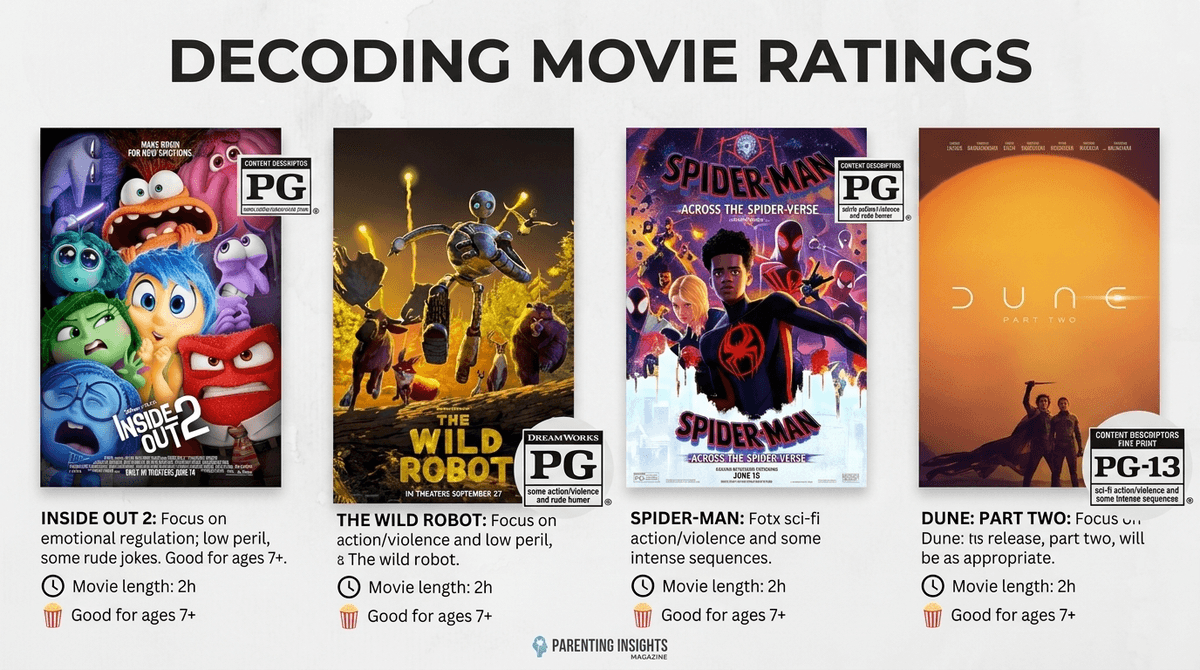
TL;DR: Movie ratings have shifted. The "G" rating is basically extinct, "PG" is a catch-all that ranges from Moana 2 to intense action, and "PG-13" has become the industry standard for anything that wants to be taken seriously. To avoid an awkward Friday night, ignore the big letter and look at the content descriptors and community data on Screenwise.
Quick Links for Family Night:
- Best for Ages 5-8: The Super Mario Bros. Movie
- Best for Ages 9-12: Spider-Man: Across the Spider-Verse
- The "Is it really okay?" Pick: Barbie
- Modern Classic for All Ages: Inside Out 2
If you feel like a PG movie today would have been a PG-13 movie ten years ago, you aren't imagining it. We are living in an era of "rating creep."
Back in the day, a G rating was common for everything from Disney classics to nature docs. Today, "G" is seen by studios as the "kiss of death" for the box office. If a movie is rated G, older kids (and even some 7-year-olds) might dismiss it as "babyish" or "total brain rot." To capture a wider audience, studios push for a PG rating even when the content is perfectly mild.
On the flip side, PG-13 has become the "Goldilocks" zone for blockbusters. It’s mature enough for adults but safe enough for middle schoolers. But because so much is packed into PG-13, the gap between a "mild" PG-13 like Wonka and an "intense" one like The Batman is massive.
The MPA (Motion Picture Association) hasn't changed its core rules, but cultural sensibilities have.
We are much more sensitive to social themes, bullying, and psychological distress than we were in the 80s or 90s. Conversely, we’ve become somewhat desensitized to fantasy violence. You can watch a city get leveled in Godzilla x Kong: The New Empire and it’s a PG-13, but a single "F-bomb" or a nuanced scene about grief might push a movie into the same category.

The most important part of the rating isn't the letter—it’s the tiny text underneath it. These are the "content descriptors," and they are your best friend for avoiding "The Talk" before you’re ready for it.
- "Thematic Elements": This is code for "heavy stuff." It usually means the movie deals with death, divorce, mental health, or complex social issues. Inside Out 2 has this because it deals with anxiety and puberty.
- "Peril": This is different from "violence." Peril means a character is in danger and the feeling of the scene is scary. Think of the sinking ship in The Little Mermaid.
- "Mild Rude Humor": Usually means potty jokes or the occasional "sucks" or "butt." If your kid is already watching Skibidi Toilet on YouTube, "mild rude humor" will be a walk in the park.
Every kid is different, but community data from Screenwise shows some pretty clear trends in how parents are navigating these ratings:
Grades K-2: The PG Sweet Spot
At this age, the "G" rating is still great, but you’ll mostly find yourself in the PG territory.
- Watch out for: Visual scares and "peril." Kids this age often struggle more with a scary-looking monster than they do with a slapstick fight.
- Safe bets: Bluey (technically a show, but the "movies" are just long episodes) or The Garfield Movie.
Grades 3-5: The Transition Years
This is when kids start asking to see the "cool" movies their friends are talking about.
Grades 6-8: The PG-13 Standard
By middle school, PG-13 is the default. At this stage, the concern shifts from "is this too scary?" to "is this too sexual?" or "is the language too much?"
- Watch out for: "Edgy" PG-13 comedies that rely on sexual innuendo.
- Recommended: Dune: Part Two (for the kids who are into epic sci-fi) or Ghostbusters: Frozen Empire.
We hear the term "brain rot" thrown around a lot lately (mostly by kids calling out other kids for liking "cringe" content). In the context of movies, "brain rot" usually refers to high-stimulation, low-substance content—think The Emoji Movie.
While these movies aren't "dangerous," they don't offer much in the way of emotional intelligence or storytelling. If you're looking for movies that actually spark a conversation, look for titles with high WISE scores on Screenwise. These are movies like The Wild Robot that manage to be entertaining without melting anyone's brain.
Before you hit play, do a quick 3-point vibe check:
- The "Older Sibling" Factor: Are you letting your 6-year-old watch Stranger Things just because their 12-year-old brother is? (We’ve all been there, no judgment, but it rarely ends well for the 6-year-old’s sleep schedule).
- The "YouTube Effect": If your kid spends hours on YouTube watching unboxed toys or Minecraft streamers, their tolerance for "boring" (slow-paced) movies might be low. You might need to bridge the gap with high-action PG movies like Sonic the Hedgehog 2.
- The "Ohio" Factor: If your kid says a movie is "so Ohio," they mean it’s weird, cringey, or outdated. Sometimes, older PG movies (from the 90s) have "Ohio" moments—outdated jokes or slow pacing that just doesn't land with today's kids.
Ratings are a starting point, not a parenting manual. A PG rating can cover everything from a singing puppet to a multi-verse-collapsing spider-battle.
The best way to navigate this is to know your kid's specific triggers. Some kids can handle "peril" but are devastated by a sad ending. Others can watch a thousand cartoon explosions but will repeat every "mild rude humor" word they hear for the next week.
- Take the Screenwise Survey: Understand how your family's media consumption compares to your local community.
- Check the WISE Score: Before your next movie night, search for the title on Screenwise to see the breakdown of violence, language, and "educational" value.
- Have the "Why" Conversation: If you say no to a movie, explain why based on the content descriptors. "It’s not because I think you're a baby; it's because this movie has 'intense thematic elements' that I don't think you'll actually enjoy right now."