

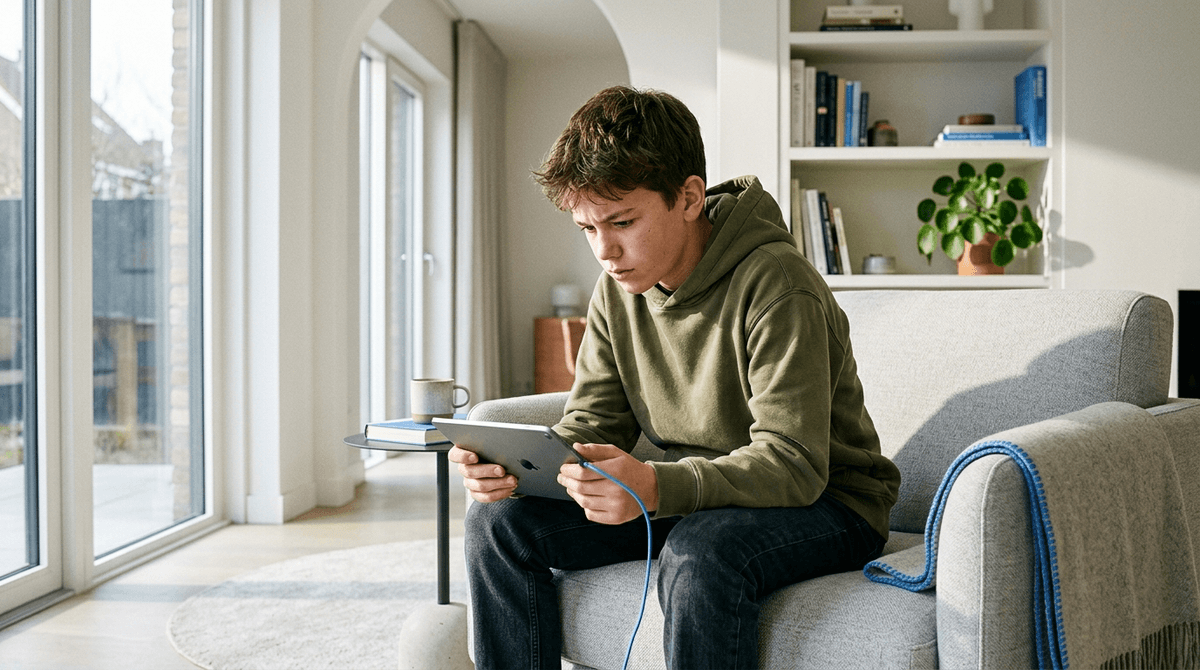
ADHD symptoms and screen habits don’t just happen at the same time; they fuel each other in a reinforcing loop where attention struggles drive kids toward devices, and those devices then make focus even harder.
Attention struggles and compulsive screen use strengthen each other over time in a "reciprocal" relationship. If your child already shows ADHD traits, they are biologically more likely to get hooked on the high-intensity rewards of gaming and social media, which in turn further erodes their ability to focus on the real world.
This shifts the focus from "how much" screen time to "what kind" and "at what cost." It’s no longer enough to just count minutes; parents need to look at the emotional pull of the device. If your child is using screens to escape reality or loses control over their usage, it is a much stronger predictor of worsening ADHD than simply spending a long time on a tablet.
For parents of neurodivergent kids, the stakes are higher. This research confirms that these children are effectively more "addiction-prone" to digital design. Their brains crave the immediate dopamine hits that apps provide, making them more vulnerable to a spiral that can crowd out essential health-promoting behaviors like sleep and exercise.
Most previous research looked at snapshots in time—showing that kids with ADHD use screens more, but not which came first. Researchers wanted to know the direction of the arrow. By reviewing a decade of longitudinal data that tracks 28 different groups of children from birth to age 17, they could finally see how these two issues interact over years rather than weeks.
The data shows a clear, two-way street where behavior at one age predicts problems at the next.
- The spiral is real: ADHD traits at "Time A" predict screen addiction at "Time B," which then predicts even more pronounced ADHD symptoms at "Time C."
- Quality over quantity: "Problematic use"—defined by a loss of control or using devices to escape reality—is a far more consistent predictor of attention issues than total hours spent online.
- Biological craving: Children with ADHD traits are drawn to gaming and social media because these platforms offer the constant arousal and instant rewards their brains are wired to seek.
- The displacement effect: Screens may worsen attention issues indirectly by "crowding out" high-quality sleep, physical activity, and face-to-face social interaction—the three pillars of brain health.
The finding that ADHD is often the starting point for screen addiction is a crucial nuance for parents. It suggests that a child’s obsession with a game or app might be an attempt to self-medicate a brain that feels under-stimulated or socially rejected. When we take a device away without replacing it with another high-intensity, rewarding activity, we are removing a coping mechanism without addressing the underlying need.
This review is based on observational data, meaning it tracks trends rather than proving direct cause-and-effect in a laboratory setting. While it shows the direction of the relationship, it cannot definitively say that screens cause ADHD in a child who has no existing traits. Furthermore, "screen time" is a broad category; the studies included varied in how they defined usage, making it difficult to pinpoint exactly which apps are the most "toxic" for attention.
- If your child uses screens to escape after a bad day... try to intervene with high-intensity physical activity or social play first to provide the dopamine hit they’re seeking without the addictive digital loop.
- If your child shows signs of ADHD... prioritize strict guardrails and "scaffolding" around gaming specifically, as their biology makes them more vulnerable to losing control than their neurotypical peers.
- If you are tracking "screen time"... shift your focus to "problematic behaviors" like agitation when stopping or lying about usage, as these are better predictors of future attention issues than a specific number of minutes.
- If you're noticing a decline in focus... ruthlessly protect the "big three"—sleep, exercise, and family meals—to ensure digital media isn't displacing the physiological requirements for a healthy attention span.
Watch the behavior, not just the clock. If your child is using digital media to hide from the world or if they can’t stop when asked, their screen habit is actively feeding their attention struggles. You have permission to be stricter than other parents if your child is neurodivergent—their brain is playing a harder game than the rest.
Thorell, Lisa B., Burén, Jonas, Ström Wiman, Johanna et al. (2024). Longitudinal associations between digital media use and ADHD symptoms in children and adolescents: a systematic literature review. European Child & Adolescent Psychiatry. doi:10.1007/s00787-022-02130-3 — link.springer.com