

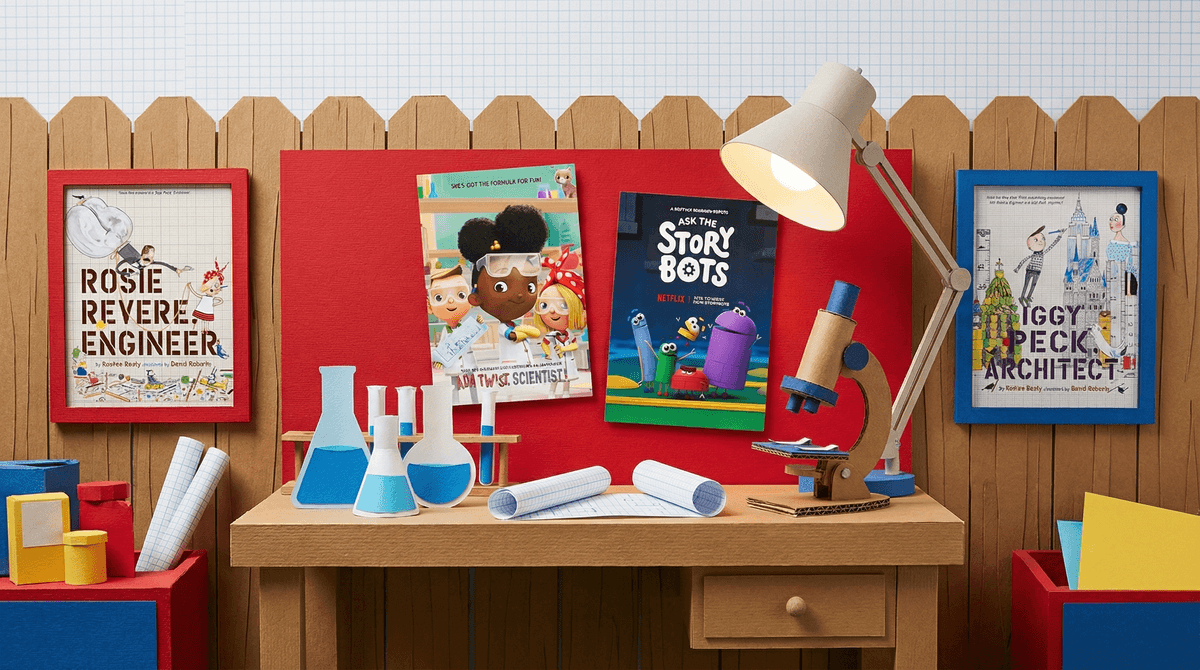
Ada Twist, Scientist is a Netflix animated series based on the beloved picture book by Andrea Beaty and David Roberts. The show follows Ada, a curious 8-year-old Black girl with natural hair styled in puffs, who approaches every question with the scientific method. Along with her best friends Rosie Revere (an engineer) and Iggy Peck (an architect), Ada runs a "lab" in her family's backyard where the trio investigates everything from why feet stink to how rainbows form.
The show premiered in 2021 and has released multiple seasons, with each 11-minute episode tackling a different question through hypothesis, experimentation, and conclusion. It's part of Netflix's growing slate of educational content for preschool and early elementary audiences, sitting comfortably alongside shows like StoryBots and Octonauts.
Screenwise Parents
See allIt validates their endless questions. If you've got a kid who asks "why?" approximately 847 times per day, Ada Twist is their spirit animal. The show treats every question—no matter how silly or messy—as worthy of serious investigation. Ada's parents never shut down her curiosity, even when her experiments involve stinking up the house or creating elaborate contraptions in the living room.
The mysteries are genuinely interesting. The show tackles questions kids actually wonder about: Why do we have to brush our teeth? What makes things sticky? How do you stop hiccups? These aren't dumbed-down topics—they're real scientific concepts presented at a developmentally appropriate level.
The characters feel like real friends. Ada, Rosie, and Iggy have distinct personalities and problem-solving styles. They disagree sometimes, they get frustrated when experiments fail, and they celebrate each other's different strengths. For kids ages 4-7, seeing this kind of collaborative friendship modeled is huge.
The music actually slaps. The theme song is genuinely catchy (sorry in advance—it will live in your head rent-free), and the show incorporates musical numbers that explain concepts without feeling like a lecture disguised as entertainment.
It's legitimately educational without being boring. Each episode follows the scientific method explicitly: Ada asks a question, forms a hypothesis, conducts experiments, and draws conclusions. But it never feels like a textbook. The show manages to teach actual STEM concepts while keeping the energy high and the storytelling engaging.
The representation matters. Ada is a young Black girl who's the undisputed leader and smartest kid in the room. Her natural hair is never a plot point—it just is. Her family is loving, supportive, and present. For Black girls especially, seeing themselves as scientists and problem-solvers from an early age can be transformative. But honestly, all kids benefit from seeing diverse characters in STEM roles.
Screen time that might actually inspire off-screen activities. Unlike shows that just occupy kids' attention, Ada Twist tends to spark real-world curiosity. Don't be surprised if your kid suddenly wants to conduct "experiments" in the kitchen or starts asking to build contraptions from recycled materials. (Pro tip: having a simple science kit or craft supplies ready can channel this energy productively.)
The pacing is perfect for younger viewers. At 11 minutes per episode, it's short enough to hold a preschooler's attention without overstimulation. Two episodes make a nice 22-minute block that feels satisfying but not overwhelming. This makes it easier to set boundaries around screen time without battles.
It normalizes failure as part of learning. Ada's experiments don't always work the first time. Sometimes her hypotheses are wrong. The show explicitly teaches that failure is information, not something to be ashamed of. In an age where kids are increasingly anxious about making mistakes, this messaging is gold.
Ages 3-5: This is the sweet spot. The concepts are accessible, the episodes are short, and the characters model the kind of curiosity that's developmentally appropriate for this age. Just be prepared for your preschooler to start calling everything an "experiment."
Ages 6-8: Still very engaging, though kids at the older end might start finding it a bit young. That said, the scientific method framework is exactly what they're learning in early elementary, so it can reinforce school concepts. Some second and third graders still enjoy it, especially if they loved it as younger kids.
Ages 9+: Most kids will have aged out by this point, though they might still enjoy it with younger siblings. If you've got an older kid who's interested in science, shows like The Magic School Bus Rides Again or Brainchild might be better fits.
In a streaming landscape full of content that ranges from genuinely educational to absolute brain rot, Ada Twist, Scientist is one of the good ones. It's the rare show that parents can feel genuinely good about their kids watching—not just because it's "educational," but because it models curiosity, resilience, friendship, and critical thinking in ways that actually resonate with young kids.
Is it going to replace hands-on science activities or outdoor play? Of course not. But as far as screen time goes, this is about as high-quality as it gets for the preschool and early elementary set. If your kid watches Ada and then wants to investigate why their sandwich got soggy or how bubbles work, that's screen time well spent.
If your kid loves Ada Twist: Check out the original picture books by Andrea Beaty, which also include Rosie Revere, Engineer and Iggy Peck, Architect. The Questioneers book series has expanded to include even more STEM-focused characters.
Want to extend the learning? PBS Kids has similar science-focused content with shows like Elinor Wonders Why and Sid the Science Kid. And if you're looking for ways to turn screen time into hands-on activities, Find age-appropriate science experiments you can do at home.