

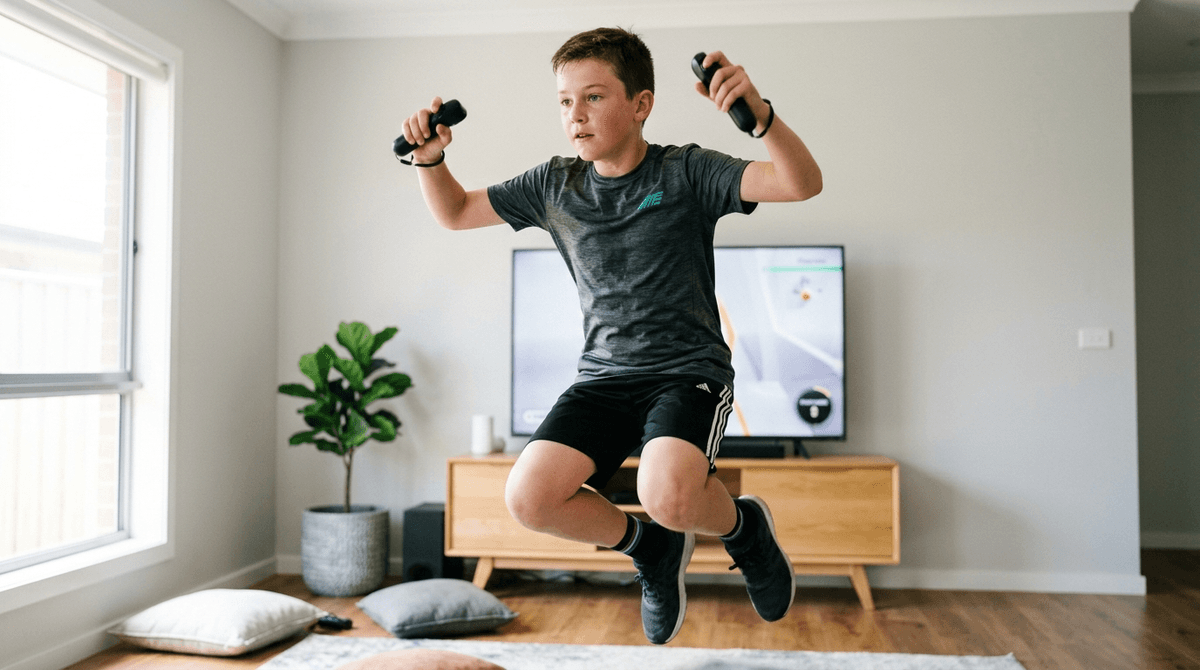
Active video games are a powerful "on-ramp" for getting kids off the couch, but the metabolic benefits for overweight children have a shelf life of about 90 days.
Active gaming converts sedentary screen time into real physical activity and reduces BMI for overweight children, but the most significant weight loss happens in the first three months. After that, kids keep moving, but their bodies adapt and the scale stops moving.
Parents often feel guilty about any screen time, but this research proves that "exergaming" isn't just better than sitting—it’s a clinically effective bridge to traditional sports for kids who might feel self-conscious or unmotivated. This finding changes the "video game" purchase from a leisure item to a 90-day metabolic intervention.
If you have a child who avoids the playground or team sports because of their weight or fitness level, a console becomes a private, low-stakes environment to build physical confidence. The goal isn't to make them a lifelong gamer, but to use the "beginner effect" of these games to jumpstart a more active lifestyle before the body plateaus.
Childhood obesity remains a persistent challenge, and the transition from sedentary screen-based entertainment to structured athletics is often too steep for kids ages 6 to 12. Researchers wanted to know if active games like the Wii or Kinect could act as a sustainable substitute for traditional exercise or if they were merely a novelty. They analyzed 13 international studies involving nearly 1,000 children to see if the "fun" of gaming could produce the same results as a gym class.
The "beginner effect" is the most prominent trend in the data. About 1,000 children across 13 studies showed a clear pattern of diminishing returns over time:
- The 90-day window. Short-term play (between 4 and 12 weeks) led to moderate increases in movement and measurable drops in body fat and BMI. This is when the child’s metabolism is most reactive to the new stimulus.
- The plateau. While kids successfully kept moving at higher levels during months four through six, their weight and body composition stopped improving. They weren't getting "worse," but the gaming was no longer enough to drive further weight loss.
- Moderate to vigorous movement. Active gaming successfully replaced "sitting" time with moderate-to-vigorous physical activity (MVPA), which is the heart-rate zone required for cardiovascular health.
- The power of play. "Free play"—where kids just played what they wanted—was often more effective at keeping them engaged than rigid, exercise-focused protocols designed by researchers.
The human body is an efficiency machine. After three months of the same dance or boxing game, children likely get better at the movements, meaning they burn fewer calories doing them. This is the same reason why a person who walks the same mile every day eventually stops losing weight from that walk.
The research implies that for exergaming to work as a long-term health strategy, the "game" has to change. To keep seeing results beyond the three-month mark, the intensity must increase or the type of movement must be totally different to keep the body from adapting.
The data quality is inconsistent. Half of the 13 studies reviewed had small sample sizes of fewer than 50 children, which can make the results less reliable. Furthermore, nearly half of the studies were rated as "low-quality" because they lacked proper control groups or randomization. Because the games used (Wii, Kinect, etc.) and the ways movement was measured varied wildly, we can't point to one specific game as the "best" for weight loss.
- If your child is currently sedentary and resistant to sports, use active games to replace "sitting" screen time rather than "outdoor" time to build their initial stamina.
- If you want to maintain weight loss beyond the first three months, swap in a new, more physically demanding game every 90 days to prevent their body from adapting to the same movements.
- If you are choosing between a "fitness-only" game and a fun "active" adventure game, opt for the one they find most fun; the research shows kids stay active longer when they are playing, not following a rigid "workout" protocol.
- If your child hits a weight-loss plateau after 12 weeks of gaming, use that moment to transition them into a local sports league or outdoor club, using their newly built-up confidence as the catalyst.
Active gaming is an excellent tool to break the cycle of inactivity and jumpstart weight loss, but it isn't a permanent replacement for traditional exercise. Use it to build a habit of movement, but be prepared to "level up" the physical challenge once the initial 90-day honeymoon period ends.
Sklavou DP, Metsios GS, Stavropoulos-Kalinoglou A et al. (2026). Active Video Gaming and Obesity in Children 6-12 Years Old: A Systematic Review. Journal of functional morphology and kinesiology. doi:10.3390/jfmk11020192 — pubmed.ncbi.nlm.nih.gov