

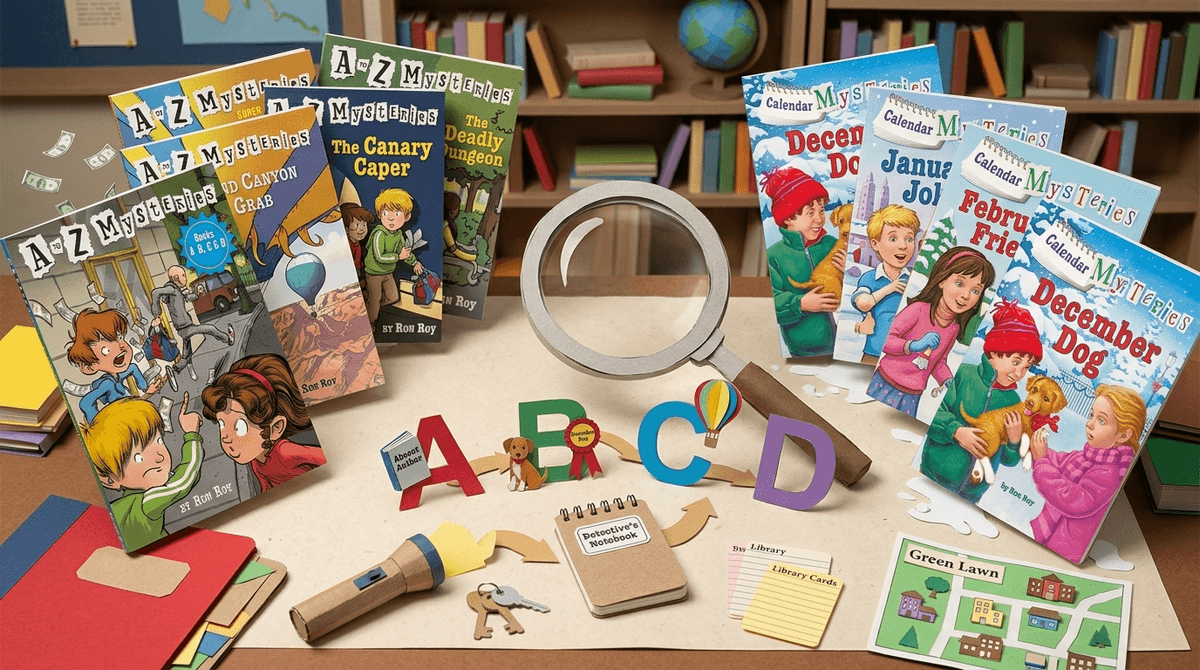
A to Z Mysteries is the absolute gold standard for kids aged 6 to 9 who are ready to graduate from "learning to read" to "reading to learn." It’s the perfect bridge series—short enough to not be intimidating, but "real" enough to make a second grader feel like a serious detective. If your kid is starting to find Nate the Great too simple but isn't quite ready for the complexity of Percy Jackson, this is exactly where you want to land them.
TL;DR: A to Z Mysteries is a 26-book series by Ron Roy that follows three best friends solving low-stakes crimes in their small town. It’s ideal for 1st to 3rd graders (ages 6-9) because of its predictable structure, simple vocabulary, and "scary" plots that are actually very safe. If they love these, move them straight to the Calendar Mysteries or Encyclopedia Brown.
The series hits a very specific developmental window. At age 6 or 7, kids are often tired of the repetitive phonics of early readers but get overwhelmed by a 300-page novel. Ron Roy nailed the "Chapter Book Lite" format: the chapters are usually 8–10 pages long, there’s a cliffhanger at the end of almost every one, and the font is large enough that the pages turn fast.
For an 8 or 9-year-old who is a reluctant reader, A to Z Mysteries acts as a confidence builder. The vocabulary is accessible, and the logic puzzles are solvable. By the time they finish The Absent Author, they’ve realized they can finish a whole book by themselves. That’s the "gateway drug" effect—once they realize they can do it, they want the next 25 letters.
Parents often see titles like The Kidnapped King or The Zombie Zone and wonder if they’re about to introduce their kid to true crime trauma. Short answer: No.
Green Lawn, Connecticut (where the books take place) is basically the safest place on Earth. The "kidnappings" usually involve a misunderstanding, a staged event, or a very polite thief who is caught by three kids before the police even finish their coffee.
Here is the breakdown of what’s actually inside:
- The Stakes: We’re talking about stolen pet canaries, a missing author who actually just went to a secret meeting, or a "ghost" that turns out to be a guy in a sheet.
- The Violence: Non-existent. There’s no blood, no weapons, and no real peril. The kids might get "trapped" in a room for ten minutes, but they always find a clever way out.
- The Kids: Dink, Josh, and Ruth Rose are respectful, smart, and—this is the best part—they actually like each other. There’s no "mean girl" trope or bullying. They work as a team, which is a nice break from the snark found in series like Diary of a Wimpy Kid.
Never underestimate the power of a collection. Because there are 26 books—one for every letter—kids get a massive hit of dopamine every time they check a letter off the list. It turns reading into a scavenger hunt.
If your kid is the type who needs to "collect them all" (think Pokémon or LEGO sets), this series will keep them occupied for months. It takes the guesswork out of "what should I read next?" The answer is always the next letter in the alphabet.
One thing A to Z Mysteries does better than almost any other starter series is teaching kids how to follow a trail of clues.
- Observation: The books frequently describe what characters are wearing or what’s out of place in a room.
- Deduction: The kids (and the reader) are given all the pieces of the puzzle. It’s not like some lazy mysteries where the detective finds a clue in the last two pages that the reader never saw.
- Independence: The adults in Green Lawn are helpful but mostly stay out of the way, allowing the kids to be the heroes of their own story.
If you find your kid is really vibing with the "solve it yourself" aspect, check out our best books for kids list for more interactive or logic-heavy series.
Once they hit The Zombie Zone, you’re going to need a plan. Ron Roy was smart enough to keep the engine running with several spin-offs and "level-up" options:
These are slightly easier than the A to Z series and follow the younger siblings of the original trio. If you have a younger kid (ages 5-7) who wants to read what their big brother or sister is reading, start here.
These are longer, include "hidden" clues in the illustrations, and usually involve travel to places like the Grand Canyon or Washington D.C. They are the perfect "final boss" for a kid who has finished the main 26.
If they love the "photographic memory" and logic side of things, Cam Jansen is the natural next step. The reading level is almost identical, but the character dynamic is different enough to feel fresh.
For the kid who finished the alphabet and is now ready for something with a bit more "edge" (monsters, gadgets, and more humor), this is a fantastic jump in complexity and engagement.
The only real "friction point" with this series is that the books were written a while ago. You won't see the characters using iPhones or Googling the answers. They use payphones, they go to the library, and they walk everywhere without a GPS.
The pro-tip: Don't treat this as a "dated" problem. Treat it as a conversation starter. Ask your kid: "How would Dink solve this if he had a smartphone?" It actually makes the mystery solving more impressive when they realize the kids had to use their brains instead of an app.
Q: Do you have to read A to Z Mysteries in order?
Not at all. While there are very minor recurring jokes, each book is a completely standalone mystery. If your kid's name starts with 'M', start with The Missing Mummy. If they love dinosaurs, grab The Deadly Dungeon (okay, that's 'D', but you get the point).
Q: Is A to Z Mysteries okay for a 5-year-old?
If you are reading it aloud, absolutely. The plots are easy to follow and the chapters are short enough for a bedtime read. For independent reading, most 5-year-olds will find the text a bit too dense, so start with Nate the Great instead.
Q: Are there any "scary" themes or content warnings?
The "scariest" it gets is a character being briefly kidnapped or a "supernatural" element that is always debunked by the end of the book. There is no profanity, no romance, and no graphic violence. It is very much a "safe" series for sensitive readers.
Q: What reading level is A to Z Mysteries?
They generally fall into the Guided Reading Level N-P range (roughly end of 2nd grade to middle of 3rd grade).
A to Z Mysteries is the workhorse of the elementary school library for a reason. It isn't trying to be "high art" or a deep philosophical meditation on childhood. It's trying to be a fun, fast-paced puzzle that makes kids feel smart. If you have a 7-year-old who is hovering at the edge of independent reading, buy the first three books, leave them on the coffee table, and watch what happens.
- Check out our digital guide for elementary school for more age-appropriate media picks.
- Explore the best books for kids to find your next series.
- Get help picking a next book series
