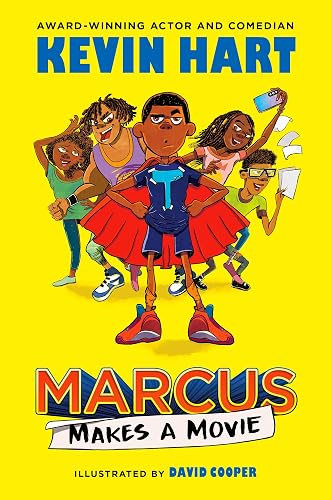
Beyond the celebrity vanity project
We’ve all seen the template: a massive celebrity puts their name on a middle-grade book, a ghostwriter does the heavy lifting, and the result is a bland, "believe in yourself" story that sits on a shelf gathering dust. Marcus Makes a Movie is the rare exception that actually works.
Kevin Hart didn't just slap his face on the cover; he teamed up with Geoff Rodkey, who knows exactly how to pace a book for kids who would rather be on YouTube, and illustrator David Cooper, whose art gives the book the kinetic energy of a comic strip. The result is a story that feels less like a lecture on "following your dreams" and more like a blueprint for the hustle required to actually make something.
The "creator" reality check
If your kid spends their time watching MrBeast or dreaming of being a YouTuber, this is the perfect entry point. It captures that specific creative itch—the one where you have a brilliant idea in your head but zero clue how to get it onto a screen.
Marcus isn't a polished hero. He’s a hotheaded misfit who ends up in an after-school film class because of his behavior. The book is honest about the friction of creativity. It shows that having a vision for a superhero movie is the easy part; the hard part is realizing you need a cast, a crew, and—most annoyingly—the help of people you don't even like.
The inclusion of Tyrell, the local bully, as the movie's villain is a classic trope, but it’s handled with more nuance than your average school story. It forces Marcus to navigate the messy reality of professional collaboration. If your kid is the type to get frustrated when a project doesn't go perfectly on the first try, they’ll see themselves in Marcus’s meltdowns.
How it stacks up to the heavy hitters
The Amazon reviews and the Common Sense Media take both point to the same thing: this is the natural next step for fans of Diary of a Wimpy Kid or Big Nate.
However, there’s a key difference. While Greg Heffley is often defined by his cynicism and his desire to take the easy way out, Marcus is defined by his ambition. He actually wants to produce something of value. It’s a more proactive kind of funny.
- For the reluctant reader: The illustrations aren't just decorations; they carry the plot. If a kid is intimidated by dense blocks of text, the visual breaks here keep the momentum high.
- For the aspiring filmmaker: The book manages to demystify the process of turning a drawing into a scene without feeling like a textbook.
- For the comedy fan: Hart’s voice is all over the dialogue. It’s fast-paced, a little bit loud, and genuinely funny.
The verdict on the "flawed" hero
Some parents might twitch at Marcus’s temper or his initial attitude, but that’s exactly why the book connects. Middle schoolers are often "hotheaded misfits" trying to figure out where to channel that energy. By showing Marcus pouring his frustrations into his film, the book offers a roadmap for turning "behavioral issues" into creative output.
It’s not literary high art, and it doesn't try to be. It’s a high-energy, high-motivation story that respects the fact that kids today don't just want to consume media—they want to own it. For a kid who feels stuck in the "after-school class" of life, Marcus is a pretty great guide for how to start filming your way out.